Landmark Supreme Court of India rulings, explained in clear, plain language.
Filter by Act / Section
Showing 15 of 16 judgments
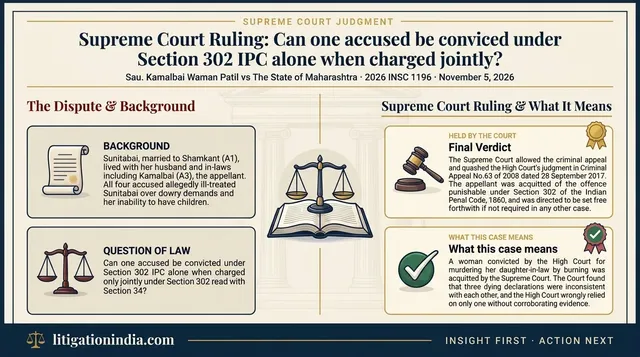
Can one accused be convicted under Section 302 IPC alone when charged only jointly under Section 302 read with Section 34?
Sau. Kamalbai Waman Patil vs The State of Maharashtra
The Supreme Court acquitted the appellant by holding that the High Court wrongly reversed her acquittal by relying on a single inconsistent dying declaration without corroboration and by convicting her under Section 302 IPC alone when the charge was only under Section 302 read with Section 34 IPC.
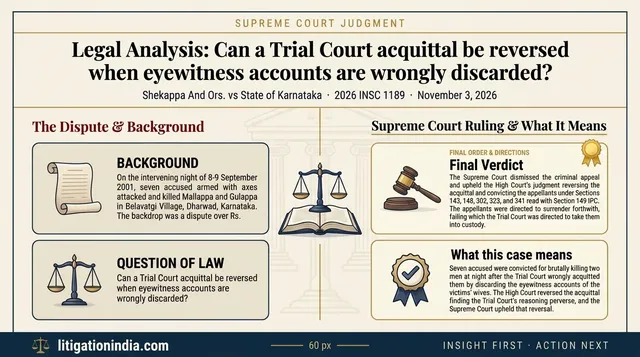
Can a Trial Court acquittal be reversed when eyewitness accounts are wrongly discarded?
Shekappa And Ors. vs State of Karnataka
The Supreme Court dismissed the appeal and upheld the High Court's conviction of seven accused for double murder, affirming that the Trial Court's acquittal was perverse and the eyewitness accounts of the victims' wives were reliable and trustworthy.
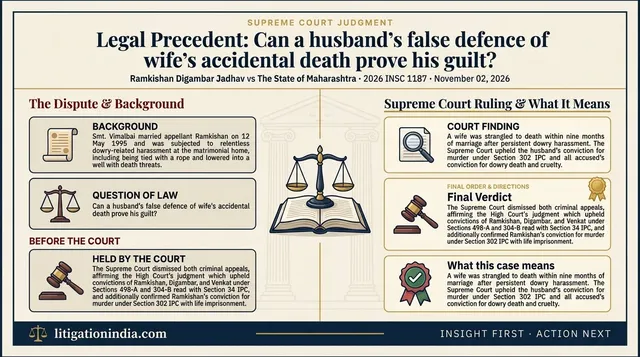
Can a husband's false defence of wife's accidental death prove his guilt?
Ramkishan Digambar Jadhav vs The State of Maharashtra
The Supreme Court dismissed the appeals and upheld conviction of the husband for murder and all three appellants for dowry death and cruelty.
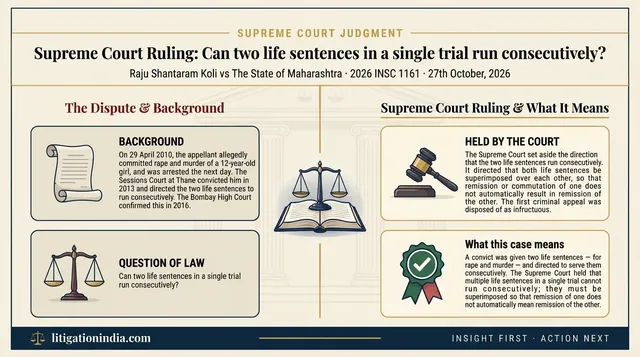
Can two life sentences in a single trial run consecutively?
Raju Shantaram Koli vs The State of Maharashtra
The Supreme Court held that two life sentences awarded for murder and rape in a single trial cannot run consecutively and must be superimposed over each other.
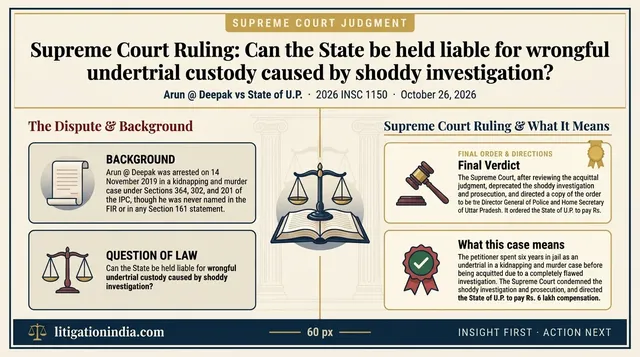
Can the State be held liable for wrongful undertrial custody caused by shoddy investigation?
Arun @ Deepak vs State of U.P.
The Supreme Court directed the State of U.P. to pay Rs. 6 lakh compensation to the petitioner who spent six years in wrongful undertrial custody before being acquitted due to a completely flawed investigation.
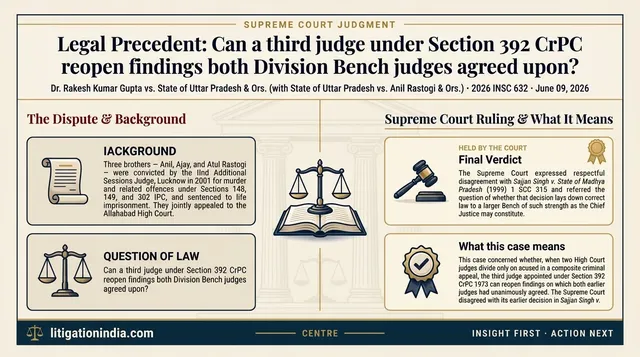
Can a third judge under Section 392 CrPC reopen findings both Division Bench judges agreed upon?
Dr. Rakesh Kumar Gupta vs. State of Uttar Pradesh & Ors. (with State of Uttar Pradesh vs. Anil Rastogi & Ors.)
The Supreme Court referred to a larger Bench the question of whether a third judge under Section 392 CrPC 1973 can overturn unanimous findings of both Division Bench judges on accused persons not in dispute, disagreeing with Sajjan Singh v. State of Madhya Pradesh (1999).
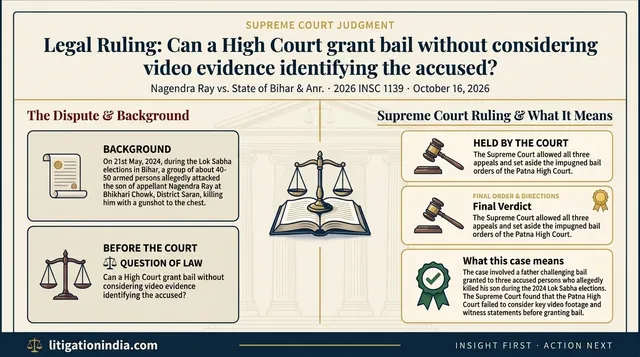
Can a High Court grant bail without considering video evidence identifying the accused?
Nagendra Ray vs. State of Bihar & Anr.
The Supreme Court set aside bail orders granted by the Patna High Court for failure to consider video footage and witness statements identifying the accused in a murder case.
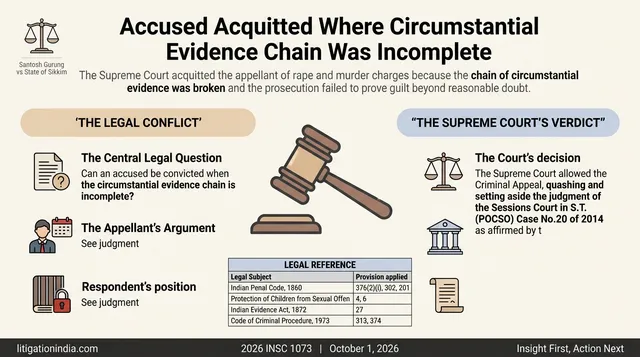
Can an accused be convicted when the circumstantial evidence chain is incomplete?
Santosh Gurung vs State of Sikkim
The Supreme Court acquitted the appellant of rape and murder charges because the chain of circumstantial evidence was broken and the prosecution failed to prove guilt beyond reasonable doubt.
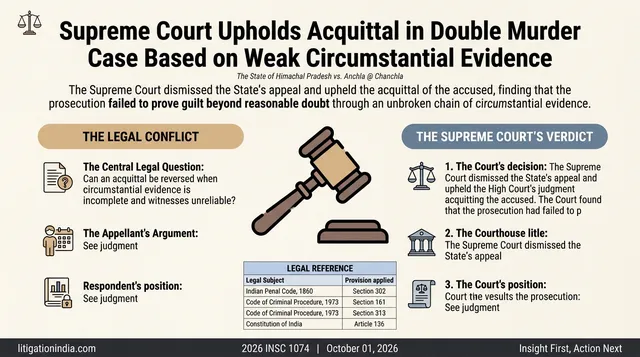
Can an acquittal be reversed when circumstantial evidence is incomplete and witnesses unreliable?
The State of Himachal Pradesh vs. Anchla @ Chanchla
The Supreme Court dismissed the State's appeal and upheld the acquittal of the accused, finding that the prosecution failed to prove guilt beyond reasonable doubt through an unbroken chain of circumstantial evidence.
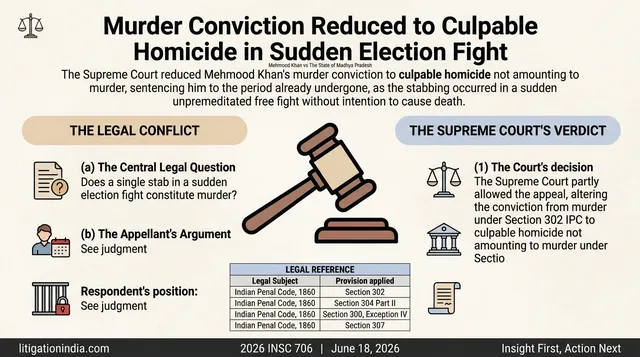
Does a single stab in a sudden election fight constitute murder?
Mehmood Khan vs The State of Madhya Pradesh
The Supreme Court reduced Mehmood Khan's murder conviction to culpable homicide not amounting to murder, sentencing him to the period already undergone, as the stabbing occurred in a sudden unpremeditated free fight without intention to cause death.
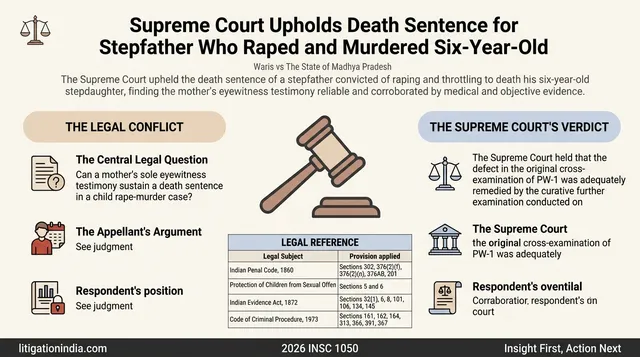
Can a mother's sole eyewitness testimony sustain a death sentence in a child rape-murder case?
Waris vs The State of Madhya Pradesh
The Supreme Court upheld the death sentence of a stepfather convicted of raping and throttling to death his six-year-old stepdaughter, finding the mother's eyewitness testimony reliable and corroborated by medical and objective evidence.
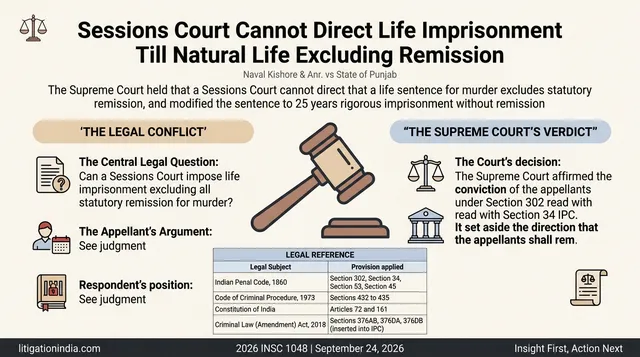
Can a Sessions Court impose life imprisonment excluding all statutory remission for murder?
Naval Kishore & Anr. vs State of Punjab
The Supreme Court held that a Sessions Court cannot direct that a life sentence for murder excludes statutory remission, and modified the sentence to 25 years rigorous imprisonment without remission.
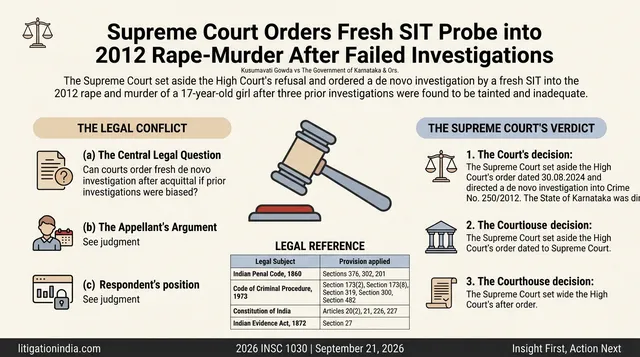
Can courts order fresh de novo investigation after acquittal if prior investigations were biased?
Kusumavati Gowda vs The Government of Karnataka & Ors.
The Supreme Court set aside the High Court's refusal and ordered a de novo investigation by a fresh SIT into the 2012 rape and murder of a 17-year-old girl after three prior investigations were found to be tainted and inadequate.
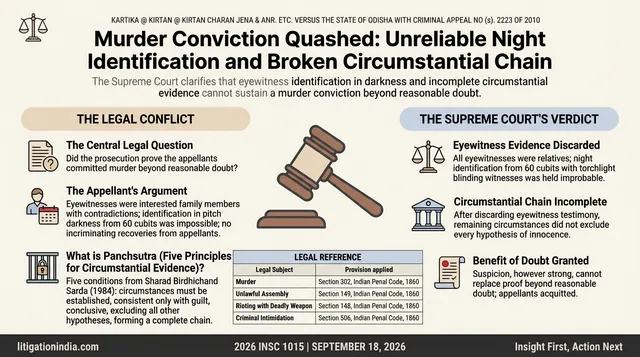
Can a murder conviction stand on unreliable eyewitnesses and incomplete circumstantial evidence?
KARTIKA @ KIRTAN @ KIRTAN CHARAN JENA & ANR. ETC. VERSUS THE STATE OF ODISHA WITH CRIMINAL APPEAL NO (s). 2223 OF 2010
The Supreme Court acquitted the appellants of murder, holding that unreliable eyewitness accounts and an incomplete chain of circumstantial evidence could not sustain conviction beyond reasonable doubt.
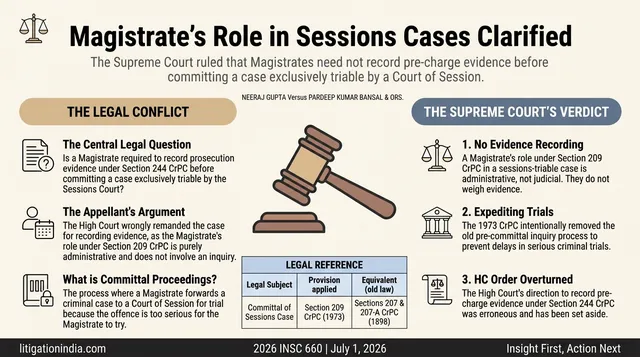
Must a Magistrate record evidence before committing a sessions-triable case?
NEERAJ GUPTA Versus PARDEEP KUMAR BANSAL & ORS.
The Supreme Court held that a Magistrate is not required to record pre-charge evidence under Section 244 CrPC before committing a case exclusively triable by a Court of Session.
Scroll to load more