
Full text of the judgment
Text extracted from Raju Shantaram Koli vs The State of Maharashtra. For the authoritative version refer to the Supreme Court of India's official website.
2026 INSC 1161 REPORTABLE IN THE SUPREME COURT OF INDIA CRIMINAL APPELLATE JURISDICTION CRIMINAL APPEAL NO.5072 OF 2026 (Arising out of Special Leave Petition (Crl.) No. 8535 of 2025) Raju Shantaram Koli
…….Appellant(s) Versus The State of Maharashtra ……. Respondent(s) WITH CRIMINAL APPEAL NO.5073 OF 2026 (Arising out of Special Leave Petition (Crl.) No.20839 of 2026) (Arising out of Diary No. 49371 of 2026) J U D G M E N T K. V. Viswanathan, J. 1) Considering the nature of the matter and the fact that the appellant has been in jail throughout, delay is condoned. 2) Leave granted. 1 Digitally signed by ANITA MALHOTRA Date: 2026.10.27 18:19:00 IST Reason: Signature Not Verified
3) Criminal Appeal arising out of Special Leave Petition (Crl.) No. 8535 of 2025 calls in question the correctness of the judgment and order dated 13.01.2025 passed by a Division Bench of the High Court of Judicature at Bombay in Criminal Writ Petition No. 842/2024. By the said writ petition, the appellant prayed that a direction be issued to the effect that the imprisonment for life awarded to him in Sessions Trial No. 282/2010 for the offences punishable under Sections 302 and 376 of the Indian Penal Code, 1860 (for short ‘the IPC’) be directed to run concurrently. The said writ petition had been disposed of by the High Court by holding that a writ court cannot review the judgment and order dated 10.06.2016, passed by a coordinate Bench of the said Court. So holding, the impugned order left it open to the appellant to challenge the sentence before the appropriate Court, as may be maintainable in law. 2
4) In Criminal Appeal arising out of Diary No. 49371 of 2026, the only question raised is whether the two sentences of life imprisonment, imposed upon the appellant, for the offences under Sections 302 and 376 of the IPC, can be directed to run consecutively. BRIEF FACTS: 5) The following are the undisputed facts. On 30.04.2010, the appellant was arrested and taken into custody on the allegation that he committed rape and murder of a 12-year-old victim on 29.04.2010. The appellant stood trial in Sessions Case No. 282/2010 before the Additional Sessions Judge, Thane, Maharashtra. 6) By a judgment dated 27.09.2013, the Additional Sessions Judge, convicted the appellant for the offence punishable under Section 302 of the IPC and sentenced him to suffer imprisonment for life and also to pay a fine of Rs. 5,000/- and, in default, to suffer simple 3
imprisonment for 5 (five) months. Further, the Additional Sessions Judge, convicted the appellant for offences punishable under Section 376 read with Section 342 of the IPC and sentenced him to suffer imprisonment for life and also to pay a fine of Rs. 5,000/- and, in default, to suffer simple imprisonment for 5 (five) months, on both counts. 7) What is important to note is that the substantive sentences awarded to the appellant-accused were directed to run consecutively, one after other, and not concurrently. 8) The appellant challenged the aforesaid judgment of the Trial Court by filing Criminal Appeal No. 975/2014 before the High Court of Judicature at Bombay. The High Court, by its judgment dated 10.06.2016, confirmed the conviction and sentence awarded to the appellant, including the direction to serve the consecutive sentences for the said offences. In the 4
operative portion, the High Court expressly noticed that the Trial Court had imposed consecutive sentences on the appellant and that the High Court would not like to interfere with the same. 9) It is this judgment of the High Court which is called in question in the Criminal Appeal arising out of Diary No. 49371 of 2026 on the limited issue of correctness of the imposition of consecutive sentences. 10) We have heard Mr. M.Y. Deshmukh, learned counsel for the appellant and Mr. Bharat Bagla, learned counsel for the State. 11) The question before us is whether the Trial Court as well as the High Court were justified in imposing consecutive life sentences in a single trial for offences under Section 302 and Section 376 read with 342 of the IPC? 12) At the outset, we may point out that since the appellant has separately challenged by way of an 5
appeal by special leave the judgment of the High Court and since we have condoned the delay and admitted the special leave petition, we are not required to decide the question arising in the first matter, (i.e., Criminal Appeal arising out of Special Leave Petition (Crl.) No. 8535 of 2025) as to whether a writ court could have passed an order for concurrent sentences. 13) The issue, whether consecutive life sentences can be awarded to a convict on being found guilty of a series of offences for which he has been tried in a single trial, came up for consideration before a Constitution Bench of this Court in Muthuramalingam and Others vs. State Represented by Inspector of Police, (2016) 8 SCC 313. 14) In Muthuramalingam (supra), this Court held as under:- “10. It would appear from the above two pronouncements that the logic behind life sentences not running consecutively lies in the fact that imprisonment for life implies 6
imprisonment till the end of the normal life of the convict. If that proposition is sound, the logic underlying the ratio of the decisions of this Court in O.M. Cherian and Duryodhan Rout cases would also be equally sound. What then needs to be examined is whether imprisonment for life does indeed imply imprisonment till the end of the normal life of the convict as observed in O.M. Cherian and Duryodhan Rout cases. That question, in our considered opinion, is no longer res integra, the same having been examined and answered in the affirmative by a long line of decisions handed down by this Court. We may gainfully refer to some of those decisions at this stage. 18. The legal position is, thus, fairly well settled that imprisonment for life is a sentence for the remainder of the life of the offender unless of course the remaining sentence is commuted or remitted by the competent authority. That being so, the provisions of Section 31 under Cr.P.C. must be so interpreted as to be consistent with the basic tenet that a life sentence requires the prisoner to spend the rest of his life in prison. Any direction that requires the offender to undergo imprisonment for life twice over would be anomalous and irrational for it will disregard the fact that humans like all other living beings have but one life to live. So understood Section 31 (1) would permit consecutive running of sentences only if such sentences do not happen to be life sentences. That is, in our opinion, the only way one can avoid an obvious impossibility of a prisoner serving two consecutive life sentences. 23. Parliament, it manifests from the provisions of Section 427(2), was fully cognizant of the anomaly that would arise if a prisoner condemned to undergo life imprisonment is directed to do so twice over. It has, therefore, carved out an exception to the general rule to clearly recognise that in the 7
case of life sentences for two distinct offences separately tried and held proved the sentences cannot be directed to run consecutively. The provisions of Section 427(2) CrPC apart, in Ranjit Singh case, this Court has in terms held that since life sentence implies imprisonment for the remainder of the life of the convict, consecutive life sentences cannot be awarded as humans have only one life. That logic, in our view, must extend to Section 31 CrPC also no matter Section 31 does not in terms make a provision analogous to Section 427(2) of the Code. The provision must, in our opinion, be so interpreted as to prevent any anomaly or irrationality. So interpreted Section 31(1) CrPC must mean that sentences awarded by the Court for several offences committed by the prisoner shall run consecutively (unless the Court directs otherwise) except where such sentences include imprisonment for life which can and must run concurrently. We are also inclined to hold that if more than one life sentences are awarded to the prisoner, the same would get super imposed over each other. This will imply that in case the prisoner is granted the benefit of any remission or commutation qua one such sentence, the benefit of such remission would not ipso facto extend to the other. 31….. That apart the view taken in Kamalanantha case has not noticed the basic premise that a life sentence once awarded would imply that a prisoner shall spend the remainder of his life in prison. Once that happens there is no question of his undergoing another life sentence. To the extent the decision in Kamalanantha case takes the view that the Court can for each offence award suitable punishment which may include multiple sentences of imprisonment for life for multiple offences punishable with death, there is and can be no quarrel with the stated proposition. The Court can and indeed ought to exercise its powers of awarding 8
the sentence sanctioned by law which may include a life sentence. But if the decision in Kamalanantha purports to hold that sentence of imprisonment for life can also be directed to run consecutively, the same does not appear to be sound for the reasons we have already indicated earlier. We need to remember that award of multiple sentences of imprisonment for life so that such sentences are super imposed over one another is entirely different from directing such sentence to run consecutively. 34. In conclusion our answer to the question is in the negative. We hold that while multiple sentences for imprisonment for life can be awarded for multiple murders or other offences punishable with imprisonment for life, the life sentences so awarded cannot be directed to run consecutively. Such sentences would, however, be super imposed over each other so that any remission or commutation granted by the competent authority in one does not ipso facto result in remission of the sentence awarded to the prisoner for the other.” (Emphasis supplied) 15) The correct legal position, as set out by this Court in Muthuramalingam (supra) is, life sentences awarded for multiple offences in a single Trial, cannot be directed to run consecutively. However, such sentences would be super imposed over each other so that any remission or commutation granted by the competent authority qua one, does not ipso facto result 9
in remission of sentence awarded to the prisoner for the other. 16) For the reasons stated above, Criminal Appeal arising out of Diary No. 49371 of 2026 is partly allowed. The impugned order, to the extent it upholds the life sentence imposed for the offence punishable under Section 302 and the life sentence imposed for the offences punishable under Section 376 read with Section 342 to run consecutively, is set aside. The net result is, the direction in the Trial Court judgment in Sessions Trial No. 282/2010 dated 27.09.2013, as confirmed by the High Court, to the effect that substantive sentences awarded to the accused “shall run consecutively, one after other, and not concurrently” shall also stand set aside. The remaining part of the operative order in Paragraph 86 of the judgment of the Trial Court, as affirmed by the 10
judgment of the High Court in Criminal Appeal No. 975/2014, is maintained. 17) The operative order of conviction and sentence of the appellant will now read as follows:- “1. The accused Raju Shantaram Koli is hereby convicted u/s. 235(2) of the Code of Criminal Procedure for the offence punishable u/s. 302 of the Indian Penal Code and sentenced to suffer Imprisonment for Life and also to pay fine of Rs. 5,000/- and in default of payment of fine to suffer Simple Imprisonment for five months. 2. The accused is further convicted for the offences punishable u/s. 376 and 342 of the Indian Penal Code and sentenced to suffer Imprisonment for Life and also to pay fine of Rs. 5,000/- and in default of payment of fine to suffer Simple Imprisonment for five months, on both counts. 3. xxxx 4.The accused is in jail since 30.04.2010. A set off u/s. 428 of the Code of Criminal Procedure is granted to the accused for a term of the period of detention undergone by him during the investigation, inquiry and trial against the substantive sentence imposed upon him. 5. The muddemal property being worthless be destroyed after the appeal period. 6. A copy of Judgment be given to the accused free of cost.” 18) We further direct, in accordance with Muthuramalingam (supra), that the life sentence 11
imposed for the offence punishable under Section 302 and the life sentence imposed for the offences punishable under Section 376 read with 342, shall be superimposed over each other so that any remission or commutation granted by the competent authority qua one, does not ipso facto result in the remission of the sentence awarded to the prisoner for the other. 19) Criminal Appeal arising out of Special Leave Petition (Crl.) No. 8535 of 2025 is disposed of as having become infructuous. ……….........................J. [K. V. VISWANATHAN]
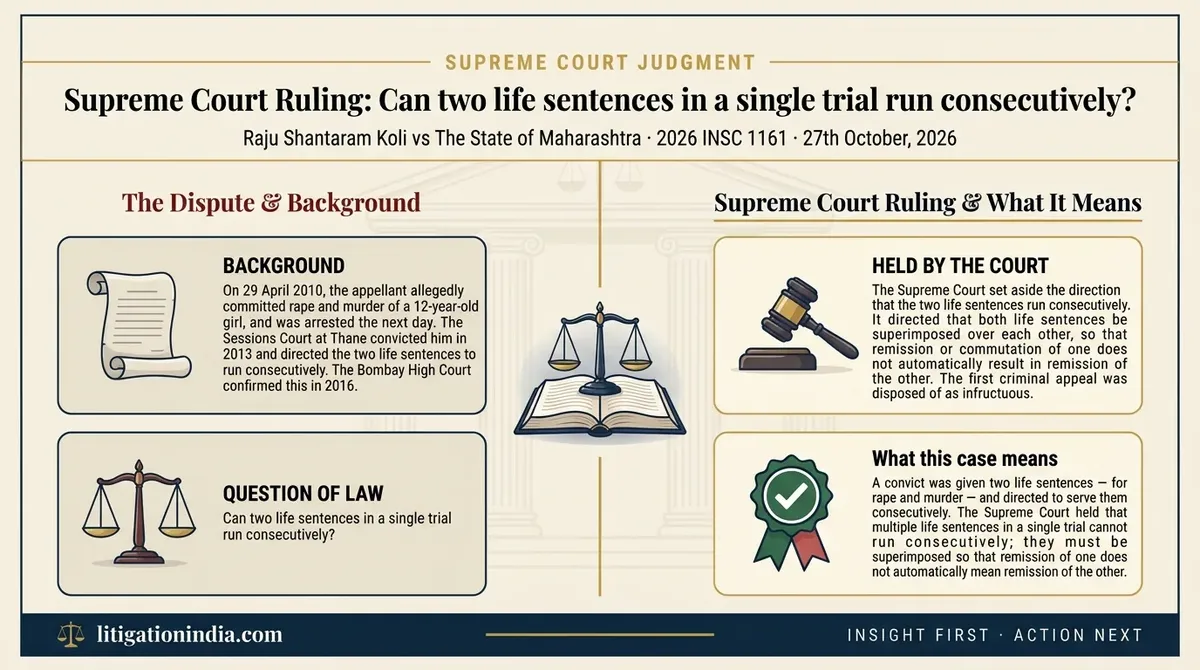
……….........................J. [ARUN PALLI] New Delhi; 27th October, 2026 12