
Full text of the judgment
Text extracted from Arun @ Deepak vs State of U.P.. For the authoritative version refer to the Supreme Court of India's official website.
2026 INSC 1150 Page 1 of 11 SLP (Crl.) No.4859 of 2026 Reportable
IN THE SUPREME COURT OF INDIA EXTRAORDINARY APPELLATE JURISDICTION
Special Leave Petition (Crl.) No.4859 of 2026
ARUN @ DEEPAK
…. PETITIONER Versus STATE OF U.P.
…. RESPONDENT
J U D G M E N T
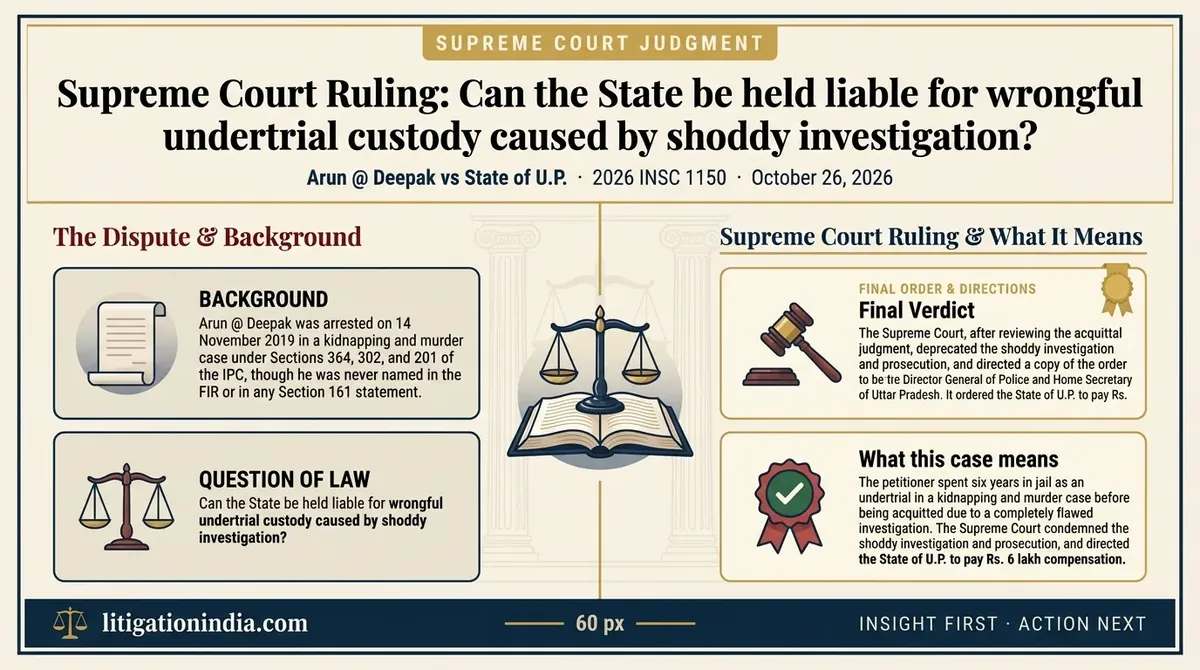
K. VINOD CHANDRAN, J. This is a classic case of how an investigation should not be proceeded with, resulting in the prosecution putting into jeopardy a person’s life and liberty. The petitioner in the above case was before us seeking bail after six years of custody as an undertrial. The crime was one registered as FIR No.367 of 2019 at P.S. Achhnera, District Agra under Section 364 read with 302 and 201 of Indian Penal Code, 18601. By order dated 23.03.2026, this Court taking into consideration the fact that the petitioner is languishing in jail since 14.11.2019 in a case hinging entirely on
1 For brevity, ‘the IPC’ Digitally signed by VISHAL ANAND Date: 2026.10.26 14:09:35 IST Reason: Signature Not Verified
Page 2 of 11 SLP (Crl.) No.4859 of 2026 circumstantial evidence, directed the Trial Court to complete the trial within three months from that date. 2. Pursuant to the same, the trial was concluded and we were informed that the petitioner was acquitted. Even at the initial stage, when we looked through the records, it was disclosed that the case was one of kidnapping and murder and the petitioner was never named in the FIR or even in the Section 161 statement. Based on a CCTV footage in which the petitioner was seen and the confession of a co-accused, he was arrayed as an accused. The recovery is said to have been made jointly by the two accused, which also was of charred bones; not identified as that of the missing person. Neither was the postmortem conclusive as to how the death was caused. Hence, we called for the judgment leading to acquittal. 3. The judgment was in Hindi, and it ran to more than 100 pages and the same had to be translated. On perusal of the translated copy, we were appalled at the manner in which the investigation was carried out. Merely six witnesses were examined by the prosecution; the informant, the Doctor, a Head Constable, a Sub-Inspector and a Circle Officer (the Investigating Officer) and an independent witness.
Page 3 of 11 SLP (Crl.) No.4859 of 2026 4. The informant, PW1 is said to have reported the missing of his son who had proceeded home from his workplace at Kiraoli Tehsil on 18.10.2019 at 3.30 PM. He is said to have been travelling in his motorcycle bearing No. UP 80 DH 7692. A further report was made on 19.10.2019, which spoke of an information that the missing person was actually abducted by unknown persons from the gate of Tehsil Kiraoli. The I.O is said to have then arrested two accused, one of whom was the petitioner. Recovery is said to have been carried out, and the investigation was completed and charge-sheet was filed before the jurisdictional court which took cognizance on 22.01.2020. 5. According to PW1, he gave two reports before the Police, one immediately on the missing of his son and then, the second report on coming to know of CCTV footage from the cameras installed in Kiraoli Tehsil. The Police, on obtaining the footage, arrested the two accused, the petitioner and one Lalit Kishore, who were seen travelling in the motorcycle. It was PW1’s deposition that on 13.11.2019, the two accused along with the mother of Lalit Kishore, one Shalini came to his house and made a ransom demand of Rs.50 lakhs, threatening that if the amounts were not paid; his son, who was in their custody would be killed.
Page 4 of 11 SLP (Crl.) No.4859 of 2026 The woman is also said to have shown an Aadhaar Card and the State Bank of India passbook of his son. Even according to him, he never reported this ransom demand coupled with the threat to the police and by evening on the same day, the police arrested the two accused and he was called to Police Station Achhnera on the night of 13.11.2019, where he saw the two accused arrested by the police. 6. According to PW1, along with the accused the police took him to one Radha Rani flats in front of which there was a drain, and the motorcycle of his son was found in the bushes. A bundle tied with a green and maroon blanket was found near the drain, in which a skull, a half-burnt thigh bone, ribs and small bones of the legs were found. Then they were led to Lalit Kishore’s house from where; a plastic can and the Aadhaar Card and the State Bank of India passbook of the deceased were recovered along with a black colour bag of Lalit Kishore. Then the two accused took them behind the house, where the bag, shoes, laptop, charger, registry papers, plain papers and stamp papers belonging to the son of PW1 were found. The recoveries were not from the petitioner herein and were recorded as carried out from the house of the coaccused.
Page 5 of 11 SLP (Crl.) No.4859 of 2026 7. PW2 was the Doctor, a Senior Radiologist at the District Women Hospital, Agra, who examined the bones recovered. The bones were eight in number, some of which were broken and some ante-mortem injuries were detected on the skull. The time and cause of death could not be ascertained and though the same was sent to FSL for DNA examination, nothing is seen produced as to the identification of the bones, as that of the deceased. 8. PW3, the Head Constable merely spoke of the registration of the missing report and the second report regarding the CCTV footage. PW4, Sub-Inspector carried out reconnaissance of the scene of recovery. He went to the spot and carried out the inquest along with five witnesses, none of whom were examined before Court. He had obtained the CCTV footage from Tehsil Kiraoli and made photos of the same from which the petitioner was identified. The CDR report of certain mobile numbers were obtained and an inquiry was made but there was no attempt to identify the persons in whose name the SIM cards were subscribed nor were the CDR supported with a certificate under Section 65B of the Evidence Act. 9. PW5 was the Circle Officer, who was the Inspector-in- Charge of the police station, who spoke of how the crime was
Page 6 of 11 SLP (Crl.) No.4859 of 2026 carried out, but without any substantiation of the same. Obviously, according to PW5, the accused had administered sleeping pills to the deceased, and his mouth was taped shut, upon which he suffocated and died. We find no medical evidence substantiating the same. The accused then purchased 55 litres of petrol in two cans from the petrol pump on 20.10.2019 and burnt the dead body, wrapped up the remaining bones and disposed it off near the drain in front of Radha Rani flats. The scene at which the alleged burning of the corpse was not identified, for a forensic examination to be conducted. No attempt was made to identify the petrol pump and bring in evidence, substantiating the purchase of petrol, that too in two empty cans. The cans were also not chemically examined to find out whether they had petrol in them. PW6, knew the deceased but it fails comprehension as to why he was examined because he did not speak of the crime or the persons allegedly involved in it. 10. Admittedly, Lalit Kishor died and Shalini, his mother; the third accused, was absconding and the petitioner alone faced trial. The trial court in its elaborate judgment has acquitted the accused, finding none of the four circumstances projected by the prosecution to be proved. The four circumstances as projected
Page 7 of 11 SLP (Crl.) No.4859 of 2026 by the prosecution were: (i) the ransom demand made by the accused to PW1, termed as an extra judicial confession, (ii) the confession of the two accused arrested on the basis of CCTV footage (iii) the last seen theory, of the two accused being seen with the deceased and (iv) the electronic evidence collected. 11. The ransom demand as found by the trial court itself was never reported to the police and it was a statement made for the first time in Court. In any event, it cannot be considered to be an extra judicial confession. More importantly, PW1 spoke of an enmity harboured by Shalini against him for implicating her son in a criminal case, which was never spoken of by PW1 to the police when he made two statements. The accused were not arrested on PW1’s pointing out and he only identified them at the Police Station after arrest as the persons who accompanied the lady who made the ransom demand. The ransom demand was never reported to the police, and the Court is kept in the dark as to how the three persons were identified as the accused and arrested, especially, when the CCTV footage from Kiraoli Tehsil was not proved. 12. The confession of the accused obviously cannot be relied on; especially when it is made to the police. There was no last
Page 8 of 11 SLP (Crl.) No.4859 of 2026 seen theory proved effectively before court. The court categorically found that the CCTV footage was not clear and it was difficult to identify the persons travelling in the motorbike. As far as electronic evidence, it comprised the CCTV footage and the CDR; both not proved with supporting certificate under Section 65B of the Evidence Act. 13. In this context, we cannot but notice that even the motorcycle recovered from the spot, from where the bones were recovered, was not produced in trial, confronted to the witnesses or its ownership proved. The result of the FSL examination of the bones was neither disclosed in trial nor was any attempt made to take the DNA sample of the father of the deceased, PW1, to match it, with that of the bones. Particularly, PW-2, Doctor, gave evidence that such an examination was necessary to determine the identity of the person whose bones were recovered along with cause and time of the death. The CCTV footage was not supported by a certificate under Section 65B of the Evidence Act. PW4, the Sub-Inspector did not testify of the accused persons having been identified by PW1, the complainant; either from the CCTV footage nor as the persons who had approached him on the same day. The recoveries made were not proved to have been
Page 9 of 11 SLP (Crl.) No.4859 of 2026 concealed by the two accused and no statement is seen recorded from the accused regarding the concealment before the same is recovered. PW1’s evidence itself is that the police had led himself and the accused to the spot from which they recovered the various items belonging to the deceased, and also from the house of one of the accused; who died during trial. We emphasize this aspect since neither was a statement regarding concealment recorded from the accused, under Section 27 of the Evidence Act, nor was it deposed by the witnesses or the I.O that it was the accused who led them to the place from which seizures were made. 14. It is unfortunate that despite no evidence against the petitioner herein, he was imprisoned for six years as an undertrial. Based on a slipshod investigation, a haphazard prosecution was carried out, which resulted, fortunately in the acquittal of the accused. We cannot but deprecate the manner in which the investigation was carried out and the prosecution conducted. As we noticed at the initial stage, we were only concerned with a bail application in which the direction was issued to complete the trial which resulted in the acquittal of the sole accused, who faced trial. We spent our valuable time going
Page 10 of 11 SLP (Crl.) No.4859 of 2026 through the judgment only to caution the State as to the manner in which investigations are carried out. The State Police would do well to educate their officers in the process of investigation. A copy of this order will be sent to the Director General of Police and Home Secretary of the State of Uttar Pradesh. 15. Be that as it may, six years have been erased from the life of a man on the strength of a concocted story built on mere surmises and conjectures. Not even a rudimentary investigation was carried out. The investigating agency also took no steps to expedite the trial, at least against the present petitioner, even if one accused was absconding, especially when the other had expired. The State cannot shirk from its responsibility to protect its citizens, especially when a person arraigned in a criminal case is presumed innocent until proven guilty. The investigation and prosecuting agencies exist not merely to, and by whatever means bring in a conviction. They should recognize themselves to be essential stakeholders in the justice delivery system, ensuring justice, not only to the victim, the de facto complainant and the injured but also to the accused. We come across such travesty of justice in many matters, but in some, so blatant and shocking, as
Page 11 of 11 SLP (Crl.) No.4859 of 2026 in this case, which requires reparation to the accused, who in turn is a victim of the system. 16. We, hence, direct the State to pay an amount of Rs.6,00,000/-; though paltry in comparison to the years spent in custody, within a period of one month to the petitioner herein. If the amount is not so paid within the time stipulated, it shall carry interest @18% per annum. 17. The Special Leave Petition stands disposed of and pending application(s), if any shall stand rejected.
.……………………………... J. (J. B. PARDIWALA)
..………….…………………. J. (K. VINOD CHANDRAN)
NEW DELHI; OCTOBER 26, 2026.