
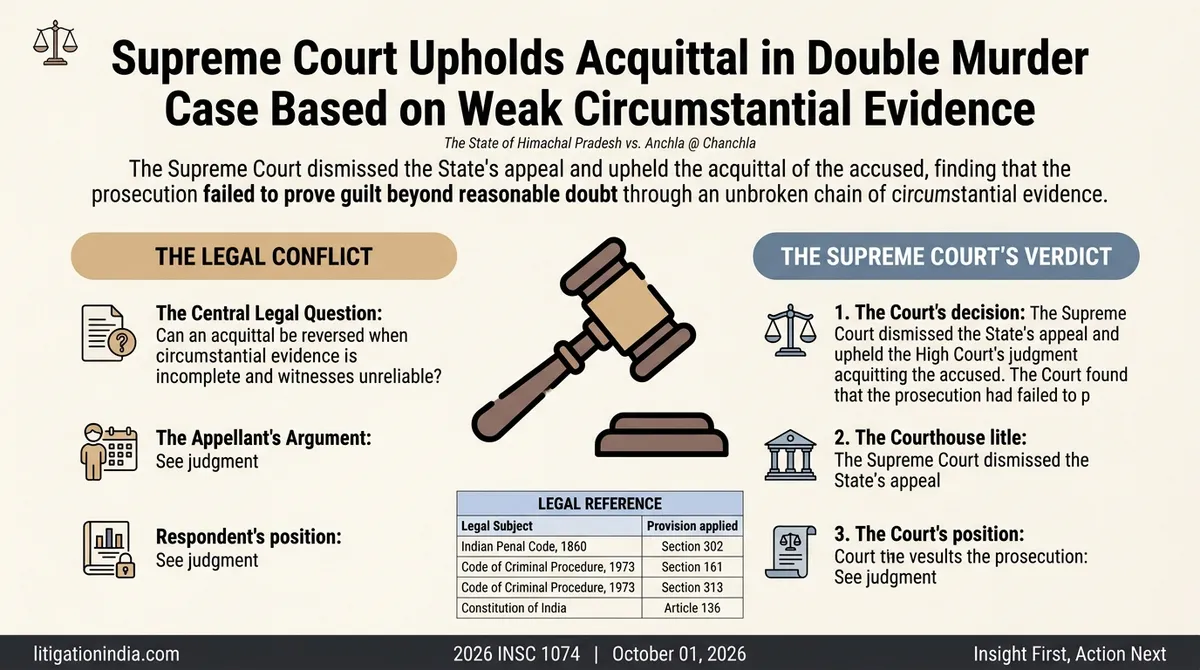
Full text of the judgment
Text extracted from The State of Himachal Pradesh vs. Anchla @ Chanchla. For the authoritative version refer to the Supreme Court of India's official website.
2026 INSC 1074 Page 1 of 60 Criminal Appeal No. 166 of 2019
IN THE SUPREME COURT OF INDIA CRIMINAL APPELLATE JURISDICTION CRIMINAL APPEAL No. 166 of 2019
THE STATE OF HIMACHAL PRADESH
…APPELLANT(S)
ANCHLA @ CHANCHLA
…RESPONDENT(S)
J U D G M E N T MANOJ MISRA, J. 1. This appeal impugns the judgment and order of the High Court1 dated 28.07.2014 whereby the appeal2 of the respondent-accused was allowed and the order of the trial court3 dated 07.11.2012, passed in Sessions Trial No. 48 of 2011, convicting and sentencing the respondent, under Section 302 of the Indian Penal Code, 18604, was set aside.
1 The High Court of Himachal Pradesh at Shimla 2 Criminal Appeal No.28 of 2013 3 Court of Session, Chamba 4 IPC Digitally signed by CHETAN ARORA Date: 2026.10.01 14:49:51 IST Reason: Signature Not Verified
Page 2 of 60 Criminal Appeal No. 166 of 2019 Facts 2. On 07.09.2011, Bhagi Ram (PW-1) informed the police that his daughter, Mithilesh Kumari, deceased No.1 (D-1), had been missing for last 6-7 days, and her house was lying locked. The report mentioned emission of foul odour from her house. Upon registration of the report, the police team entered the house, allegedly after breaking the lock, and found two dead bodies, one of D-1 and the other of her minor son, Bhupinder Singh (D-2). Autopsy revealed that the death was homicidal, due to strangulation, which might have occurred 5 to 7 days before. 3. Prosecution case was that D-1 was second wife of Amar Singh. Accused Anchla alias Chanchla (respondent herein) was born from Amar Singh’s first wife who died several years ago. After demise of his first wife, Amar Singh married D-1; in the wedlock, D-2 was born. Both D-1 and D-2 resided at Diur. Anchla used to stay at Chamba, though she had been visiting her step-mother (D-1) every 2-3 months. In the evening of 31.08.2011, when PW-1 visited D-1’s house, he noticed the accused present there. Besides, D-1 had informed PW-1 that the accused would be staying
Page 3 of 60 Criminal Appeal No. 166 of 2019 overnight with her. Next day, doors of D-1’s house were found locked. PW-1 thought that D-1 may have left to visit some place. But when the deceased did not return for 6-7 days, and foul odour started effusing from the house, the police was informed. Whereafter, police broke open the lock and found bodies of D-1 and D-2. Based on those events, Anchla (i.e., the accused-respondent) was the prime suspect of committing those murders to grab the property of her father which he had bequeathed to D-2. 4. To support its case, the prosecution, inter alia, examined a Taxi driver, namely, Vijay (PW-4), who stated that he had brought the accused from Chamba to Diur in the evening of 31.08.2011 and late night of that day, had taken her back to Chamba where she stayed in a hotel. PW- 4 also noticed a bleeding injury on Anchla’s hand. Besides PW-4, Suresh Kumar (PW-18), a worker in a hotel at Chamba, was examined to confirm that he saw the accused at the hotel that night. 5. Further, the case of the prosecution was that after her arrest, Anchla suffered a disclosure statement; basis which, a bunch of keys and a mobile of the deceased (D-1),
Page 4 of 60 Criminal Appeal No. 166 of 2019 without SIM, were recovered. Prosecution also claimed to have recovered an OPD slip indicating that on 01.09.2011 the accused had got sutures put on her hand consequent to an injury. 6. It was also the case of the prosecution that a forensic team had visited the house of the deceased and had seized / collected from there bedsheets, quilt cover, scrapings from the floor, trunk, etc. 7. Further, according to the prosecution, Call Detail Record (CDR) of the mobile of the deceased and the accused were procured. 8. Blood sample of the accused was also obtained. DNA profile generated from the blood sample of the accused and dried blood sample collected from the house of the deceased matched, as per FSL report. 9. FSL report in respect of the broken lock, allegedly removed from the door of the deceased’s house, and the bunch of keys, recovered pursuant to the disclosure statement of the accused, pointed out that the said keys were operable on that lock.
Page 5 of 60 Criminal Appeal No. 166 of 2019 10. The accused in her statement under Section 313 Code of Criminal Procedure, 19735 denied all the incriminating circumstances except the following: (a) D-1 and D-2 were her step mother and step brother respectively; (b) she was arrested on 09.09.2011 and that her blood sample was taken; and (c) she had suffered an injury on her hand as it got crushed in the car door while she was travelling to Mani Mahesh, and it was this injury which she sutured on 01.09.2011 of which OPD slip was handed over by her to the police. A defence witness was also examined by her to show her travel to Mani Mahesh on the fateful day i.e., 31.08.2011. Trial Court Findings 11. The Trial Court found the accused-respondent guilty based on the following circumstances: (i) D-1 and D-2 died a homicidal death. (ii) Bodies of D-1 and D-2 were found on 07.09.2011 in their house at Diur, which was found locked from outside.
Page 6 of 60 Criminal Appeal No. 166 of 2019 (iii) D-1 was last seen alive at her house in the evening of 31.08.2011; at that time, the accused was present there. (iv) Late evening /night of 31.08.2011/ 01. 09.2011, PW-4 brought the accused from Diur to Chamba where the accused checked in a Hotel at about 02.30 AM. At that time accused was carrying a thumb injury. (v) Accused’s thumb injury was attended to at a regional hospital at Chamba on 01.09.2011. (vi) Accused was arrested on 11.09.2011. Basis her disclosure statement, the mobile of the deceased and bunch of keys which operated on the lock found at the door of the deceased’s house were recovered. (vii) DNA profile generated from the blood sample of the accused matched with the profile generated from dried blood collected from the room where the deceased was found dead. 12. Based on above, the Trial Court concluded that the proven circumstances constituted a chain that unerringly
Page 7 of 60 Criminal Appeal No. 166 of 2019 pointed towards the guilt of the accused and ruled out all hypothesis consistent with her innocence so as to indicate that in all human probability it was the accused and no one else who committed the murder of D-1 and D-2. Trial Court thus convicted and sentenced the accused-respondent under Section 302 of IPC. 13. Aggrieved with the order of the Trial Court, the respondent preferred Criminal Appeal No.28 of 2013 before the High Court. By the impugned order, the High Court allowed the appeal. High Court’s Analysis 14. The High Court noticed that though PW-1 had deposed that on 31.08.2011 when he had gone to the house of D-1 he noticed the accused talking to D-2, however, in his previous statement under Section 161 of CrPC, with which he was confronted, there was no such disclosure. Besides, the motive for the crime that Amar Singh had bequeathed his entire property to D-2 was not proved. The High Court had also noticed that PW-1 during crossexamination had stated that out of 4 rooms in her house, D-1 had given 1 room to PW-1 and his wife. It also noticed
Page 8 of 60 Criminal Appeal No. 166 of 2019 that PW-1’s daughter in law, namely, Kiran i.e., sister-inlaw of D-1, had informed PW-1 that two persons, namely, Shokat and Noora, were asking about the properties of D-1 few days before D-1’s death. 15. In addition to above, High Court found the testimony of PW-4 doubtful because, though he claimed to have provided first aid to the accused to bandage a bleeding injury on her hand, he did not notice any blood on his vehicle. Besides PW-4 admitted that he had not issued any receipt for hire of his taxi. High Court also discarded the testimony of PW-18 because no record of Hotel stay was produced. 16. In respect of breaking of lock, High Court found that in the testimony of witnesses regarding breaking of the lock on the door of D-1’s house, it was not specific that the lock alleged to have been broken and produced in court was the one found on the latch of the door. Rather, the witness who identified the lock had deposed that he had noticed the lock on the handle of the door of the house. Conclusions of the High Court
Page 9 of 60 Criminal Appeal No. 166 of 2019 17. After analysing the evidence, the High Court concluded: (a) the motive for the crime was not proved inasmuch as there was no evidence to substantiate that a bequest was made by father of the accused in favour of D- 2; (b) the evidence of PW-1 regarding D-1 and the accused being last seen alive at D-1’s house in the company of D-2 on 31.08.2011 was not convincing, as PW-1’s previous statement had omitted to make such a disclosure; (c) PW- 1’s credibility was doubtful inasmuch as he chose to remain silent for 6-7 days even though he resided in close proximity to D-1’s house and was aware, from the next day itself, that D-1’s house was lying locked; (d) PW-1’s explanation that he was under the belief that the deceased may have gone to visit Mani Mahesh was not reliable because no such explanation was there in his previous statement; (e) PW-1’s statement that two persons, namely, Shokat and Noora, visited his shop at around 06:00 PM and thereafter they visited the house of the deceased, ought to have been thoroughly investigated as there could have been involvement of third parties; (f) PW-4’s statement that he did not notice any blood stain in his vehicle even though he
Page 10 of 60 Criminal Appeal No. 166 of 2019 provided first aid to a bleeding injury on the hand of the accused created a doubt about his credibility; (g) the story that the door of the house of D-1 was found locked, and the lock had to be broken, is not proved inasmuch as PW-1 in his deposition had not stated that the lock was found on the bolt/ latch of the door, rather it was noticed on the door handle; and (h) DNA profile generated from the blood of the accused matching with the blood stains scraped from some article in the house of the deceased was not conclusive to hold the accused guilty when the presence of the accused at the house of the deceased on or about the relevant time was not proved beyond doubt; moreover, the blood of the accused could have been planted at the site of occurrence in as much as the accused had provided her blood sample. Based on the above conclusions, the High Court took the view that the prosecution had failed to prove the charge of murder beyond reasonable doubt. 18. Aggrieved with the order of the High Court, the State is in appeal before us. We have heard learned counsel for the parties and perused the record. Submissions on behalf of State-Appellant
Page 11 of 60 Criminal Appeal No. 166 of 2019 19. The submissions on behalf of the State are as follows: (a) The High Court had discarded critical pieces of evidence on conjectures and surmises. (b) There was no basis for the High Court to hold that after collecting blood sample from the accused, blood was spilled in the house of the deceased to create evidence. (c) Besides, the blood sample was collected after the forensic team had already collected incriminating materials from the crime scene. (d) The presence of blood of the accused at the crime scene, coupled with proof that on the fateful night the accused was carrying a bleeding injury, is an incriminating circumstance which, in the absence of any explanation from the accused, pointed that in all human probability it is the accused who had committed the crime. (e) There was no good reason to discard the testimonies of PW-1, PW-4 and PW-18. PW-1 had been straight forward in his deposition that the
Page 12 of 60 Criminal Appeal No. 166 of 2019 deceased was in the company of the accused on 31.08.2011, and thereafter the door of the house of the deceased was found locked. If PW-1 had not lodged a missing report earlier, it was not a ground to discard his testimony as he had no occasion to suspect any foul play. It was only when he sensed foul odour effusing from the house that he lodged the report. (f) The High Court without any basis discarded the evidence of recovery of keys of the lock on the basis of disclosure made by the accused. Those keys conclusively linked the accused to the crime. (g) Holding the accused not guilty is perverse as it is not one of the views possible on the proven circumstances; therefore, it is a fit case where the order of the High Court be set aside, and the order of conviction and sentence passed by the trial court be restored. Submissions on behalf of the Respondent-Accused
Page 13 of 60 Criminal Appeal No. 166 of 2019 20. Per contra, on behalf of the respondent-accused, it was submitted: (a) The last seen circumstance by its very nature is a weak piece of evidence and can form the basis of conviction only when the time gap between the last seen circumstance and discovery of the body of the deceased is not much as to rule out third party involvement. In the instant case, the deceased, according to the testimony of PW-1, was last seen in the company of the accused on 31.08.2011, and the body was discovered on 07.09.2011. In such circumstances even if last seen circumstance is accepted, intervening factors cannot be ruled out. (b) The statement of PW-1 that because the door of the house was found locked since the morning of 01.09.2011 he thought that D-1 may have left to visit Mani Mahesh, hence report was not lodged, does not inspire confidence. It is unbelievable that a widow lady, whose father is residing in the vicinity, would not inform her father before
Page 14 of 60 Criminal Appeal No. 166 of 2019 leaving the station. In such circumstances, the High Court was justified in discarding the testimony of PW-1 as unreliable. In any event High Court’s conclusion on unreliability of PW-1 is one of the views possible and, therefore, warrants no interference. (c) In so far as the evidence of PW-4 and PW-18 is concerned, it appears that their testimony was made up to create a chain of circumstances. If the accused had really hired a taxi to go to Diur and come back, she would not have stayed at a Hotel and instead would have returned back to her home at Chamba. There was no occasion for her to stay overnight in a hotel at Chamba. Besides, in absence of any record of her stay in the hotel, her stay there is not proved beyond reasonable doubt. The High Court was, therefore, justified in discarding the testimonies of PW-4 and PW-8. (d) As far as collection of blood stains from the crime scene is concerned, firstly, it is not conclusive of
Page 15 of 60 Criminal Appeal No. 166 of 2019 guilt because as per the prosecution case, the accused had been visiting the house of D-1 in the past also; secondly, if the investigating agency was found creating evidence, creation of such evidence is easy, particularly when the blood sample of the accused had been collected; and, thirdly, DNA profiling is not hundred percent reliable as to be the sole basis of conviction. (e) The circumstance of seizure of keys on the basis of disclosure by the accused has been denied by the accused in her statement recorded under Section 313 Cr.P.C. Besides, it is inexplicable as to why would the accused would carry keys of the house of deceased with her when she could easily dispose them of at some place. Moreover, there is no clear evidence that the door of deceased’s house was found locked by the lock whose key was allegedly recovered because, as per the evidence, the lock was found on the door handle and not on its latch. In fact, the High Court had noticed this fact to observe that evidence
Page 16 of 60 Criminal Appeal No. 166 of 2019 regarding the lock being on the bolt of the door is lacking. This falsifies the prosecution story that the door of the house was noticed locked since 01.09.2011. (f) There was no evidence to prove any bequest in favour of D-2, therefore no motive was proved. In absence of proof of motive, and other circumstances not being proved beyond reasonable doubt, the prosecution failed to elevate its case from the level of suspicion to the level of proof. Accordingly, the appeal is liable to be dismissed. ANALYSIS 21. Before we set out to analyse the evidence in the context of the rival contentions, we must remind ourselves that this is an appeal against acquittal, therefore, it would be apposite to notice the law as to when an order of acquittal may be interfered with. Scope of an appeal against acquittal 22. A judgement of acquittal has the obvious consequence of granting freedom to the accused. This Court
Page 17 of 60 Criminal Appeal No. 166 of 2019 has taken a consistent view that unless the judgment under appeal is contrary to the evidence or palpably erroneous or takes a view which could not have been taken by the court of competent jurisdiction, keeping in view the settled canons of criminal jurisprudence, this Court is reluctant to interfere with such judgment of acquittal. Normally, an appeal against acquittal has always been differentiated from an appeal against conviction. Whenever there is perversity of facts and/or law appearing in the judgment, the appellate court would be within its jurisdiction to interfere with the judgment of acquittal, otherwise such interference is not called for. Therefore, if the view taken by the High Court is one of the views possible, or there appears no perversity in its reasoning and evaluation of evidence, merely because another view is possible, the order of acquittal does not call for interference6. 23. However, there is no embargo on the appellate court reviewing the evidence upon which an order of acquittal is based. Generally, the order of acquittal is not to be interfered with because the presumption of innocence of
6 State of Rajasthan V. Shera Ram Alias Vishnu Dutta, (2012) 1 SCC 602, paragraphs 7 and 8
Page 18 of 60 Criminal Appeal No. 166 of 2019 the accused is strengthened by acquittal. The general principle is that if two views are possible on the evidence adduced in the case, one pointing to the guilt of the accused and the other to his innocence, the view which is favorable to the accused should be adopted. The paramount consideration of the court is to ensure that miscarriage of justice is prevented. A miscarriage of justice which may arise from acquittal of the guilty is no less than from the conviction of an innocent. In a case where admissible evidence is ignored, a duty is cast upon the appellate court to reappreciate the evidence where the accused has been acquitted, for the purpose of ascertaining as to whether any of the accused really committed any offense or not. The principle to be followed by the appellate court considering the appeal against the judgment of acquittal is to interfere only where there are compelling and substantial reasons for doing so. If the impugned judgment is unreasonable, particularly where relevant and convincing evidence(s) have been unjustifiably discarded, it becomes a compelling reason for interference7.
7 State of M.P. versus Bacchudas alias Balram and others, (2007) 9 SCC 135, paragraph 9
Page 19 of 60 Criminal Appeal No. 166 of 2019 24. In Rajesh Prasad v. State of Bihar and another8, a three-Judge Bench of this Court after considering a number of decisions summarised the circumstances under which this court may entertain an appeal from an order of acquittal, and also when it may interfere with an order of acquittal. The relevant paragraphs are reproduced below: “31.1. Ordinarily, this court is cautious in interfering with an order of acquittal, especially when the order of acquittal has been confirmed up to the High Court. It is only in rarest of rare cases, where the High Court, on an absolutely wrong process of reasoning and a legally erroneous and perverse approach to the facts of the case, ignoring some of the most vital facts, has acquitted the accused, that the same may be reversed by this Court, exercising jurisdiction under Article 136 of the Constitution. Such fetters on the right to entertain an appeal are prompted by the reluctance to expose a person, who has been acquitted by a competent court of a criminal charge, to the anxiety and tension of a further examination of the case, even though it is held by a superior court. An appeal cannot be entertained against an order of equity which has, after recording valid and weighty reasons, has arrived at an unassailable, logical conclusion which justifies acquittal.
31.2. However, this court has on certain occasions, set aside the order of acquittal passed by a High Court. The circumstances under which this Court may entertain an appeal against an order of acquittal and pass an order of conviction, may be summarized as follows:
31.2.1. Where the approach or reasoning of the High Court is perverse: (a) Where incontrovertible evidence has been rejected by the High Court based on suspicion and surmises, which are rather unrealistic. For example, where direct, unanimous accounts of the eyewitnesses, were discounted without cogent reasoning.
(b) Where the intrinsic merits of the testimony of relatives, living in the same house as the victim, were discounted on the ground that they were “interested” witnesses.
(c) Where testimony of witnesses had been disbelieved by the High Court, on an unrealistic conjecture of personal motive on the part of witnesses to implicate the accused, when in fact, the witnesses had no axe to grind in the said matter.
8 (2022) 3 SCC 471
Page 20 of 60 Criminal Appeal No. 166 of 2019
(d) Where dying declaration of the deceased victim was rejected by the High Court on an irrelevant ground that they did not explain the injury found on one of the persons present at the site of occurrence of the crime.
(e) Where the High Court applied an unrealistic standard of “implicit proof” rather than that of “proof beyond reasonable doubt” and therefore evaluated the evidence in a flawed manner.
(f) Where the High Court rejected circumstantial evidence, based on an exaggerated and capricious theory, which were beyond the plea of the accused; or where acquittal rests merely in exaggerated devotion to the rule of benefit of doubt in favor of the accused.
(g) Where the High Court acquitted the accused on the ground that he had no adequate motive to commit the offence, although, in the said case, there was strong direct evidence establishing the guilt of the accused, thereby making it unnecessary on the part of the prosecution to establish “motive”. 31.2.2. Where acquittal would result in gross miscarriage of justice: (a) where the findings of the High Court, disconnecting the accused persons with the crime, were based on a perfunctory consideration of evidence, or based on extenuating circumstances which were purely based in imagination and fantasy. (b) Where the accused had been acquitted on ground of delay in conducting trial, which delay was attributable not to the tardiness or indifference of the prosecuting agencies, but to the conduct of the accused himself; or where accused had been acquitted on ground of delay in conducting trial relating to an offence which is not of a trivial nature.
25. The legal position that emerges from various decisions of this Court is that though there are no fetters on the power of the appellate court to interfere with an order of acquittal, the appellate court must not ordinarily interfere with the order of acquittal if it is one of the two views possible on overall consideration/ appreciation of evidence. However, where cogent evidence is discarded on non-sustainable grounds, or undue emphasis is laid on
Page 21 of 60 Criminal Appeal No. 166 of 2019 grounds which are not so relevant in the context of other proven facts, the appellate court can always come to its own conclusion based on the evidence on record. 26. Bearing the aforesaid legal principles in mind we shall now consider the prosecution evidence to assess whether it had succeeded to bring home the charge against the accused respondent. Law on Circumstantial Evidence 27. Before we proceed to closely scrutinize the evidence we must remind ourselves that the prosecution case rests on circumstantial evidence. It is well settled that where the evidence is of a circumstantial nature, the circumstances from which the conclusion of guilt is to be drawn should in the first instance be fully established, and all the facts so established should be consistent only with the hypothesis of the guilt of the accused. Besides, the circumstances should be of a conclusive nature and tendency, and they should be such as to exclude every hypothesis but the one proposed to be proved. In other words, there must be a chain of circumstances so far complete as not to leave any reasonable ground for a conclusion consistent with the
Page 22 of 60 Criminal Appeal No. 166 of 2019 innocence of the accused and it must be such as to show that within all human probability the act must have been committed by the accused9. Circumstances Relied by the Prosecution 28. In the present case, the circumstances relied by the prosecution to prove the accused guilty are: (a) On 31.08.2011, the accused was seen in the house of D-1. (b) On 01.09.2011, the door of the house of D-1 was found locked from outside. (c) D-1’s father tried to contact the deceased on her mobile, but could not succeed as her mobile was found switched off. (d) On 07.09.2011 when foul odour effused from D-1’s house police was informed. (e) Based on this information, the lock on the door of the house was broken to gain entry to the house. (f) On entry, dead bodies of D-1 and D-2 were found.
9 Hanumant v. State of Madhya Pradesh, (1952) 2 SCC 71: 1952 SCC OnLine SC 75; followed in Sharad Birdhichand Sarda vs. State of Maharashtra; (1984) 4 SCC 116
Page 23 of 60 Criminal Appeal No. 166 of 2019 (g) Autopsy revealed that death was homicidal, caused by strangulation 5 to 7 days before. (h) On 31.08.2011, the accused had hired a taxi from Chamba taxi stand, at about 05:15 PM, to come to Diur i.e., the place where the deceased resided. The taxi driver dropped her at Diur, at about 07:50 PM. Thereafter, the accused travelled back to Chamba from Diur, post-midnight, at 12:15 AM, and was dropped at a hotel in Chamba at about 02:30 AM. (i) At the time when the accused boarded the taxi from Diur to Chamba she had a bleeding injury on her left thumb. (j) On 10.09.2011, the accused was arrested. Based on her disclosure, mobile of the deceased, with no SIM, and a bunch of keys, alleged to have been used to lock the door of the house of D-1, were recovered. Besides an OPD prescription slip was collected from the accused which disclosed that she got her left thumb treated i.e., sutured on 01.09.2011.
Page 24 of 60 Criminal Appeal No. 166 of 2019 (k) Forensic team collected blanket, druggets, pillow cover, bedsheets, towel, quilt cover and floor scrape as well as trunk scrape, etc. for forensic analysis. (l) On 11.09.2011, the accused was medically examined and it was found that she had injury on her left thumb. (m) On 11.09.2011, accused’s blood sample was taken. (n) Forensic reports indicated that the DNA profile of the blood collected from the accused matched with the blood stained scrape collected from the house of D-1. Besides, few keys in that bunch of keys recovered on the basis of disclosure made by the accused operated on the lock seized from the door of the house of the deceased. (o) The accused had motive to commit the murder of D-1 and D-2 because accused’s father had bequeathed his property to D-2, accused’s step-brother.
Page 25 of 60 Criminal Appeal No. 166 of 2019 29. We shall now consider whether the above circumstances were proved beyond reasonable doubt? If so, whether they were of conclusive nature and tendency? And whether they constituted a chain so far complete as to exclude all hypothesis save and except the one pointing towards the guilt of the accused? D-1 & D-2 died a homicidal death
30. To prove the charge of murder, first it has to be proved that the deceased died a homicidal death. Here, PW- 7, i.e., the doctor, who conducted the autopsy of the bodies of D-1 and D-2 not only proved the autopsy reports but also substantiated that death of the two deceased was a consequence of asphyxia due to antemortem strangulation. There appears no reason to doubt the doctor’s statement that the two deceased died a homicidal death. Duration of death before Autopsy 31. However, what is important is that autopsy was conducted on 08.09.2011 and in the opinion of the doctor, the death had occurred any time between 5-7 days before. In such circumstances, the possibility of death occurring even after 01.09.2011 is not ruled out.
Page 26 of 60 Criminal Appeal No. 166 of 2019 Whether D-1 and D-2 were last seen alive with the Accused on 31.08.2011 32. The last seen circumstance is the core of the prosecution case. The sole witness of the said circumstance is PW-1, who is father of D-1 and maternal grandfather of D-2. PW-1’s statement is that including D-1 he had five daughters and one son. Two of his daughters had expired earlier. D-1 was his eldest daughter. She was married to Amar Singh 15 years ago. Amar Singh died after six years of marriage with her. D-1 was Amar Singh’s second wife. His first wife Achhri Devi had died earlier leaving five daughters including the accused. D-2 was the only son of Amar Singh, who was born from D-1. All daughters of Achhri Devi used to visit D-1. However, the accused used to visit more often i.e., once in one or two months. PW-1 deposed that after retiring from service, he had been running a shop in the village near the house of D-1. He stated that on 31.08.2011, one Shokat and Noora, both Kashmiris, had come to his shop at around 06:00 PM to recharge their mobile. Thereafter, they went to the house of D-1, and left about half an hour later. However, later that
Page 27 of 60 Criminal Appeal No. 166 of 2019 evening when he had gone to the house of D-1 to enquire as to who would be staying with her in the night, he was informed by D-1 that the accused would be staying with her in the night. PW-1 added that there (i.e., House of D-1) he saw the accused talking to D-2. PW-1 stated that that night he slept at his shop. Next day, he found all doors of D-1’s house locked. Thereafter, he tried to contact D-1 on her mobile, but the mobile was switched off. Thinking that D-1 may have gone to ‘Mani Mahesh’ along with the accused, he waited for her to return. But, after 6-7 days, when he sensed foul odour effusing from D-1’s house, he informed the police on 07.09.2011. Whereafter, the police broke the lock on the door of the house to enter the house. There they discovered bodies of D-1 and D-2. PW-1 added that since his son-in-law (i.e., Amar Singh) had bequeathed his entire property to D-2 (i.e., son of D-1), accused committed the murder so that the property could revert to the accused. 33. During cross-examination, PW-1 admitted that there were four rooms in D-1’s house, and D-1 had given one room to PW-1 and his wife. He also admitted that Kiran (i.e., PW-1’s daughter-in-law) had informed him that Shokat
Page 28 of 60 Criminal Appeal No. 166 of 2019 and Noora had been enquiring about the properties of D-1. He further admitted that entire village knew that D-1 and D-2 used to live alone in their house. 34. Further, during cross-examination, PW-1 admitted that when he went to D-1’s house on 31.08.2011, between 06:30 PM and 07:00 PM, he had not spoken to the accused. At that stage, PW-1 was confronted with an omission in his previous statement under Section 161 Cr.P.C. where he had not disclosed noticing the accused at D-1’s house talking to D-2. Besides, during cross examination, PW-1 admitted that he had not disclosed to the police the motive for the crime. However, he denied the suggestion that he had not seen the accused in the house of the deceased on 31.08.2011. 35. What is clear from PW-1’s deposition is that on 31.08.2011 he had not interacted with the accused. Besides, his statement that he saw the accused talking to D-2 at D-1’s house is an improvement on his previous statement where he had omitted to make any such disclosure. What is also important is that in his previous statement he had disclosed that from outside of D-1’s house
Page 29 of 60 Criminal Appeal No. 166 of 2019 he had enquired from D-1 as to who would be staying with her that night and that D-1 had responded from inside the house about the accused staying with her that night. The discrepancy between his previous statement and deposition in Court indicates that PW-1 has improved upon his earlier statement. In our view, therefore, on the sole basis of PW- 1’s testimony it would be unsafe to hold that the accused was with the deceased in the evening of 31.08.2011. In such circumstances, we would have to look at other evidences for corroboration. The other evidence which the prosecution has produced to show the presence of the accused at Diur in the evening of 31.08.2011 comes from PW-4, a taxi driver. PW-18, a worker at a Hotel in Chamba, has been produced to corroborate PW-4. We shall now consider their testimonies.
Circumstance of accused travelling from Chamba to Diur and back to Chamba on 31.08.2011 36. PW-4 deposed that he runs a taxi. On 31.08.2011, at about 05:15 PM, the accused hired his taxi to visit Diur. He took the accused from Chamba to Diur where he reached at about 07:30 PM. The accused had asked him to
Page 30 of 60 Criminal Appeal No. 166 of 2019 wait as she had to return; therefore, he waited. According to PW-4, the deceased came back at around 00:15 hrs., that is post-midnight of the intervening night of 31.08.2011 and 01.09.2011. Thereafter, PW-4 took her to Chamba and dropped her at a hotel there at about 02:30 AM. PW-4 stated that when the accused was boarding his taxi for her journey back to Chamba, he noticed a bleeding wound on her left thumb for which he provided first aid to her. 37. What is important to note is that PW-4 did not disclose that he parked his car next to D-1’s house or that he could see the accused entering and exiting D-1’s house. He also did not state that he saw the accused with D-1 or D-2. His testimony is basically about travel from Chamba to Diur and back. However, if his testimony is accepted, it provides a vital link to the chain of circumstances. 38. PW-18, a worker at a hotel in Chamba, deposed that in the intervening night of 31.08.2011 and 01.09.2011, a man had come to ask for accommodation in the hotel, and thereafter he brought a lady. The said lady is none other than the accused in the dock.
Page 31 of 60 Criminal Appeal No. 166 of 2019 39. If we accept the testimonies of PW-4 and PW-18, the prosecution story that on 31.08.2011 the accused was at Diur would stand substantiated and it lends assurance to PW-1’s testimony. Besides, it explains the presence of blood of the accused at the scene of crime. PW-4 & PW-18 are not trustworthy 40. Whether the testimonies of PW-4 and PW-8 are to be accepted depends on their credibility/ trustworthiness. In our view, there are certain circumstances which dent their credibility. First, there is no indication in the testimony of the investigating officer (PW-20) as to what prompted him to record statement of PW-4 and PW-18. Second, PW-20 despite repeated questions did not tell the date when statements of PW-4 and PW-18 were recorded. How those two circumstances are relevant to doubt the credibility of PW-4 and PW-18 is discussed below. 41. To a lay man, the above circumstances may appear irrelevant in assessing credibility/ trustworthiness of a witness. But to a trained judicial mind it is an important circumstance in assessing whether a person is a natural witness, who is aware of relevant facts, or is the one who
Page 32 of 60 Criminal Appeal No. 166 of 2019 has been set up to create evidence. Normally, when a person is aware about a crime and has knowledge of any circumstance which, to his understanding, is incriminating in nature and may be of help to the police, he may, as a responsible person of the society, provide information to the police. But where the circumstance, of which one has knowledge or awareness, in itself is not one which could be considered incriminating or relevant for investigation of a crime, there is no likelihood of that person reporting it to the police. Therefore, the answer to the question as to why, when and in what circumstances the witness statement was recorded during investigation becomes an important tool in assessing the credibility of that witness. The reason is simple. Because the answer would help in determining whether the witness is a natural one or has been set up to create evidence. 42. It is well settled that the role of the investigating officer is to collect evidence and not to create one. Where there is no occasion for the investigating officer to record statement of a person, or for that person to impart information to the police, yet, the police proceeds to record
Page 33 of 60 Criminal Appeal No. 166 of 2019 his statement without narrating the circumstance in which it was considered necessary to record his statement, a serious doubt arises as to whether that witness has been set up to create evidence. 43. We have no doubt in our mind that an investigating officer may pick up clues from any statement recorded during investigation to record statement of another. Such an exercise is completely bona fide. For example, if after recording statement of A, the investigating officer comes to know that B may have knowledge of something relevant, he would be justified in recording statement of B. But if the investigating officer straightway records statement of B, and there is no palpable reason for him to believe that B is possessed of relevant information, and B has no reason to impart information on his own to the investigating officer, a suspicion would arise whether the exercise of recording statement of B is undertaken just to create evidence. Lack of explanation in that regard may dent the credibility of B. 44. Ordinarily an investigating officer collects evidence from witnesses who are either present at the scene of crime or are likely to be aware of the crime and have information
Page 34 of 60 Criminal Appeal No. 166 of 2019 about it. Evidence may also be collected from persons who, by virtue of their relationship with the victim or the named accused, are likely to have relevant information. Investigation may also reach out to those who may be in contact with the victim, or the known accused, based on Call Detail Record (CDR) of the mobile of the victim or the suspects. Likewise, information may be collected on the basis of information received through disclosure statement suffered by the accused. However, where a person is not even aware that the information which he is possessed of is incriminating against some person, there is no likelihood of that person reporting that information to the police. In such circumstances, what propels the investigating officer to record his statement becomes important, and failure to disclose the reason may dent the credibility of that witness as it may reasonably be inferred that the said witness is one who has been set up. 45. In the present case, PW-20 i.e., the investigating officer ducks the question and feigns ignorance as to when he recorded the statement of PW-4 and PW-18 during investigation. Further, there is no explanation as to what
Page 35 of 60 Criminal Appeal No. 166 of 2019 prompted him to record statements of PW-4 and PW-18 during investigation. Importantly, PW-20 does not state that in her disclosure statement the accused had disclosed about travelling by Taxi from Chamba to Diur and back or about her stay at the hotel. PW-20 only states that the accused in her disclosure had stated that she could get the keys and mobile recovered. Thus, statements of PW-4 and PW-18 appear to have been recorded only to create evidence. 46. Importantly, PW-1 does not state that he saw the accused coming to the house of the deceased in a taxi. Therefore, what prompted the investigating officer to record the statement of PW-4 is a mystery. Possibility of PW-4 on his own going to the police and getting his statement recorded is remote because travelling in a taxi, or staying in a hotel, by itself is not an incriminating circumstance as to disturb a person and prompt him to report it to the police. Therefore, what prompted the investigating officer to record statements of PW-4 and PW-8 assumes importance, and lack of disclosure/ explanation in that regard, in our view,
Page 36 of 60 Criminal Appeal No. 166 of 2019 is sufficient to consider them as witnesses set up to create evidence for constituting a chain of circumstances. 47. The High Court had doubted PW-4’s testimony for a different reason. According to the High Court PW-4, though spoke about noticing a bleeding thumb injury on the hand of the accused and of providing first aid to her, saw no spilled blood on his vehicle. High Court was of the view that if the accused had a bleeding injury which allegedly spilled blood at the scene of crime, and PW-4 also noticed blood oozing out, a drop or two of blood falling inside the vehicle was likely. In our view, though this by itself is not sufficient to discard PW-4, it might be an added reason to doubt his testimony. 48. In addition to above, there is another reason to doubt the testimony of PW-4, which is, if the accused had hired the taxi for her journey from Chamba to Diur, there was no need for her to stay overnight in a hotel at Chamba. Instead, she would come back to her home at Chamba. 49. Insofar as PW-18 is concerned, he candidly admitted that record of accused’s stay at that hotel was not handed over to the police. Lack of record of her stay
Page 37 of 60 Criminal Appeal No. 166 of 2019 seriously dents the credibility of his statement because it is a matter of common knowledge that all hotels /Sarai, in ordinary course of business, are required to maintain guest record/ register. Absence of such corroborative evidence of stay, seriously impairs the credibility of PW-18. 50. For all the reasons above, we are of the view that statements of PW-4 and PW-18 are not trustworthy and unworthy to serve as corroborative piece of evidence of the last seen circumstance narrated by PW-1. Lapse in collecting tower location of mobile(s) while obtaining CDR 51. During investigation, the investigating officer was apprised of mobile numbers of the deceased Mithilesh Kumari (D-1) and the accused respondent. PW-19 was produced to prove the CDR of one of the mobiles, though both CDRs were part of police papers collected during investigation. However, interestingly, the CDRs do not disclose tower location of the concerned mobiles which could have helped in pin-pointing as to whether the two mobiles at the relevant time were in close proximity of each other, and whether D-1’s mobile had moved to the place of
Page 38 of 60 Criminal Appeal No. 166 of 2019 residence of the accused from where it was allegedly recovered. Non-collection of tower location of the two mobiles is a serious investigational lapse in the facts of the case. 52. Further, strangely, the CDR of D-1’s mobile was not even exhibited. Interestingly, PW-20 (i.e., the investigating officer) does not even disclose whether D-1’s mobile was operative or not after 31.08.2011 as per its CDR. 53. In our view, CDRs of the two mobiles with corresponding tower locations would have been critical in revealing: a. whether the accused’s mobile at the relevant time was near the location where the dead bodies of the two deceased were found; and b. whether D-1’s mobile was active any time after 31.08.2011; if yes, whether she received any call after 31.08.2011; if yes, from what location. 54. The importance of clarity on the aforesaid questions cannot be undermined as they had the potential
Page 39 of 60 Criminal Appeal No. 166 of 2019 to either corroborate or demolish the prosecution story. Because if the mobile of the deceased was operative after 31.08.2011, PW-1’s statement that it was found switched off would have been negated. Besides, its tower location would have indicated where the person in possession of that mobile was located. This was crucial because the prosecution story hinges on the circumstance that the deceased and the accused were together on 31.08.2011. Therefore, if the tower location of the two mobiles had disclosed that they were not in close proximity to each other on the fateful day, some explanation would have been required as to why it was so, when, according to the prosecution, owners of those two mobiles were together on the fateful day. Assuming that the accused may not have carried her mobile to the scene of crime, tower location of D-1’s mobile could have reflected upon the truth of the prosecution story. Here there is no explanation by the prosecution as to why the tower location was not collected. In our view, lack of information in that regard is a serious investigational lapse.
Page 40 of 60 Criminal Appeal No. 166 of 2019 55. Besides, there is another reason to doubt the testimony of PW-1 on the last seen circumstance, which is, that he remained silent for 6-7 days. According to him, he found the door of the house locked since the morning of 01.09.2011. He kept quiet for 6-7 days because he felt that his daughter may have gone to visit ‘Mani Mahesh’. Was there a plan to go there? Was a taxi already booked? Did she plan to go by bus? At what time does the bus leave? These are few questions on which there is no investigation to test the correctness of his statement. Therefore, PW-1’s explanation for the delay in reporting about his daughter (D-1) and grandson (D-2) going missing does not inspire confidence. Besides, if PW-1 had a shop in the vicinity, as was his admission, and the deceased had provided a room to PW-1 and his wife in the house where she resided, as would appear from PW-1’s statement during cross examination, the situation gets worse. It creates an impression that PW-1 is either suppressing some vital information or telling a lie. 56. Above all, probability of death occurring later than 31.08.2011/01.09.2011 night is not ruled by the autopsy
Page 41 of 60 Criminal Appeal No. 166 of 2019 report. Therefore, when we consider PW-1’s testimony in conjunction with (a) the medical evidence; (b) the lapse on the part of investigating agency in collecting tower location(s) of the mobiles of D-1 and the accused on or about the relevant time; (c) the improvement in his testimony from his previous statement about noticing the accused talking to D-2 at D-1’s house; (d) his admission, during cross-examination, that he was provided a room in the house by D-1; and (e) the delay in reporting the matter to the police despite staying in the vicinity, a serious doubt arises about the prosecution story that the accused had come to D-1’s house in the evening of 31.08.2011. And when we consider it in conjunction with the testimony of PW-4 and PW-18, the prosecution case appears contrived. In such circumstances, the view taken by the High Court that PW-1 is not reliable cannot be faulted. 57. In the light of the analysis above, we are of the considered view that the prosecution has not been successful in proving beyond reasonable doubt that the deceased was last seen alive with the accused in the evening of 31.08.2011. Besides, the testimony of PW-4 and PW-18
Page 42 of 60 Criminal Appeal No. 166 of 2019 regarding travel of the accused to Diur from Chamba and back to Chamba in the night of 31.08.2011, and her stay at a Hotel in Chamba, is neither trustworthy nor reliable. Circumstance of lock breaking and recovery of keys and mobile of the deceased Lock Breaking & Recovery of Keys 58. The circumstance of recovery of key(s) at the instance of the accused would be relevant only if it is established beyond reasonable doubt that the lock which had to be broken to gain access to the room where the bodies were lying was the one which was seized and sent to the laboratory to ascertain whether those keys operated on that lock. 59. Thus, the prosecution had to prove (a) that the door of D-1’s house was locked, and (b) it was locked by the same lock of which keys were discovered at the instance of the accused. 60. In this regard, PW-1, who has been examined apart from others, though states that the door of D-1’s house was locked, is neither a witness to the seizure memorandum of
Page 43 of 60 Criminal Appeal No. 166 of 2019 the lock nor he describes the lock with which the door was locked. 61. PW-3 (Vias Dev) along with Baldev are witnesses of the seizure of the lock, and have allegedly signed the seizure memorandum i.e., Ext. PW-3/A. The seizure memo reads thus: “Today, i.e. on 07.09.2011, in the presence of undersigned witnesses, at the spot at Bhinga (Diur), room of the residential house of Mithilesh Kumari, where she along with her son Bhupinder was sleeping, was found locked from outside, which was opened after breaking the lock. The said broken lock bearing inscription “Godly Fighter 65 mm” was lifted from the spot and made into a cloth parcel which was sealed with three seals bearing inscription ‘A’. Sample of the seal was taken on a separate piece of cloth and the seal after having been put to use was handed over to witness Vias Dev. Parcel containing lock was taken into police possession for the purpose of evidence vide memo. Memo was prepared at the spot to which witnesses appended their respective signatures.”
62. Although PW-3 proved the seizure memorandum and identified the lock lifted from the spot, which was marked Exhibit P-28, during cross-examination, he stated: “When I reached the spot, the lock was on the handle of the door.” It is, therefore, clear that the lock was not noticed by PW-3 on the latch of the door rather he saw it on the handle of
Page 44 of 60 Criminal Appeal No. 166 of 2019 the door. PW-3 does not say that he ever saw that lock on the latch which bolted the door. 63. Besides PW-3, there are two more witnesses of the circumstance. One is PW-15 i.e., SI Darshan Singh, and the other is investigating officer PW-20. Though PW-15 makes a statement that the room was lying locked and the lock was broken in his presence, he does not identify the lock which was produced in court to prove that it was that very lock which was hanging on the latch of the door. 64. Interestingly, PW-20, the investigating officer is not even a witness of breaking of the lock. PW-20 states as under: “By the time, I had reached the spot, the lock on the main door had already been broken open by the police team present at the spot.”
65. Having regard to the above evidence, we are of the view that it was not established beyond reasonable doubt that the lock which was broken to gain entry to D-1’s house and the lock which was sent for forensic examination and produced in Court, was one and the same. We say so because PW-3 who identified the lock in court did not say that it locked the latch that shut the door of D-1’s house,
Page 45 of 60 Criminal Appeal No. 166 of 2019 and PW-15, who is witness to the lock breaking process, does not identify the lock produced in Court as the one which locked the door. Once that is the position, the recovery of keys at the instance of the accused-respondent is rendered inconsequential. More so, when the recovery has been denied by the accused in her statement under Section 313 CrPC. The High Court was therefore justified in concluding that in the absence of clear and cogent evidence, that it was this very lock that had locked the latch which shut the door, and had to be broken to gain access to D-1’s house, the discovery of keys is inconsequential. 66. Besides above, it does not appeal to reason as to why the accused would take away the keys of the lock with her, or for that matter why would she even lock the door, when she resided at another place. This recovery, therefore, appears artificial and does not inspire confidence. Recovery of Mobile 67. The other incriminating circumstance is regarding the recovery of mobile of the deceased from the house of the accused. This circumstance is denied by the accused. In our view, it has been rendered doubtful for multiple
Page 46 of 60 Criminal Appeal No. 166 of 2019 reasons. Firstly, the investigating officer has not got CDR of the said mobile exhibited in evidence. Further, the investigating officer (PW-20) is silent on as to whether (a) mobile was switched off or not on 01.09.2011; if not, whether it received any call on 01.09.2011, or later; and (b) if it had received a call, where it was located. Secondly, a mobile can always be planted by picking it from the scene of crime and putting it at the place from where recovery is to be shown. Therefore, to remove all doubts, the investigating officer ought to have placed the complete CDR of the mobile along with its tower location. Thirdly, why would the accused carry the mobile from the house of the deceased to her own house when she has her own mobile. Rather, she would carry other valuables from the deceased’s house. At this stage, we may observe that there is no evidence that she carried any valuables from the house of the deceased to her own house. 68. In such circumstances, firstly, recovery of mobile from the accused’s house is doubtful and, secondly, in absence of the complete CDR of that mobile along with its
Page 47 of 60 Criminal Appeal No. 166 of 2019 tower location, its incriminatory value, if any, is seriously dented. Circumstance of DNA profile of the bloodstain found at the scene of crime matching with that of the accused 69. At this stage, we shall consider another incriminating circumstance which the prosecution seeks to rely upon. According to the prosecution, (a) the scrape of cabinet/ trunk containing dried blood was forensically matched with DNA profile generated from the blood sample obtained from the accused; and (b) the DNA profile of the two had matched indicating that the accused was present in the house of D-1 with a bleeding injury and, therefore, coupled with the fact that the accused had got herself treated for that bleeding injury on 01.09.2011, it could safely be concluded that the accused was present at the scene of crime on 31.08.2011. 70. The High Court discarded this circumstance by observing that blood of the accused may have been planted after collecting the blood sample from the accused. The learned counsel for the appellant submitted that this
Page 48 of 60 Criminal Appeal No. 166 of 2019 conclusion of the High Court is without any basis and is perverse. 71. In this context, we would have to consider as to when the scene of crime was discovered; when the samples were collected from the scene of crime; when was the accused arrested; when was the blood sample of the accused collected; and when was the sample sent to the forensic laboratory for analysis. 72. Before we examine and evaluate the evidence on the aforesaid aspects, it may be put on record that except for one stained material, the other bloodstains had disintegrated to an extent that it was not possible to generate the DNA profile. As to why the other blood-stained material lifted from the spot, such as quilt cover, pillow cover, etc., could not generate DNA profile whereas one found over the trunk/ cabinet could generate, when the blood seems to have oozed out on the same day i.e., the day of murder, is an aspect which we must bear in mind while evaluating the evidence. Probably the High Court had this in mind to hold that the sample sent for forensic
Page 49 of 60 Criminal Appeal No. 166 of 2019 examination might have been planted after collecting the blood sample from the accused. 73. Admittedly, the scene of crime was first discovered on 07.09.2011. The testimony of the investigating officer (PW-20) discloses that he was a part of the FSL team which had lifted samples of blood from different points in the room where the deceased had been murdered. He states that the FSL team had visited on 10.09.2011 and had taken parts of mattresses, pillow cover, drugget and bedsheet into possession. A single bedsheet was also taken into possession. A cloth cover lying over a trunk was also taken into possession by the team. He stated that all the aforesaid articles were sealed in a cloth parcel. PW-20 also states that the FSL team had taken photographs of palm prints of the accused and had also sent them to fingerprint bureau Shimla for comparison. However, there appears no record of palm prints report. There is also no explanation as to why it was not produced. Interestingly, none of the members of the forensic team which collected the articles was examined. However, we do not propose to draw adverse
Page 50 of 60 Criminal Appeal No. 166 of 2019 inference on that count as there is not much crossexamination regarding it. 74. The arrest memo of the accused reflects that she was arrested on 10.09.2011. The accused, however, claims in her statement under Section 313 CrPC that she was arrested on 09.09.2011. Interestingly, PW-20 in his deposition states that the accused was arrested on 11.09.2011, which appears to be at variance with the date mentioned in the arrest memo. However, the blood sample of the accused was taken on 11.09.2011. In such circumstances, the date on which FSL team collected the blood-stained material from the scene of crime and the date on which those materials were sent for forensic examination including the date on which those articles were received in the forensic laboratory assume importance. 75. PW-10, the Head Constable, deposed that on 07.09.2011, a parcel allegedly carrying a broken lock with seal was deposited. On 10.09.2011, multiple parcels carrying various bloodstained articles collected from the scene of crime were deposited along with the seal. On 11.09.2011, the salwar suit worn by the accused at the time
Page 51 of 60 Criminal Appeal No. 166 of 2019 of occurrence was also deposited along with the LG mobile and a bunch of keys recovered from the house of the accused. He states that on 12.09.2011, the blood sample of the accused was also deposited. On 12.09.2011, a parcel containing the viscera of D-1 and D-2 was deposited. On 13.09.2011, he sent parcels containing lock and keys to RFSL Gutkar. On the same date i.e., on 13.09.2011, he forwarded blood sample of the accused along with five parcels deposited on 12.09.2011 to RFSL Dharamshala. 76. PW-11 to whom PW-10 handed over the parcels for carrying it to the laboratories concerned, stated that on 13.09.2011, PW-10 had handed over five parcels and an envelope to him, and those articles were deposited at FSL Junga on 14.09.2011. He states that on 19.09.2011, he had deposited two envelopes in the office of the Finger Printing Bureau at Bharari. On 20.09.2011, he deposited two parcels carrying lock and keys at RFSL Gutkar. PW-11’s statement is extracted below: “My statement had been recorded by the police. I had got recorded in my statement that I had come back from FSL Junga because documents had not been signed by the SP and thereupon again proceeded to Shimla on 19.09.2011 (confronted with statement Exhibit D-3 wherein it is not so recorded).”
Page 52 of 60 Criminal Appeal No. 166 of 2019
77. What is clear from above is that the articles were dispatched to the FSL laboratory after the blood was collected from the accused. Observations in the FSL report dated 21.03.2012 are as under: “(i) In Exhibits P-2 (dried blood scratched from trunk), P-4 (cotton thread containing blood lifted from trunk), P-5 (blood sample of accused Anchla Devi) and P-6 (blood sample of accused Anchla Devi on blotting paper); good quality DNA was extracted and it was possible to amplify it at all the fifteen Autosomal STR loci and Amelogenin with the AmpF/STR Identifiler Plus PCR Amplification Kit.
(ii) Highly degraded DNA was extracted from Exhibit P-1 (piece of mattress having blood stains) and P-3 (dried blood scratched from floor) and it was not possible to amplify these despite repeated attempts.
(iii) The DNA profile obtained from Exhibits P-5 (blood sample of accused Anchla Devi) and P-6 (blood sample of accused Anchla Devi on blotting paper) completely matches with the DNA profile obtained from Exhibits P-2 (dried blood scratched from trunk) and P-4 (cotton thread containing blood lifted from trunk).
Conclusion: On the basis of the above analysis performed on the exhibits, it is concluded that:-
The DNA profile obtained from exhibits P-5 and P-6 (liquid and dried blood samples of the accused Anchla Devi) completely matches with the DNA profile obtained from exhibits P-2 (source: dried blood scratched from trunk) and P-4 (source: cotton thread containing blood lifted from trunk).”
Page 53 of 60 Criminal Appeal No. 166 of 2019 78. What is surprising is that all samples were found to have disintegrated save and except the scrape from the cabinet and the one lifted from the cabinet by cotton thread. Interestingly the control sample from the cabinet was not sent for forensic examination. Besides, if blood stains on all articles were collected on or about the same time, disintegration of other blood stains and non-disintegration of blood stain found at one spot is something which puzzles us. Unfortunately, the author of the report i.e., the scientific expert was not called for cross-examination, and there is not much effort from the defence to demonstrate that the seal of the articles dispatched was tampered with. In such view of the matter, though we have questions in our mind, we have no option but to accept the report as it stands. However, whether this circumstance clinches the case for the prosecution is what we shall now discuss. 79. Presence of blood of the accused in the room at best indicates that at some point in time the accused was present there. This does not indicate that the accused was present on 31.08.2011 or for that matter on any given date. Importantly, the prosecution case itself is that the accused
Page 54 of 60 Criminal Appeal No. 166 of 2019 had been visiting the house of the deceased regularly in the past. Probability of some injury in the past causing blood to spill on the cabinet is one possibility which cannot be ruled out. Besides, what is important is that the accused’s blood was not found on the clothes of the deceased or on any cloth or material which might have been used to strangulate the two deceased. In consequence, this circumstance, even if it is accepted as proven, is not conclusive of the accused being the perpetrator of the crime. Circumstance of left thumb injury found on the hand of the accused. 80. There is no doubt that the thumb injury was found at the time of the arrest and the accused had got it attended by a doctor on 01.09.2011. The explanation of the accused is that she had visited ‘Mani Mahesh’ and while traveling her thumb got crushed in the car door and, therefore, she got the wound stitched. She had herself produced the OPD slip of her treatment. PW-20 also states that the accused had herself produced the OPD slip. Now, what is important is that PW-20 does not state that he had come to know from the statements of PW-4 and PW-18 that the accused had a
Page 55 of 60 Criminal Appeal No. 166 of 2019 thumb injury. Further, PW-20 does not disclose that he had arrested the accused after recording the statement of PW-4 and PW-18. At this stage, it would be useful to consider the statement of PW-4 during cross examination. PW-4 states: “I do not remember when and to whom, I had disclosed this incident first of all. The police had contacted me after about 9-10 days. I was called to the police station. The Dy SP had asked me whether I know the accused present in the court today and thereupon I had narrated the incident to him. I had not disclosed about the fare to anyone. Apart from the accused, there were two other ladies in the police, who were police constables.”
The above statement of PW-4 clearly reveals that his statement was recorded after the accused was arrested. Thus, at the time when PW-4’s statement was recorded, the police had noticed the injury on the hand of the accused, they had the OPD slip in their possession disclosing the date of the injury and, therefore, they had the opportunity to weave a story about the deceased carrying a bleeding thumb injury right from the scene of crime. This we say so because PW-20 i.e., the investigating officer does not state that the accused had made a disclosure about travelling to Diur in the Taxi of PW-4. In such circumstances, the need to call PW-4 to the police station remains a mystery. Possibility of PW-4 being used as a tool to weave a story
Page 56 of 60 Criminal Appeal No. 166 of 2019 appears more probable. In the aforesaid circumstances, though presence of thumb injury on the hand of the accused is proved but it carries little weight as we have already discarded PW-4 and PW-18 as untrustworthy witnesses. Besides, the accused had offered explanation for the injury and had voluntarily handed over the OPD slip to the police. Motive not proved 81. In cases of circumstantial evidence, the presence of a strong motive lends credence to the prosecution case, though, absence of motive is not fatal to the prosecution case. However, if the other circumstances are not conclusive or lack the requisite probative value to conclude that the accused is guilty, absence of motive becomes an important reason to give the benefit of doubt to the accused. 82. In the instant case, the motive propounded by the prosecution is that the accused was annoyed that her father had bequeathed his property to D-2 and therefore, she wanted to finish him off. However, no evidence has come on record that there was any bequest in favour of D-2. Besides, the accused would not alone derive the benefit of the crime
Page 57 of 60 Criminal Appeal No. 166 of 2019 because admittedly her father had left five daughters including the accused from his first wife. Thus, even if her stepbrother i.e., D-2 was removed, the other sisters would get the benefit. Therefore, there was no strong motive for the accused-respondent to commit the crime. Summary of our Analysis 83. Having discussed all the incriminating circumstances, the summary of our analysis is as under: (a) Death of the two deceased though was homicidal but whether death had occurred in the intervening night of 31.08.2011/ 01.09.2011 is not proved beyond doubt. Possibility of death occurring later, perhaps on 01.09.2011 or 02.09.2011 is not ruled out by the medical evidence. (b) The accused being present in the house of D-1 on 31.08.2011 is not proved beyond reasonable doubt. PW-1, the witness of last seen circumstance, makes an improvement over his previous statement
Page 58 of 60 Criminal Appeal No. 166 of 2019 and is not wholly reliable. PW-4 and PW- 18 are not credible witnesses hence they fail to corroborate the last seen circumstance narrated by PW-1. (c) It is not proved beyond reasonable doubt that the lock which was produced in Court was the one that had locked the door of D-1’s house. (d) Recovery of keys of the lock and the mobile of D-1, at the instance of the accused, does not inspire confidence, more so when there is an investigational lapse in obtaining the CDR with tower location of that mobile. Besides, CDR of D-1’s mobile was not exhibited. (e) DNA matching of the profile generated from blood of the accused with the profile generated from the blood stained scrape collected from a cabinet placed in the room of D-1’s house is not conclusive about the accused being guilty of the
Page 59 of 60 Criminal Appeal No. 166 of 2019 crime as the accused had been a regular visitor to that house and, therefore, the presence of blood from before is not ruled out. Importantly, blood of the accused was not found present on the clothes of D-1 and D-2 or on the cloth with which D-1 and D-2 were allegedly strangulated. (f) Suppression of CDR of D-1’s mobile and its tower location creates an impression that prosecution is suppressing vital information, as it would have helped in determining whether the deceased died on the date and time professed by the prosecution or any time later as also whether the accused and the deceased were at one place at any given point in time. (g) In a nutshell, neither the incriminating circumstances were proved beyond reasonable doubt nor they constituted a chain so far complete as to exclude all
Page 60 of 60 Criminal Appeal No. 166 of 2019 hypothesis consistent with the innocence of the accused and point conclusively that it was the accused and no one else who, in all human probability, had committed the murders. Conclusion 84. In conclusion, we have no hesitation in holding that the prosecution had failed to bring home the charge against the accused. Consequently, we find no reason to interfere with the decision of the High Court. The appeal is accordingly dismissed. 85. Pending application(s), if any, shall stand disposed of. ...................................J.
(MANOJ MISRA)
...................................J.
(VIJAY BISHNOI)
New Delhi; October 01, 2026