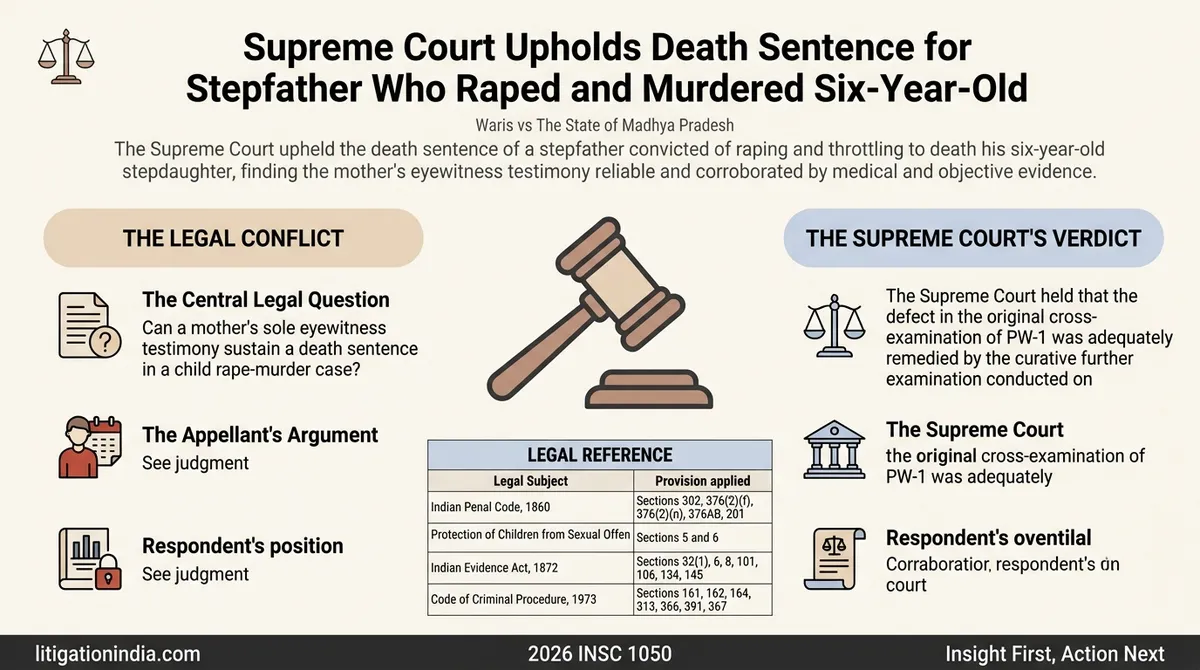
Full text of the judgment
Text extracted from Waris vs The State of Madhya Pradesh. For the authoritative version refer to the Supreme Court of India's official website.
2026 INSC 1050 CRL.A. NOS.429-430 OF 2020
Page 1 of 157
IN THE SUPREME COURT OF INDIA CRIMINAL APPELLATE JURISDICTION CRIMINAL APPEAL NOS. 429-430/2020 WARIS
…APPELLANT(S)
THE STATE OF MADHYA PRADESH …RESPONDENT(S)
J U D G M E N T
VIKRAM NATH, J.
TABLE OF CONTENTS
PART I- INTRODUCTION ................................................ 3 PART II- THE PROSECUTION CASE ................................ 6 PART III - THE TRIAL AND THE FINDINGS OF THE COURTS BELOW ............................................................ 8 PART IV - PROCEEDINGS BEFORE THIS COURT .......... 11 PART V - THE SUBMISSIONS OF THE PARTIES ............ 14 PART VI - THE POINTS FOR DETERMINATION ............. 16 PART VII - ANALYSIS ................................................... 18 SECTION A - THE CURATIVE FURTHER CROSS- EXAMINATION AND THE RIGHT TO A FAIR TRIAL ....... 18 SECTION B - THE PRINCIPLES OF APPRECIATION ....... 20 SECTION C- THE OBJECTIVE SUBSTRATUM: THE MEDICAL EVIDENCE .................................................... 26 SECTION D - THE OCULAR ACCOUNT OF THE MOTHER OF THE VICTIM ........................................................... 32 Digitally signed by SHIPRA NARANG Date: 2026.09.24 15:29:41 IST Reason: Signature Not Verified
CRL.A. NOS.429-430 OF 2020
Page 2 of 157
SECTION E - THE ASSAULT UPON THE CREDIBILITY OF THE MOTHER OF THE VICTIM ..................................... 40 E.1 The alleged material omissions .............................. 40 E.2 The alleged internal contradictions ........................ 50 E.3 The conduct of the mother of the victim: the entrapped witness ........................................................ 56 E.4 The submission founded upon the call detail record64 E.5 The alleged contradiction with PW-4 and the theory of false implication ...................................................... 68 SECTION F — THE VICTIM’S DYING DECLARATION ..... 73 SECTION G - THE CORROBORATIVE EVIDENCE ........... 80 SECTION H- THE SCIENTIFIC EVIDENCE ..................... 86 SECTION I- THE DEFENCE CASE ................................. 92 SECTION J- THE ALLEGED DEFECTS IN THE INVESTIGATION ........................................................... 98 SECTION K - THE OFFENCES ESTABLISHED .............. 103 SECTION L- THE COMPLETE PICTURE ....................... 108 PART VIII- CONCLUSION ON CONVICTION ................. 112 PART IX - THE QUESTION OF SENTENCE .................. 115 SECTION M- THE SENTENCING PROCEEDINGS AND THE MATERIAL NOW BEFORE THE COURT ....................... 115 SECTION N- THE LAW GOVERNING THE SENTENCE OF DEATH ....................................................................... 120 SECTION O - THE AGGRAVATING CIRCUMSTANCES .. 127 SECTION P - THE MITIGATING CIRCUMSTANCES ...... 134 SECTION Q- THE WEIGHING OF THE CIRCUMSTANCES .................................................................................. 140 SECTION R - THE COMPARABLE CASES, THE MIDDLE PATH, AND THE ADEQUATE SENTENCE ..................... 148 PART X – THE CONCLUSION ...................................... 155
CRL.A. NOS.429-430 OF 2020
Page 3 of 157
PART I- INTRODUCTION
1. The present criminal appeals arise out of the final judgment and order dated 18.11.2019 passed by the High Court of Madhya Pradesh, Bench at Indore1 in Criminal Reference No. 1 of 2019 and Criminal Appeal No. 1854 of 2019, whereby the High Court affirmed the conviction of the appellant and confirmed the sentence of death imposed upon him by the judgment dated 17.12.2018 passed by the Second Additional Sessions Judge and Special Judge under the Protection of Children from Sexual Offences Act, 2012, Jaora, District Ratlam2 in Special Case No. 3 of 2018. 2. The appellant stands convicted for the offences punishable under Sections 376(2)(f), 376(2)(n), 376AB, 302 and 201 of the Indian Penal Code, 18603 and Sections 5 and 6 of the Protection of Children from Sexual Offences Act, 20124. For the offences under Section 376AB and Section 302 of the IPC, the Trial Court sentenced the appellant to death, and the High Court confirmed the said sentence while answering the reference in the affirmative and dismissing the appeal preferred by the appellant.
1 hereinafter referred to as the "High Court" 2 hereinafter referred to as the "Trial Court" 3 (hereinafter referred to as the "IPC") 4 (hereinafter referred to as the "POCSO Act")
CRL.A. NOS.429-430 OF 2020
Page 4 of 157
3. The charge against the appellant was that he subjected his own step-daughter, a girl child of about six years of age who is referred to throughout this judgment only as "the victim", to repeated sexual assault within the four walls of the home, and thereafter throttled her to death. The solitary eyewitness to the events was the mother of the victim, who is the wife of the appellant, and who has been examined as the first prosecution witness5. In deference to the mandate of Section 33(7) of the POCSO Act and the settled law forbidding disclosure of the identity of a child victim of sexual assault, neither the victim nor her mother is named in this judgment, and the parties and witnesses connected to the family are referred to only in a manner that preserves that anonymity. 4. Although the appeals were laid before this Court against a concurrent conviction, they came to acquire an unusual dimension in the course of their hearing. It emerged that the cross-examination of PW-1, who is the foundation of the entire prosecution edifice, had been conducted at the trial by a legal aid counsel appointed on the very day on which her testimony was recorded. This Court, by its order dated 08.05.2025, therefore directed a further crossexamination of PW-1, which was carried out on
5 (hereinafter referred to as "PW-1")
CRL.A. NOS.429-430 OF 2020
Page 5 of 157
14.06.2025, and the record of that exercise now forms part of the material before us. The appeals consequently require this Court to determine, at the threshold, whether the infirmity which attended the recording of the evidence of PW-1 has been duly remedied pursuant to the directions issued by this Court. If the Court is satisfied that the appellant has now had an effective opportunity to cross-examine the said witness and that no residual prejudice survives so as to vitiate the trial, the Court would thereafter be required to consider the entire material on record, including the additional evidence now recorded, to assess whether the conviction and sentence recorded against the appellant can be sustained in law. 5. At the heart of these appeals lies a question that is at once evidentiary and profoundly human, namely the measure of credence that the law accords to the testimony of a mother who deposes to the sexual violation and killing of her own child within the home in which she herself was confined, and the manner in which a court must weigh the omissions, the improvements, the delay and the seeming inconsistencies that so often accompany the evidence of such a witness. Having regard to the gravity of the charge and the sentence, we have considered the entire record with the care that a matter of this nature demands.
CRL.A. NOS.429-430 OF 2020
Page 6 of 157
PART II- THE PROSECUTION CASE
6. The case set up by the prosecution may be narrated as follows: 6.1. The mother of the victim was earlier married to one Shakeel, from whom she had four children. After his death, she returned to her parental home at Jaora with the victim, who was then about five years of age. On 04.08.2017, she married the appellant and shifted with the victim to his house at village Kushalgarh. 6.2. The prosecution case is that after an initial period of cordiality, the appellant began illtreating the victim and thereafter subjected her to sexual abuse within the household. The mother alleged that the appellant threatened her when she objected, controlled her movements and prevented disclosure of what was taking place in the home. 6.3. The immediate events are alleged to have commenced on the night of 21.04.2018, when the appellant sexually assaulted the victim after confining the mother in another room. The child thereafter remained restless, vomited and her condition progressively deteriorated. On 22.04.2018 also, according to the prosecution, the appellant assaulted the child and refused to
CRL.A. NOS.429-430 OF 2020
Page 7 of 157
take her for medical treatment despite the requests of the mother. 6.4. On 23.04.2018, the mother telephoned the appellant in the morning as the condition of the child worsened. The call detail record shows two calls made to the appellant at 09:20:30 hours and 09:21:24 hours. The appellant returned at about noon. According to the mother, his first enquiry was whether the child had disclosed anything to her. When the mother again pressed for medical treatment, the appellant refused. Shortly thereafter, she heard the child scream and saw the appellant throttling her with both hands. The child died soon thereafter. 6.5. The appellant thereafter took the child to private medical practitioners, who either did not examine her or declared her dead. The body was taken towards Kushalgarh, where the appellant proposed immediate burial, but upon the insistence of the mother it was taken to Jaora. The body was then brought to the Civil Hospital, Jaora. The post-mortem examination conducted on 24.04.2018 opined that the cause of death was asphyxia due to throttling and also recorded a fresh tear at the fourchette with oozing of blood, indicative of sexual assault. The appellant was arrested on 25.04.2018, and after
CRL.A. NOS.429-430 OF 2020
Page 8 of 157
investigation a charge-sheet was filed for offences under the IPC and the POCSO Act. PART III - THE TRIAL AND THE FINDINGS OF THE COURTS BELOW
7. On the basis of the material collected during the investigation, the Trial Court framed charges against the appellant on 02.07.2018 for the offences punishable under Sections 376(2)(f), 376(2)(i), 376(2)(n), 376AB, 302 and 201 of the IPC and Sections 5 and 6 of the POCSO Act. The appellant denied his guilt, pleaded not guilty and claimed trial. 8. In support of its case the prosecution examined twenty-four witnesses and exhibited a large number of documents. The material witnesses may be identified at the outset for convenience. PW-1 is the mother of the victim and the solitary eyewitness to the events within the household. PW-2 and PW-5 are residents of the locality who spoke with respect to the antecedent conduct of the appellant and the condition of the victim shortly before her death. PW- 3 is the medical practitioner at Hasanpaliya who examined the child and declared her dead. PW-4 is the sister-in-law of the mother of the victim. PW-6 is the autopsy surgeon who conducted the post-mortem examination. PW-7 is the village health worker who was summoned to see the child, and PW-8 is the doctor who conducted the pre-medico-legal
CRL.A. NOS.429-430 OF 2020
Page 9 of 157
examination at the Civil Hospital, Jaora. PW-24 is the Investigating Officer. 9. The appellant was thereafter examined under Section 313 of the Code of Criminal Procedure, 19736, and the incriminating circumstances appearing in the evidence were put to him. The appellant denied the entirety of the prosecution case and set up a plea of false implication. His defence, in substance, was that he had been falsely roped in at the instance of PW-4, that the mother of the victim had deposed against him under pressure and instigation, that he had been threatened by the police with implication in a case relating to opium husk and had been made to sign blank papers, and that he was in fact absent from the village on the relevant dates, having gone to Khodana near village Kalukheda. In support of the plea, the appellant examined three witnesses in defence, being DW-1, who is the appellant himself, DW-2 and DW-3, the last of whom is the son of the appellant. 10. The Trial Court, upon an appreciation of the evidence, held the mother of the victim to be a natural and truthful witness whose account of the sexual assault and the throttling of the child bore the stamp of truth. The Trial Court found her testimony to be corroborated by the medical evidence of the autopsy surgeon, which established that the death was
6 hereinafter referred to as the “CrPC”
CRL.A. NOS.429-430 OF 2020
Page 10 of 157
homicidal and was occasioned by throttling, and which disclosed an injury indicative of sexual assault, as well as by the forensic evidence, the recoveries and the conduct of the appellant. The Trial Court rejected the plea of alibi and the plea of false implication, convicted the appellant for the offences under Sections 376(2)(f), 376(2)(n), 376AB, 302 and 201 of the IPC and Sections 5 and 6 of the POCSO Act, and by a separate order of the same date, namely 17.12.2018, sentenced him to death for the offences under Section 376AB and Section 302 of the IPC, together with the fines and the substantive sentences set out in the judgment of the Trial Court. The appellant was acquitted of the charge under Section 376(2)(i) of the IPC. 11. In view of the sentence of death, the Trial Court transmitted a reference to the High Court under Section 366 of the CrPC for confirmation, which was registered as Criminal Reference No. 1 of 2019, and the appellant preferred Criminal Appeal No. 1854 of 2019 assailing his conviction and sentence. The reference and the appeal were heard together. 12. Before the High Court, a specific plea was pressed on behalf of the appellant that he had been denied a proper opportunity of defence, inasmuch as the legal aid counsel appointed to represent him at the trial was inexperienced and had cross-examined the mother of the victim without adequate preparation.
CRL.A. NOS.429-430 OF 2020
Page 11 of 157
The High Court did not find merit in the said objection. Upon a reappreciation of the evidence, the High Court affirmed the finding that the mother of the victim was a reliable witness, held that the prosecution had established the guilt of the appellant beyond reasonable doubt, and concluded that the case fell within the category of the rarest of rare cases warranting the extreme penalty. By its judgment dated 18.11.2019 the High Court accordingly answered the reference in the affirmative, confirmed the sentence of death, and dismissed the appeal preferred by the appellant.
PART IV - PROCEEDINGS BEFORE THIS COURT
13. When the present criminal appeals were being heard, the grievance concerning the denial of effective legal assistance at the trial came to be crystallised before this Court, and on a scrutiny of the record it assumed a significance that could not be ignored. It is necessary to set out the sequence of events at the trial that gave rise to this grievance. 14. The record of the Trial Court discloses that the counsel initially engaged by the appellant appeared on 21.06.2018 and declined to plead on his behalf. On 02.07.2018 one Advocate Mr. Mohd. Ahmad Khan entered appearance for the appellant and filed his vakalatnama, and on the same day charges were
CRL.A. NOS.429-430 OF 2020
Page 12 of 157
framed. On 06.07.2018 the matter was fixed for the recording of prosecution evidence, and two dates were appointed, the first of which, being 16.07.2018, was fixed for the examination of the mother of the victim as the star prosecution witness. On 16.07.2018, the appellant was produced from custody but the counsel engaged by him was not present. The appellant submitted that he was unable to bear the fees of his counsel and prayed that he be provided the services of a legal aid counsel. The Trial Court acceded to the request and appointed a legal aid counsel to represent the appellant. On that very day, the Trial Court proceeded to record the entire examination-in-chief of the mother of the victim and ensured that her crossexamination was also completed by the newly appointed legal aid counsel. 15. It was this feature of the trial that engaged the attention of this Court. By order dated 08.05.2025, this Court found that the appointment of a legal aid counsel and the recording of the complete deposition of the star prosecution witness on the self-same day, without the counsel being afforded any opportunity to prepare, had occasioned grave prejudice to the appellant in the matter of her cross-examination, while recording that in all other respects the trial had been conducted with remarkable precision. Invoking its powers under Section 391 read with Section 367 of the CrPC, corresponding to Section 432 read with
CRL.A. NOS.429-430 OF 2020
Page 13 of 157
Section 408 of the Bharatiya Nagarik Suraksha Sanhita, 20237, this Court directed a further examination of the mother of the victim. The operative directions were, in substance, that the matter be remitted to the Trial Court for her further examination as PW-1, that appropriate protection be extended to her under the witness protection scheme and that she be counselled by a Senior or Special Public Prosecutor before entering the witness box in view of the lapse of time and the apprehension of her being won over, that the appellant be at liberty to engage counsel of his own choice or to have the crossexamination conducted through counsel assisting him under Project 39A with the complete record being furnished to such counsel at least fifteen days in advance, and that the prosecution be at liberty to put additional questions by way of re-examination if so required. 16. In compliance with the said order, the further crossexamination of the mother of the victim was conducted on 14.06.2025 before the Special Judge under the POCSO Act, Jaora, District Ratlam, after she was once again put on oath. The further crossexamination was carried out on behalf of the appellant by Advocate Mr. Amit Dubey, and it was conducted over the course of a full working day in two
7 hereinafter referred to as the "BNSS"
CRL.A. NOS.429-430 OF 2020
Page 14 of 157
sessions, the first from about 11.40 AM to 02.00 PM and the second from about 03.20 PM to 4.35 PM. On the conclusion of the further cross-examination, the opportunity of re-examination was made available to the prosecution and was not availed. The record of the further examination, together with the original record, was thereafter transmitted to this Court. 17. It is with the benefit of this augmented record, comprising the original deposition of the mother of the victim recorded on 16.07.2018 and her further cross-examination recorded on 14.06.2025, that these appeals have been heard. By this judgment we take up, in the first instance, the question of conviction, and the effect of the curative exercise so undertaken upon the appreciation of the evidence is a matter to which we shall presently return. PART V - THE SUBMISSIONS OF THE PARTIES
18. Mr. C.U. Singh, learned Senior Counsel appearing for the appellant, assailed the concurrent findings of the courts below resting on the following primary arguments: 18.1. The Senior Counsel for the appellant assailed the conviction principally on the ground that the prosecution case rests upon the testimony of PW-1, the mother of the victim, whose evidence, according to him, is unreliable. It was
CRL.A. NOS.429-430 OF 2020
Page 15 of 157
submitted that PW-1 introduced material facts for the first time in court, although they did not appear in her statements under Sections 161 and 164 of the CrPC, and that these omissions went to the root of the prosecution case. Her testimony was also attacked on the grounds of internal contradictions, unnatural conduct, delay in disclosure, access to a mobile phone and alleged contradiction with PW-4. 18.2. On sentence, it was submitted that the case did not fall within the rarest of rare category. The appellant relied upon the mitigation material now placed before this Court, including his childhood deprivation, absence of criminal antecedents, satisfactory jail conduct, family ties and the absence of any material from the State establishing that he was beyond reform. It was urged that in any event the intermediate sentence of imprisonment for the remainder of natural life would adequately meet the ends of justice. 19. Per contra, learned counsel appearing for the State supported the judgments of the courts below. It was submitted that the core testimony of PW-1 remained unshaken despite two cross-examinations and stood corroborated by the medical evidence, the victim’s disclosure, the call detail record, the extra-judicial confession and the conduct of the appellant. The
CRL.A. NOS.429-430 OF 2020
Page 16 of 157
State submitted that the omissions relied upon by the appellant were either peripheral or adequately explained, that the defence case was false, and that the defects alleged in the investigation did not vitiate an otherwise proved case. On sentence, the State relied upon the extreme vulnerability of the victim, the appellant’s position of trust, the sustained sexual abuse, the denial of medical aid and the killing of the child to suppress disclosure of the offence.
PART VI - THE POINTS FOR DETERMINATION
20. Having heard learned counsel for the parties at length and having perused the entire record, we are of the view that the following points arise for the determination of this Court on the question of conviction. i) Whether the infirmity attending the recording of the evidence of the mother of the victim as PW- 1 on 16.07.2018 stands cured by the further cross-examination conducted pursuant to the order of this Court dated 08.05.2025, and what is the effect of the said exercise upon the appreciation of her evidence? ii) Whether the testimony of the mother of the victim is reliable and is sufficient, read with the corroborative material on record, to sustain the conviction of the appellant, notwithstanding the
CRL.A. NOS.429-430 OF 2020
Page 17 of 157
omissions, the improvements, the contradictions and the conduct attributed to her? iii) Whether the death of the victim is established to be homicidal and is attributable to the appellant? iv) Whether the offence of aggravated penetrative sexual assault upon the victim, a child below twelve years of age, is established against the appellant? v) Whether the plea of alibi set up by the appellant and the version of events put forth in his defence are established or are shown to be reasonably probable? vi) Whether the defects and the alleged mala fides in the investigation are of such a character as to vitiate the prosecution case? vii) Whether, on a consideration of the entire evidence, the offences under Sections 302, 376(2)(f), 376(2)(n), 376AB and 201 of the IPC and Sections 5 and 6 of the POCSO Act are established against the appellant?
21. We propose to address these points in the course of the analysis that follows.
CRL.A. NOS.429-430 OF 2020
Page 18 of 157
PART VII - ANALYSIS
22. Before we embark upon the analysis, it is convenient to indicate the sequence in which we propose to proceed, for the questions are interconnected and the order of their consideration is deliberate. Having answered at the threshold the question concerning the curative exercise, we shall set out the principles governing the appreciation of the evidence, and shall then take up the objective medical evidence, which establishes the substratum of the offence independently of any oral account. It is against that substratum that we shall examine the ocular testimony of the mother of the victim and the attacks mounted upon her credibility, and we shall thereafter consider the disclosure made by the victim, the corroborative evidence, and the scientific evidence, before turning to the defence of the appellant and the alleged infirmities in the investigation, and finally recording our conclusions upon the offences and the complete picture that emerges. SECTION A - THE CURATIVE FURTHER CROSS- EXAMINATION AND THE RIGHT TO A FAIR TRIAL
23. The first question is whether the infirmity attending the original cross-examination of PW-1 has been remedied by the further cross-examination conducted pursuant to the order of this Court dated 08.05.2025.
CRL.A. NOS.429-430 OF 2020
Page 19 of 157
The concern arose because PW-1, the principal prosecution witness, had been examined and crossexamined on 16.07.2018 by a legal aid counsel appointed on the very same day, without any real opportunity to prepare. In a capital case, such a course plainly fell short of the standard of effective legal assistance and meaningful cross-examination guaranteed by Article 21. 24. The defect, however, was confined to the crossexamination of one witness, though an important one. It did not infect the entire trial. Sections 391 and 367 of the CrPC empower the appellate court, and the court dealing with a death reference, to take or direct the taking of further evidence where it is necessary for a just decision. The course adopted by this Court, namely directing the further cross-examination of PW-1 with adequate protection to the witness and full access to the record to the defence, was therefore a proportionate cure rather than a retrial. 25. The further cross-examination was conducted on 14.06.2025 before the Special Judge under the POCSO Act. The appellant was represented by counsel of his choice, the complete record had been made available in advance, and the witness was cross-examined at length on every material aspect, including the omissions and contradictions now pressed before us. The prosecution was given an opportunity of re-examination but did not avail it. No
CRL.A. NOS.429-430 OF 2020
Page 20 of 157
specific line of cross-examination that remained unavailable, nor any concrete residual prejudice, has been demonstrated. 26. We therefore hold that the defect in the original crossexamination has been adequately remedied. The evidence of PW-1 must now be appreciated by reading together her deposition dated 16.07.2018 and her further cross-examination dated 14.06.2025, with due allowance for the passage of time between the occurrence and the further examination. SECTION B - THE PRINCIPLES OF APPRECIATION
27. Since the prosecution rests its case in large measure upon the testimony of the mother of the victim, and since her evidence has been assailed on the grounds of omissions, improvements, contradictions and conduct, it is necessary to set out the principles by which the evidence of such a witness is to be appreciated, before we apply those principles to the evidence on record. 28. The first principle concerns the sufficiency of a solitary witness. It is not the law that the testimony of a single witness, howsoever reliable, must be discarded for want of a plurality of witnesses. Section 134 of the Indian Evidence Act, 18728 provides in unequivocal terms that no particular number of
8 hereinafter referred to as the “Evidence Act”
CRL.A. NOS.429-430 OF 2020
Page 21 of 157
witnesses shall in any case be required for the proof of any fact. The provision reads as follows:
"134. Number of witnesses.— No particular number of witnesses shall in any case be required for the proof of any fact."
The principle enshrined in the said provision is that evidence is to be weighed and not counted, and that the conviction of an accused may rest upon the testimony of a single witness if that testimony is found to be reliable and inspires confidence. This Court, as early as in Vadivelu Thevar v. State of Madras9, held that a court may act upon the testimony of a single witness though uncorroborated, and that if the testimony of a solitary witness is wholly reliable, a conviction may be founded upon it. We are conscious, at the same time, that where the solitary witness is closely related to the deceased and to the accused, and where her evidence has been the subject of a searching attack, the prudent course is to seek corroboration in the material particulars of her account. We do not, therefore, approach the evidence of the mother of the victim on the footing that she is a witness of such flawless quality that her word must be accepted without more. We approach her evidence on the footing that if the
9 (1957) 1 SCC 700
CRL.A. NOS.429-430 OF 2020
Page 22 of 157
core of her account is found to be reliable and is corroborated in its material particulars by the other evidence on record, it may safely be acted upon, and it is by that standard, and no lower one, that we have tested her testimony.
29. The second principle concerns the character of a related witness. It was faintly suggested by the appellant that the mother of the victim, being the wife of the appellant, was an interested witness whose evidence must be viewed with suspicion. The suggestion proceeds upon a confusion between a related witness and an interested witness, which this Court has repeatedly cautioned against. A related witness is one who is connected by blood or by marriage to the victim or to the accused, whereas an interested witness is one who has a motive to see the accused convicted for reasons other than the vindication of the truth, such as a pre-existing enmity or an expectation of gain. The two are not the same, and the evidence of a related witness cannot be discarded merely on the ground of relationship. This Court held in Dalip Singh v. State of Punjab10, that a witness is normally to be considered independent unless he springs from sources which are likely to be tainted, and that a relation would not conceal the actual culprit and make allegations against an
10 (1953) 2 SCC 36
CRL.A. NOS.429-430 OF 2020
Page 23 of 157
innocent person in order to wreak vengeance, but would ordinarily be the last to screen the real offender. The distinction was reaffirmed by this Court in State of Rajasthan v. Kalki11, and in Goverdhan v. State of Chhattisgarh12, wherein it was explained that the related witness is not necessarily an interested witness, and that the evidence of a related witness, if found to be reliable, requires no corroboration and may be acted upon. 30. These principles acquire a particular force in the present case. The witness who has deposed against the appellant is not a stranger who might harbour some ulterior design against him. She is his wife, and she is the mother of the child who was the victim of the crime. A woman in her position, in deposing to the rape and the murder of her own child, does not merely give evidence against a stranger. She testifies against her own husband, and in doing so she renounces her marriage, forfeits the shelter and the maintenance that the marriage afforded her, exposes herself to the hostility of the family into which she married, and courts the social opprobrium that in the milieu to which she belongs attaches to a woman who breaks her home. That she was willing to endure all of this in order to accuse the appellant powerfully attests to her credibility. A mother is, in the
11 (1981) 2 SCC 752 12 (2025) 3 SCC 378
CRL.A. NOS.429-430 OF 2020
Page 24 of 157
considered view of this Court, ordinarily the last person who would shield the murderer of her own child and substitute an innocent man in his place. 31. The third principle concerns the appreciation of evidence in cases of sexual offences and of crimes committed within the privacy of the home. Offences of this nature are seldom committed in the presence of witnesses. The sexual abuse of a child within the household, in particular, is perpetrated in secrecy and in stealth, and the persons ordinarily present are the perpetrator, the child and, if at all, a member of the household who is powerless to prevent it. To insist, in such cases, upon the kind of corroboration that might be available in a crime committed in the open would be to insist upon a standard that the very nature of the offence renders impossible of attainment, and would be to grant to those who prey upon children within the home an immunity founded upon the secrecy in which they cloak their crime. This Court, in State of Punjab v. Gurmit Singh13, deprecated the tendency to view the evidence of the prosecutrix in a sexual offence with suspicion, and held that such evidence is to be appreciated with sensitivity and realism, and that minor contradictions or insignificant discrepancies which do not touch the core of the prosecution case ought not to be a ground
13 (1996) 2 SCC 384,
CRL.A. NOS.429-430 OF 2020
Page 25 of 157
for throwing out an otherwise reliable case. The same sensitivity governs the appreciation of the evidence of the mother of a child victim, who is often the only person in a position to speak to what was done to the child behind the closed doors of the home. 32. The fourth principle concerns the treatment of a witness whose evidence is found to be partly acceptable and partly not. The appellant's submission, reduced to its essence, is that because the mother of the victim omitted certain facts from her earliest statements and introduced others for the first time in court, her testimony must be rejected in its entirety. That submission invokes, in substance, the maxim falsus in uno, falsus in omnibus, that is, false in one thing, false in everything. It is well settled that the said maxim is not a rule of law in India, and is at best a rule of caution. The duty of the court is not to reject the whole of a witness's evidence upon finding a part of it to be unacceptable, but to sift the truth from the falsehood, to separate the grain from the chaff, and to act upon that part of the evidence which it finds to be reliable after a careful scrutiny, provided that the acceptable part can be safely separated from the rest and is corroborated by the other evidence on record. This Court, in State of U.P. v. M.K. Anthony14, held that the evidence of a
14 (1985) 1 SCC 505
CRL.A. NOS.429-430 OF 2020
Page 26 of 157
witness must be read as a whole and in the context of the case, that minor discrepancies on trivial matters not touching the core do not corrode the credibility of an otherwise reliable witness, and that a rustic or an illiterate witness cannot be judged by the standards of precision expected of an educated one. These principles have been consistently reiterated, including in the recent decisions of this Court in Selvamani v. State of T.N.15, and in Goverdhan v. State of Chhattisgarh16, wherein it has been reaffirmed that even where omissions, contradictions and discrepancies exist, the whole of the evidence is not to be discarded, and the court must sift the reliable from the embellished and determine whether the residue establishes the guilt of the accused. SECTION C- THE OBJECTIVE SUBSTRATUM: THE MEDICAL EVIDENCE 33. Having set out the principles that govern the appreciation of the evidence, we now turn to the evidence itself, and we begin not with the oral account of the mother of the victim but with the medical evidence, for a deliberate reason. The oral testimony of a solitary witness is best assessed not in a vacuum but against whatever objective and incontrovertible facts the record independently establishes. The medical evidence in this case furnishes precisely such
15 (2024) 19 SCC 112 16 (2025) 3 SCC 378
CRL.A. NOS.429-430 OF 2020
Page 27 of 157
an objective substratum. It is the evidence of a professional witness who had no interest in the outcome, it rests upon physical findings recorded upon the body of the victim, and it stands wholly independent of the account of the mother. If the medical evidence establishes the corpus of the offence, then the oral testimony falls to be tested against an established foundation of fact rather than upon its own strength alone. It is for this reason that we take up the medical evidence first. 34. The post-mortem examination upon the body of the victim was conducted on 24.04.2018 at about 11 a.m. by PW-6, and the post-mortem report was proved as an exhibit on the record. The autopsy surgeon deposed, and the report records, that the cause of death of the victim was asphyxia as a result of throttling, that the death was homicidal in nature, and that the time of death was within about fortyeight hours preceding the examination. The opinion as to the cause of death was founded upon objective signs, including the injuries observable upon the neck of the victim, consistent with the compression of the throat by hand. There is no material on the record to doubt the competence of the autopsy surgeon or the correctness of the opinion, and the finding as to the cause of death was not seriously assailed before us.
CRL.A. NOS.429-430 OF 2020
Page 28 of 157
35. Two conclusions of the utmost importance follow from this evidence, and they follow independently of the oral testimony of any witness. The first is that the death of the victim was homicidal, and was occasioned by manual strangulation. This is not a case in which the fact of a homicide is itself in doubt, or in which the death is capable of being attributed to natural causes, to accident or to disease. The medical evidence puts it beyond doubt that the child was throttled to death. The second conclusion concerns the time of death. The post-mortem examination having been conducted at about 11:00 AM on 24.04.2018, and the death being opined to have occurred within about forty-eight hours prior thereto, the death is thereby fixed to a period that comfortably includes the afternoon of 23.04.2018, which is the very time at which, on the prosecution case, the appellant is said to have throttled the victim. The medical evidence thus independently corroborates the prosecution case both as to the manner and as to the approximate time of the death. 36. The post-mortem report is significant in a further and distinct respect. It records the presence of a small tear at the fourchette with oozing of blood, and the autopsy surgeon opined that this injury was indicative of sexual assault. The fourchette is the posterior commissure of the labia, and a fresh tear at that site accompanied by bleeding is a finding
CRL.A. NOS.429-430 OF 2020
Page 29 of 157
consistent with recent penetrative sexual assault upon the child. This finding, it must be emphasised, is an objective physical finding recorded upon the body of the victim at the post-mortem examination, and it is wholly independent of the account of the mother of the victim. The injury constitutes objective medical evidence strongly consistent with recent penetrative sexual assault and materially corroborates the account concerning the sexual violation of the victim. We shall have occasion, when we come to consider the scientific evidence and the defence, to address the submission founded upon the absence of male DNA in the vaginal smear, and it is sufficient at this stage to record that the physical injury to the genitalia of the child stands proved as a fact by the medical evidence. 37. The evidence of PW-8, the doctor who conducted the pre-medico-legal examination at the Civil Hospital, Jaora, on the evening of 23.04.2018, is consistent with and reinforces the conclusion that the death was unnatural, and it was upon the report of PW-8 that the machinery of the criminal law was set in motion by the registration of the report of unnatural death. We shall return to the sequence of the reporting when we deal with the submissions concerning the investigation, and it is sufficient at this stage to note that the medical evidence, taken as a whole, establishes an unnatural and homicidal death by
CRL.A. NOS.429-430 OF 2020
Page 30 of 157
throttling and a recent sexual assault upon the victim. 38. It is at this point that the setting of the crime assumes a decisive significance, and it is convenient to introduce it here, for it forms the backdrop against which the entirety of the evidence must be read. The offences were committed within the four walls of the matrimonial home at village Kushalgarh. As per the case of both the prosecution and the defence, the only adults who ordinarily resided in that home were the appellant and the mother of the victim. The victim was a child of about six years. It is a settled principle of the law of evidence that where an offence takes place inside the privacy of a house, in which the inmates of the house are in a position to know how the crime was committed, and where the death of a person is shown to have occurred in circumstances within the special knowledge of the accused, a corresponding burden is cast upon the inmate of the house to offer a cogent explanation as to how the crime was committed, and a false or an absent explanation becomes an additional link in the chain of circumstances. This principle finds statutory recognition in Section 106 of the Evidence Act, which provides as follows:
"106. Burden of proving fact especially within knowledge.—When any fact is especially within the knowledge of any
CRL.A. NOS.429-430 OF 2020
Page 31 of 157
person, the burden of proving that fact is upon him."
39. This Court, in Trimukh Maroti Kirkan v. State of Maharashtra17, explained the application of the said principle to offences committed within the secrecy of the home. It was held that where an accused is alleged to have committed the murder of a person and the offence is alleged to have taken place inside the four walls of a house in circumstances where the accused had a special knowledge of the events, the accused is under an obligation to give a plausible explanation for the cause of the death in his statement under Section 313 of the CrPC, and the absence of such an explanation, or the giving of a false explanation, would itself be an additional link in the chain of circumstances that completes the chain. We shall carry this principle with us through the analysis that follows, for the appellant was, on his own showing as well as on the prosecution case, an inmate of the home in which the victim met her death, and the burden of accounting for how a child living in that home came to be sexually assaulted and throttled to death is one that rests, in the manner and to the extent explained in Trimukh Maroti (Supra) , upon him.
17 (2006) 10 SCC 681
CRL.A. NOS.429-430 OF 2020
Page 32 of 157
40. The medical evidence thus establishes, independently of any oral account, a homicidal death by throttling on or about 23.04.2018 and a recent sexual assault, within a home whose only adult occupants were the appellant and the mother. It is against this substratum that we now examine the ocular testimony of the mother of the victim. SECTION D - THE OCULAR ACCOUNT OF THE MOTHER OF THE VICTIM
41. Against the substratum established by the medical evidence, we now examine the ocular account of the mother of the victim, who was examined as PW-1 and who is the solitary eyewitness to the events that unfolded within the home. Her evidence comprises her deposition recorded on 16.07.2018 and her further cross-examination recorded on 14.06.2025, and, in conformity with the standard we have already laid down, we read the two together as constituting the whole of her testimony. We propose in this section to set out the substance of her account in her own words on the matters that lie at the heart of the case, and to record our impression of it, reserving for the section that follows our consideration of the several attacks that have been mounted upon her credibility. 42. On the antecedent sexual abuse of the victim, the mother deposed in her examination-in-chief to what she had seen with her own eyes. She described the
CRL.A. NOS.429-430 OF 2020
Page 33 of 157
sleeping arrangement in which the appellant would place himself between her and the child, and she stated that one night, on lifting the blanket, she saw the appellant with his hand inside the undergarment of the victim. In her own words, recorded on 16.07.2018, she deposed as follows. "One day I saw in the night, that day, the accused varish turned on my girl's side and put her to sleep sticking to her and then I lifted the blanket and saw the accused moving hands in the underwear of my daughter touching private parts."
She went on to depose that when she objected, the appellant threatened her, and she described the threat in these terms.
"I objected but he threatend me to bury we both. He threatened to put imputation on us for fled away with some one else ."
43. On the events of the night of 21.04.2018, which constitute the immediate occasion of the sexual assault, the mother gave a detailed and graphic account. She described how the appellant confined her to the rear room, how she heard the muffled sobs of her child, how she beat upon the door and adjured him in the name of Allah, and how, upon the door being opened, she found the child in a distressing condition. She then deposed to what the child herself told her, and we shall have occasion in a later section to consider the legal character and effect of that
CRL.A. NOS.429-430 OF 2020
Page 34 of 157
disclosure. For the present, it is sufficient to set out her description of the condition in which she found the child, recorded in her deposition of 16.07.2018.
"Then I saw that my girl was suffering and my girl was not wearing both leggings and underwear and also kept her black color kurti high."
She deposed that on examining the child she found the private part of the victim to be swollen and red, that the child complained of pain, and that the child was restless and vomited through the night.
44. On the events of 23.04.2018, which constitute the occasion of the murder, the account of the mother lies at the very core of the prosecution case, and it is necessary to set it out with some fullness. She deposed that upon the return of the appellant to the house at about noon, his very first concern was not for the deteriorating condition of the child but was to ascertain whether the child had spoken to her mother. In her words, recorded on 16.07.2018:
"Then the accused came home at 12:00 pm and told me that whether [victim’s name] told you something or else, i replied the accused that she did not tell me anything."
She then deposed that when she pressed that the child be taken to hospital, the appellant refused, that she thereafter went to another room to cook, and that
CRL.A. NOS.429-430 OF 2020
Page 35 of 157
on hearing the child scream she returned to the child. She described what she then saw in these words, recorded on 16.07.2018:
"Before my cooking, the accused told me that my girl was pretending, then I had gone to the kitchen. After going to another room, I heard my girl screaming, then I came to my girl and saw that the accused had strangled my girl's throat with both hands and removed her18 hands immediately after seeing me. When I saw my baby girl, she had turned her eyes. I had also seen his fingerprints on [victim’s name]’s throat, at that time the accused was trembling with fear and was sweating and was saying that I did not kill." (emphasis supplied)
45. The mother did not depose merely that the appellant had killed the child, which would have been the natural assertion of a witness bent upon a bald implication. She described a specific and particular scene, namely the appellant caught in the very act with both hands upon the throat of the child, the instinctive withdrawal of the hands the moment he was seen, the turned eyes of the dying child, the impressions of the fingers left upon the small throat, and the appellant sweating and trembling and unprompted in his denial. The impressions of the fingers upon the throat, spoken to by the mother, are in complete accord with the opinion of the autopsy
18 *His (Typographical error in translation).
CRL.A. NOS.429-430 OF 2020
Page 36 of 157
surgeon that the death was caused by throttling, that is, by manual strangulation. The account of the mother and the finding of the medical evidence thus dovetail with one another, and the one authenticates the other. A witness who was inventing a false scene would have been under no compulsion to furnish detail of this order, and the correspondence between the finger impressions she described and the cause of death established by the autopsy is a powerful indication of the truth of her account. Equally telling is the first reaction of the appellant upon his return, which was to enquire not after the health of the gravely ailing child but whether the child had disclosed anything to her mother, a reaction to which we shall return when we consider the conduct of the appellant.
46. The account of the mother did not stand alone in her examination-in-chief. It withstood the test of crossexamination on both occasions on which she was cross-examined, separated as those occasions were by nearly seven years. In her original crossexamination on 16.07.2018 she adhered to her account and repelled the suggestions put to her, affirming in terms that she had witnessed the events with her own eyes, in the following words recorded on that date:
CRL.A. NOS.429-430 OF 2020
Page 37 of 157
"The accused strangled my girl. It is wrong to say that the accused never strangled my girl. It is wrong to say that the accused did not do any wrong act with [victim’s name]. I have seen it with my own eyes. It is wrong to say that I am making false statements in the court today." (emphasis supplied)
In her further cross-examination on 14.06.2025, conducted at length by counsel of the appellant's choice, she once again withstood a sustained challenge to the core of her account, and, when the suggestions of false implication were put to her, she rejected them in categorical terms, in the following words recorded on that date:
"It is wrong to say that the accused Waris did not rape my daughter repeatedly. It is wrong to say that the accused Waris never raped my daughter. It is wrong to say that I have lodged a false case of rape and murder against the accused Waris and recorded statements under pressure from the police. It is wrong to say that I used to beat my daughter, due to which she died. ... It is wrong to say that I am recording false statements in the court today to falsely implicate the accused." (emphasis supplied)
47. We are conscious that the mere consistency of a witness is not, by itself, a guarantee of truth, and that a false account may be adhered to as tenaciously as a true one. We do not therefore rest upon consistency
CRL.A. NOS.429-430 OF 2020
Page 38 of 157
alone. What persuades us of the essential reliability of the core of her account is the conjunction of several features, namely the particularity of her description of the scene of the throttling, the correspondence of that description with the independent medical evidence, the inherent improbability of a mother fabricating such a charge against her own husband concerning her own child, and the further circumstance, to which we now turn, that her account is corroborated upon a verifiable particular by the objective record. 48. That verifiable particular is the telephone record. The mother deposed that on the morning of 23.04.2018, finding the condition of the child worsening, she telephoned the appellant twice on his mobile, and she placed the timing of those calls at between 09:00 AM and 09.30 AM. In her further cross-examination on 14.06.2025 she deposed as follows:
"It is correct to say that on 23.04.2018, I called the accused Waris on his mobile when my daughter was unwell. It is correct to say that I called Waris twice on that morning. I called him between 9:00 am and 9.30 am."
The call detail record on the file, which was placed on the record by the prosecution, bears out this account, for it records two calls made from the mobile telephone used by the mother to the mobile
CRL.A. NOS.429-430 OF 2020
Page 39 of 157
telephone of the appellant on 23.04.2018 at 09:20:30 hours and at 09:21:24 hours, that is, two calls in close succession within the very window of time that the mother described. This is corroboration of her account upon a particular that is objectively verifiable and that lay beyond her power to fabricate, for she could not have known, and could not have contrived, that the telephone records of the network would confirm two calls at those precise moments. Where the testimony of a witness is found to be accurate upon a matter that admits of independent and objective verification, the court is justified in extending to that witness a measure of credence upon the matters that do not so admit of verification, unless there be good reason to withhold it. We find in the telephone record a significant assurance of the reliability of the mother of the victim.
49. For these reasons, we are satisfied that the core of the account of the mother of the victim, namely that the appellant subjected the victim to sexual assault and thereafter throttled her to death within the matrimonial home, is reliable and is corroborated by the objective medical evidence and by the telephone record. Her testimony has, however, been assailed on several grounds, to which we now turn.
CRL.A. NOS.429-430 OF 2020
Page 40 of 157
SECTION E - THE ASSAULT UPON THE CREDIBILITY OF THE MOTHER OF THE VICTIM
50. The reliability of the account of the mother of the victim, which we have found to be established at its core, has been assailed by the appellant from several directions, and it is necessary to address each line of attack, for a finding of reliability cannot rest secure until the challenges to it have been met. The attacks are five in number. The first is that her deposition before the court contains a series of material omissions when compared with her earliest statements to the police and to the Magistrate. The second is that her further cross-examination is riddled with internal contradictions. The third is that her conduct was so unnatural as to belie her account. The fourth is that the call detail record demolishes her case of isolation and fear. The fifth is that her evidence stands contradicted by that of PW-4 and that she was made to depose falsely at the instance of PW-4. We take up these attacks in turn. E.1 The alleged material omissions
51. The principal and most strenuously pressed attack is founded upon the omissions in the earliest statements of the mother of the victim. It is pointed out that a number of facts to which she deposed before the court found no mention in her statement
CRL.A. NOS.429-430 OF 2020
Page 41 of 157
recorded under Section 161 of the CrPC on 24.04.2018 or in her statement recorded under Section 164 of the CrPC on 26.04.2018, and that she candidly admitted these omissions in her further cross-examination on 14.06.2025. It is urged that omissions of this magnitude reduce her court testimony to an afterthought. To assess this submission it is necessary first to state the legal framework, and then to apply it to the facts. 52. A statement recorded under Section 161 of the CrPC in the course of investigation is not substantive evidence. It is a previous statement, and the use that may be made of it is strictly circumscribed by Section 162 of the CrPC, which provides that no such statement shall be used for any purpose at the trial, save that it may be used to contradict its maker in the manner provided by Section 145 of the Evidence Act. The Explanation to Section 162 of the CrPC further provides that an omission to state a fact in such a statement may amount to a contradiction only if it appears to be significant and otherwise relevant having regard to the context, and that whether it does so is a question of fact. The substantive evidence in a criminal trial is therefore the testimony given on oath before the court, and it is that testimony, and not the earlier statement to the police, which furnishes the material for decision. The earliest statements of the mother are thus not the benchmark of truth against
CRL.A. NOS.429-430 OF 2020
Page 42 of 157
which her court testimony is to be measured, and their only legitimate use is to contradict her in the manner the law permits. A statement recorded under Section 164 of the CrPC, though recorded by a Magistrate, is likewise not substantive evidence, and it too may be used only to corroborate or to contradict its maker. 53. The manner of such contradiction is prescribed by Section 145 of the Evidence Act, which provides as follows:
"145. Cross-examination as to previous statements in writing.—A witness may be cross-examined as to previous statements made by him in writing or reduced into writing, and relevant to matters in question, without such writing being shown to him, or being proved; but, if it is intended to contradict him by the writing, his attention must, before the writing can be proved, be called to those parts of it which are to be used for the purpose of contradicting him."
The language of the provision is explicit. If it is intended to contradict a witness by a previous statement in writing, her attention must, before the writing can be so used, be called to those specific parts of it which are to be used for that purpose. A general assertion that a fact was not stated earlier does not satisfy the provision.
CRL.A. NOS.429-430 OF 2020
Page 43 of 157
54. Nor does an omission amount to a contradiction as a matter of course. The question was authoritatively settled by the Constitution Bench of this Court in Tahsildar Singh v. State of U.P.19, wherein it was explained that an omission attains the character of a contradiction only where the omitted fact is irreconcilable with the statement made in the witness box, that is to say, where what was stated in court and what was omitted before the police cannot both be true, or where the omission is of a fact which, had it been true and within the knowledge of the witness, she would in the ordinary course have been expected to state. A mere failure to mention a detail which the narration did not call for, and which is not irreconcilable with the court version, is an omission simpliciter and not a contradiction. This position has been reiterated by this Court in Vijayakumar v. State of Tamil Nadu20, which reaffirms that the writing must be specifically put to the witness if it is to be used for contradiction, and that an omission ripens into a contradiction only when it is significant and otherwise relevant in the context. 55. Consequently, two stages of inquiry follow. The first is whether the omission relied upon is irreconcilable with the court testimony, so as to amount to a contradiction at all. The second, which arises only if
19 1959 SCC OnLine SC 17 20 2026 INSC 525
CRL.A. NOS.429-430 OF 2020
Page 44 of 157
the first threshold is crossed, is whether the omission, being a contradiction, is material, that is, whether it goes to the root or touches only a peripheral detail. It is only a material contradiction going to the core that can impair the substratum of the testimony. In applying these two stages, it is convenient to classify the omissions relied upon, for they are not of a single kind, and to lump them together is to obscure the analysis. The omissions fall into three distinct categories. The first category comprises facts of a background and explanatory character, namely the prior ill-treatment of the child, the prohibition upon attending the Anganwadi, the earlier threats, the prior incident of strangulation, the episode relating to the function at the house of Tahira Bi, and the burning of the child's leg. The second category comprises facts relating to the core incident, namely the sexual assault upon the child and the throttling of the child by the appellant. The third category comprises the details that emerged for the first time in the further cross-examination conducted in the year 2025. Each category calls for a distinct treatment. 56. As regards the first category, the background and explanatory facts, the nature of the omissions is illustrated by the admissions of the witness herself. Thus, of the prohibition upon the child attending the Anganwadi, she admitted in her further cross-
CRL.A. NOS.429-430 OF 2020
Page 45 of 157
examination that in her statements under Sections 161 and 164 of the CrPC she had not stated that fact. Of the earlier incident of strangulation, she admitted, in her own words:
"It is correct to say that in my police statement (Section 161 Cr.P.C.) Exhibit D.03 and statement (Section 164 Cr.P.C.) Exhibit D.04, I have not stated that 'Once he killed my daughter by choking her. When I rescued her, he beat me up too.'"
And of the threat held out by the appellant, she admitted that she had not stated in those earlier statements that the appellant had threatened to bury her and the child and to proclaim that she had eloped. These are, every one of them, facts of a background and explanatory character. They establish the atmosphere of the household and the antecedent conduct of the appellant, and they supply the context and the motive, but they are not themselves the ingredients of the offences with which the appellant stands charged. A statement recorded under Section 161 of the CrPC is ordinarily recorded briefly, in the language of the recording officer and not of the witness, in the immediate aftermath of a traumatic event, and it is neither expected nor required to be an exhaustive catalogue of every antecedent circumstance. The mother of the victim was, moreover, an illiterate
CRL.A. NOS.429-430 OF 2020
Page 46 of 157
woman who affixed her thumb impression to statements that were recorded by others and that she could not herself read to verify. In these circumstances, the omission from her earliest statements of the background facts relating to the antecedent abuse and the atmosphere of the household is readily explicable, and it does not detract from the reliability of her account of the core events. Their omission goes, at the highest, to the weight to be attached to those background facts, and not to the credibility of her account as a whole.
57. As regards the second category, the core incident facts, a stricter scrutiny is warranted, for an omission from the earliest statement of the very facts constituting the offence would be a matter of serious consequence. On such scrutiny, however, we find that the substratum of the prosecution case was not omitted from the earliest statements at all. Of the scene of the throttling, she admitted in her further cross-examination that a particular sentence of her deposition had not found place in her earlier statements, in these words:
"In my police statement (Section 161 Cr.P.C.) Exhibit D.03 and statement (Section 164 Cr.P.C.) Exhibit D.04, I did not
CRL.A. NOS.429-430 OF 2020
Page 47 of 157
state that, 'When I came near my daughter, she removed her hands.21'"
It will be seen at once that what was admitted to have been omitted was not the fact that the appellant throttled the child, but the particular detail that the appellant removed his hands as the mother approached. The core accusation, that the appellant strangled the child, was not the subject of the omission at all. So too, of the appellant's conduct after the death, she admitted that certain of the sentences describing his refusal to take the child to hospital and the summoning of a private doctor who did not touch the child were not contained in her earlier statements, but here again these are details of the appellant's conduct surrounding the killing, and not the fact of the killing itself. The core of the accusation, namely that the appellant subjected the child to sexual assault and that he throttled her to death, was present from the earliest stage, and it is only the elaboration of the detail of that accusation that was added in the sworn deposition. The addition of detail at the trial, upon a foundation that was laid at the earliest stage, is a familiar and an unexceptionable feature of the evidence of a truthful witness, and is to be distinguished from
21 *He removed his hands (Typographical error in translation).
CRL.A. NOS.429-430 OF 2020
Page 48 of 157
the introduction, for the first time at the trial, of a wholly new and previously unstated accusation. A statement recorded under Section 161 of the CrPC is not a dress rehearsal of the evidence, and this is especially so where, as we have found, the core of the deposition is independently corroborated by the medical evidence and by the telephone record.
58. As regards the third category, the details that emerged in the further cross-examination of 2025, we have already indicated the standard by which they are to be assessed. That cross-examination was conducted nearly seven years after the events, and this Court, in directing it, was itself alive to the likelihood that the lapse of time would have taken its toll upon the recollection of the witness. Answers elicited in the course of that exercise are to be read together with, and in the light of, her original deposition, and not as though they displaced it. A witness recalling, after seven years, a detail not earlier articulated, or misremembering a peripheral particular, is exhibiting the ordinary frailty of human memory and not the cunning of a fabricator. We decline to treat the additions and the variations of the 2025 cross-examination as impairing the core of an account that was given much closer to the events and that is corroborated by the objective evidence.
CRL.A. NOS.429-430 OF 2020
Page 49 of 157
59. It is not without significance that the omissions relied upon by the appellant are known to the record only because the witness herself, in her further crossexamination, candidly admitted them. Confronted with each of the sentences of her deposition, she did not prevaricate or attempt to deny the omission, but acknowledged in each instance that the fact had not found place in her earlier statements. A witness bent upon deceiving the court would have been tempted to assert that she had stated these facts to the police all along and that the recording officer had failed to record them. The candour with which she admitted the omissions is itself a circumstance that speaks to her truthfulness rather than against it. 60. There is a further and overarching answer to the entire submission founded upon the omissions, and it lies in the settled principle that governs the consequence of a proved contradiction. Even where an omission is shown to amount to a contradiction, and even where that contradiction is established in the manner that the law requires, the consequence is not the automatic rejection of the whole of the testimony of the witness. The maxim falsus in uno, falsus in omnibus is not a rule of law in this country, as we have already observed, and the duty of the court is to sift the truth from the exaggeration and the embellishment, to separate the grain from the chaff, and to act upon that part of the testimony which,
CRL.A. NOS.429-430 OF 2020
Page 50 of 157
after a careful scrutiny, it finds to be reliable and corroborated. This Court, in Selvamani v. State (Supra) has reiterated that the existence of omissions, contradictions and discrepancies does not entitle a court to discard the entirety of the evidence, and that the court must sift the evidence and determine whether the residue, after the embellishments are set aside, is sufficient to establish the guilt of the accused. Applying that principle, even if every omission relied upon by the appellant were treated as a proved contradiction, the result would not be the effacement of her testimony but the setting aside of the peripheral embellishments, leaving intact the corroborated core, namely that the appellant sexually assaulted the child and throttled her to death, which is the finding upon which the conviction rests. E.2 The alleged internal contradictions
61. The second attack upon the credibility of the mother of the victim is that her further cross-examination is riddled with internal contradictions, and that these destroy the foundation of isolation and intimidation upon which the prosecution sought to explain her silence. The contradictions relied upon are principally three. The first is that although she asserted that the appellant did not permit her or the child to meet or speak to anyone, she deposed that the child used to
CRL.A. NOS.429-430 OF 2020
Page 51 of 157
visit the house of one Munni, that the son of the appellant named Golu used to frequent the house, and that the appellant himself used to take her and the child to her parental home. The second is that although she asserted that she could not contact her family, she deposed that her father's number was saved in her mobile telephone and that she used to speak to him. The third is that although she asserted that the appellant had locked her and the child inside the house, she admitted that when the appellant left for the place of worship the house was not locked, and that even then she did not go to her parental home or to the police station. 62. We have considered these alleged contradictions with care, and we are unable to regard them as contradictions at all, for they proceed upon a misreading of what the witness deposed and upon a misconception of the nature of the confinement she described. The confinement to which she deposed was not a case of a woman kept under lock and key in perpetual solitude. It was a case of a woman whose movement, whose contacts and whose access to the outside world were regulated and controlled by the appellant. That much appears from her own words, for even as she described the visits of Munni and of Golu, she prefaced and qualified them by the statement:
CRL.A. NOS.429-430 OF 2020
Page 52 of 157
"Voluntarily said that the accused Waris did not let me go anywhere, so I do not know the names of the people living in the houses nearby."
The two supposed halves of the contradiction thus sit within the same account, and once the qualifying words are restored, the appearance of contradiction dissolves.
63. So examined, the incidents relied upon are not instances of freedom inconsistent with control. The visits of Munni, who was the wife of a friend of the appellant, and of Golu, who was the son of the appellant, were visits of persons within the circle of the appellant himself, and are in no way inconsistent with a regime in which the appellant regulated with whom his wife and the child might associate. The submission founded upon the visits to her parental home is answered by her own description of how those visits took place, in these words:
"Accused Waris used to take me and my daughter to my maternal home in Jaora on his motorcycle. When Waris went to work, he used to drop us both at my maternal home and take us with him while returning in the evening."
Far from establishing her freedom, this establishes the very opposite, for it shows that her visits to her own parents were undertaken not at her will but
CRL.A. NOS.429-430 OF 2020
Page 53 of 157
under the escort of the appellant and subject to his control. A woman who can visit her parents only when her husband chooses to take her, and in his company, and who is retrieved by him in the evening, is not a woman at liberty. She is a woman whose liberty is in the keeping of another.
64. The submission founded upon the mobile telephone can be dispelled similarly. It is true that the mother deposed that her father's number was saved in her telephone and that she used to speak to him. But the same passage of her evidence discloses the true nature of that access, for she deposed:
"I did not know how to dial a number from my mobile. I could call only those numbers which were saved by Waris in my mobile. ... Waris had not given my mobile number to my parents."
A woman so placed does not possess a free means of communication. She possesses an instrument that functions only within the limits her husband has set for it, and the circumstance that her father's number was among the few that the appellant had chosen to save does not convert her controlled and dependent access into the freedom of a person able to summon help at will. Her evidence, indeed, was that the appellant had at one stage snatched the telephone from her and deleted
CRL.A. NOS.429-430 OF 2020
Page 54 of 157
her father's number, which is the very antithesis of free communication, for when asked whether she had telephoned her father for help she answered:
"Accused Waris had snatched my mobile phone from me, then she said that he had deleted my father's mobile number from my mobile phone."
65. The submission founded upon the house not being locked when the appellant went to the place of worship requires a closer word, for it was pressed with some force. The mother did admit, and it is to be noted that she volunteered the admission, drawing the distinction herself in these words:
"It is true that the accused had locked me and my daughter and left, I am telling this for the first time in this court today. ... Voluntarily said that on the day he22 was beaten up, he had locked the place and left. When the accused had gone to the Divine Place, he had not locked the place."
It is precisely because she volunteered this distinction, conceding against her own interest that on the day of the visit to the Deviya Sthan, the house was open when she could as easily have maintained that it was always locked, that her evidence carries the stamp of truth rather than of contrivance. A witness bent upon fabricating a
22 *She (Typographical error in translation).
CRL.A. NOS.429-430 OF 2020
Page 55 of 157
case of total confinement would not have gone out of her way to concede that on a particular day the house was open. That she did so is the mark of a witness attempting to state the facts as they were. The further question, namely why she did not use the occasion of the unlocked house to flee or to seek help, does not go to the internal consistency of her evidence at all. It goes to the reasonableness of her conduct, and it is answered not by the law of contradictions but by an understanding of the situation of a woman circumstanced as she was, which we address in the section that immediately follows.
66. For these reasons, we hold that the alleged internal contradictions are not contradictions at all. They dissolve upon a correct appreciation of the nature of the confinement described by the mother of the victim, which was a confinement of control and regulation and not of perpetual physical incarceration, and the true character of which appears from her own words once they are read as a whole and not in dismembered fragments. The incidents relied upon by the appellant are consistent with, and in some instances are positive proof of, the very regime of control that she described, and they do not detract from the reliability of her account.
CRL.A. NOS.429-430 OF 2020
Page 56 of 157
E.3 The conduct of the mother of the victim: the entrapped witness
67. The third and most insistent attack upon the mother of the victim is directed not at what she said but at what she did, and, more pointedly, at what she did not do. It is urged that her conduct was irreconcilable with that of a truthful witness and of a mother, in that she made no complaint to the police or to her own family though the abuse continued over months, that she did not herself take the child for treatment or summon help, that she did not flee or raise an alarm even on the day when the house was left unlocked, and that she washed the body of the child before it was taken away. These circumstances, it is said, are so unnatural that they rob her account of credibility. This submission, which has a superficial appeal, rests upon an assumption that must be examined, namely that there exists a single natural manner in which a woman so placed ought to have behaved, and that a departure from it betrays falsehood. We are unable to accept the assumption, and we consider it necessary to explain why, for the point is of importance well beyond this case. 68. It must be emphasized that human beings do not react to trauma, to terror and to abuse in a uniform or a predictable manner, and that there is no standard or model response against which the conduct of a victim or a witness may be measured
CRL.A. NOS.429-430 OF 2020
Page 57 of 157
and, if found wanting, condemned as false. This Court has repeatedly cautioned that different people react differently to a given situation, and that the court must not substitute for the actual conduct of the witness its own notion of how a reasonable person ought to have behaved. In Rana Partap v. State of Haryana23, this Court observed that every person who witnesses a serious crime reacts in his own way, that there is no set rule of natural reaction, and that to discard the evidence of a witness on the ground that he did not react in a particular manner is to appreciate evidence in a wholly unrealistic manner. This Court has, more recently, deprecated in the strongest terms the tendency to judge the conduct of women who are victims of, or witnesses to, sexual crime against stereotyped assumptions of how such a woman ought to comport herself, and in XYZ v. State of M.P., 24it was emphasised that courts must not resort to notions of the appropriate or expected behaviour of a woman and must guard against assessing her credibility by reference to such stereotypes. The reticence of a victim of a sexual offence, or of a person compelled to witness one, may spring from fear, from shame, from social constraint or from a well-founded apprehension of the consequences of speaking, and delay or silence
23 (1983) 3 SCC 327, 24 (2021) 16 SCC 179,
CRL.A. NOS.429-430 OF 2020
Page 58 of 157
attributable to such causes is not a badge of falsehood. This much is settled by the consistent line of authority in State of Punjab v. Gurmit Singh25, and Tulshidas Kanolkar v. State of Goa,26. 69. When the conduct of the mother of the victim is examined in this light, and against the reality of her situation as it emerges from the record, it ceases to appear unnatural at all, and appears instead as the entirely intelligible conduct of a woman held in a condition of entrapment. She was a widow of the first marriage, without means of her own, who had entered upon a second marriage with the appellant and had brought her child into his house. She was illiterate. She was economically wholly dependent upon the appellant. She was the fourth wife of a man whose three previous wives had left him on account of his violence, and she was, on the evidence, subjected to the same violence, being beaten when she attempted to intervene to protect her child. She was threatened, in terms, that if she spoke she and the child would both be buried and that it would be given out that she had run away with another man. Her movements were controlled, her contacts were regulated, and her access to a telephone was confined to the numbers her husband permitted. A woman so placed is not a free agent who may be expected to walk into a police
25 (1996) 2 SCC 384, 26 (2003) 8 SCC 590
CRL.A. NOS.429-430 OF 2020
Page 59 of 157
station at the first opportunity. She is, in a real and not a merely rhetorical sense, a captive. 70. The behavioural sciences have long recognised the phenomenon of which the conduct of the mother of the victim is an instance. Dr. Lenore E. Walker27, an American clinical and forensic psychologist and a pioneering authority on the psychology of abused women, in her work The Battered Woman published in the year 1979, described the cyclical pattern of violence that characterises abusive intimate relationships, in which phases of tension and acute violence alternate with phases of contrition, and explained, by reference to the concept of learned helplessness, how the repetition of such cycles may erode the capacity of the victim to extricate herself, so that her continued presence in the abusive home is not to be mistaken for acquiescence or for the absence of abuse. Dr. Judith Lewis Herman28, an American psychiatrist associated with the Harvard Medical School, in her work Trauma and Recovery published in the year 1992, situated domestic abuse alongside other conditions of prolonged captivity and
27 For Walker's cycle of violence and learned helplessness, refer to Lenore E. Walker, The Battered Woman (New York, Harper and Row, 1979). A convenient scholarly synopsis confirming the three-phase cycle and the learned-helplessness construct, drawing on Walker (1979) and Seligman (1975), is available at https://nsuworks.nova.edu/cgi/viewcontent.cgi?article=1023&context=edp and https://onlinelibrary.wiley.com/doi/abs/10.1002/9781118929803.ewac0083. 28 For Herman on captivity, coercive control, secrecy and the perpetrator attacking the victim's credibility, refer to Judith Lewis Herman, Trauma and Recovery: The Aftermath of Violence from Domestic Abuse to Political Terror (New York, Basic Books, 1992).
CRL.A. NOS.429-430 OF 2020
Page 60 of 157
coercive control, and observed how the perpetrator of such abuse maintains his dominance through isolation, secrecy and terror, and how, in order to escape accountability, he promotes the forgetting of his acts, so that, in her words, "If secrecy fails, the perpetrator attacks the credibility of his victim." We are conscious that the framework of learned helplessness has itself been the subject of scholarly qualification, and we do not adopt it as a diagnosis or apply it as a label to the mother of the victim, whose conduct in fact reveals not passivity but a persistent and courageous resistance, to which we shall come. We refer to this body of learning for the limited but important purpose of dispelling the lay assumption, upon which the appellant's submission rests, that a woman genuinely subjected to abuse would necessarily and promptly report it, and of affirming that silence, endurance and continued cohabitation are, tragically, among the most common features of the experience of abused women, and are not indicia of fabrication. 71. That this is not a matter of theory alone, but of demonstrable social reality in the very society to which the mother of the victim belongs, is borne out by the empirical record. According to the National Family Health Survey (NFHS-5) conducted in the
CRL.A. NOS.429-430 OF 2020
Page 61 of 157
years 2019 to 202129, approximately 29.3 per cent of ever-married women in India in the age group of 18 to 49 years reported having experienced physical or sexual violence at the hands of their spouse, and, of the women who had experienced such violence, on the order of three-fourths never sought help from any quarter and never so much as disclosed the violence to any person. These figures, drawn from the largest such survey in the country, establish that the silence of the abused woman is not the exception but the norm, and that the failure to report is the overwhelmingly common response and not an aberration calling for suspicion. The conduct of the mother of the victim, in enduring in silence what was done within the home, is therefore not the singular conduct of a false witness but the tragically representative conduct of the abused woman, and it would be a perverse use of these realities to convert the very silence that the conditions of her captivity imposed upon her into an instrument for the acquittal of the man who imposed them. 72. There is a further and a compelling answer to the submission, which is that the conduct of the mother of the victim, examined in its entirety, was not in
29 For the prevalence figure of 29.3 per cent, refer to National Family Health Survey (NFHS-5), 2019 to 2021, International Institute for Population Sciences and Union Ministry of Health and Family Welfare, Government of India. A peer-reviewed source reporting this exact figure from NFHS-5 is at https://www.nature.com/articles/s41598-025-05474-3.
CRL.A. NOS.429-430 OF 2020
Page 62 of 157
truth the conduct of one who acquiesced, but the conduct of one who resisted to the extent that her circumstances allowed. She intervened to protect the child and was beaten for it. She telephoned the appellant when the condition of the child worsened, as the call records confirm. She pressed the appellant, more than once, to take the child to hospital. When the appellant proposed that the child be buried at Kushalgarh, where the death might have passed unremarked, it was she who insisted that the body be taken to Javra to her own family, and it was there, upon reaching her family, that she at last disclosed what the appellant had done. Her conduct, taken as a whole, is not that of a confederate but that of a woman doing what little she safely could against a man who held every advantage of strength, of means and of liberty over her. To read her enforced silence in the home as complicity, while ignoring her resistance at every point where resistance was possible, would be to misread the record. 73. The specific reliance placed by the appellant upon two circumstances may be separately addressed. The first is that she did not flee or go to the police on the day the appellant went to the Deviya Sthan and the house was left unlocked. But an unlocked door is not an open road to freedom for a woman without means, without money for the journey, without a place of refuge secure from a husband who had threatened to
CRL.A. NOS.429-430 OF 2020
Page 63 of 157
bury her, and burdened with a gravely injured child whom she could not carry to safety. The absence of a lock upon the door did not remove the manifold other bonds that held her, and her failure to seize that occasion is no mark of falsehood. The second is that she washed the body of the child before it was taken for burial. This was the customary preparation of the body for burial, performed by the family in accordance with its rites, and not the calculated destruction of evidence, and it is to be remembered that notwithstanding the washing of the body the injury to the genitalia of the child survived to be discovered at the post-mortem examination. Neither circumstance detracts from the reliability of her account. 74. At this juncture, we want to make an important observation. It is a recurring feature of cases of this nature that the very conditions of secrecy, isolation and terror by which the abuser secures his dominance and the silence of his victim are afterwards pressed into service, in the courtroom, as arguments to discredit that victim when at last she speaks, so that, as the scholarship we have referred to observes, the perpetrator who cannot maintain secrecy turns instead to attacking the credibility of his victim. The perpetrator who has procured silence through fear then seeks to convert that silence, and the imperfections of a disclosure made late and under
CRL.A. NOS.429-430 OF 2020
Page 64 of 157
duress, into proof that the abuse never occurred. A court alive to the realities of abuse within the home must be vigilant not to lend itself to this stratagem, and must ensure that the disabilities which the abuser imposed upon his victim are not permitted to enure to his benefit. For the reasons we have given, we hold that the conduct of the mother of the victim, far from impairing her credibility, is consistent with the truth of her account, and that the submission founded upon it must be rejected.
E.4 The submission founded upon the call detail record
75. The fourth attack upon the credibility of the mother of the victim is founded upon the call detail record of the mobile telephone that she used. It is urged that this record demolishes her case of isolation and fear, because it shows that during the very period in which she claimed to have been confined, intimidated and cut off from the world, she was in fact making and receiving several calls of substantial duration to and from a number of telephone numbers. The submission, as it was developed, is that a woman engaged in such telephonic communication cannot have been the isolated captive that the prosecution portrayed.
CRL.A. NOS.429-430 OF 2020
Page 65 of 157
76. We are unable to accept the submission, and it appears to us to suffer from more than one infirmity. In the first place, the call detail record, so far from undermining the account of the mother of the victim, corroborates it upon the single particular that is of real significance to the events in issue. As already noted in Section D, the call detail record corroborates rather than undermines the account of the mother of the victim. The very document upon which the appellant relies thus confirms the truthfulness of the mother upon a matter that she could neither have anticipated nor contrived, and it is a curious use of a document to found upon it an attack on the credit of a witness whom it corroborates. 77. In the second place, the remaining entries in the call detail record, upon which the appellant lays stress, do not carry the significance attributed to them. The record establishes no more than that calls were made to and received from certain numbers. It does not establish the identity of the persons at those numbers, nor the content of the conversations, nor that any of those conversations was a free and unconstrained communication of the kind that the submission assumes. Under Section 101 of the Evidence Act, the burden of proving a fact lies upon the party who asserts it and who would fail if no evidence were given on either side, and the burden of establishing that these calls were of a character
CRL.A. NOS.429-430 OF 2020
Page 66 of 157
inconsistent with the condition of control that the mother described therefore lay upon the appellant who asserted that inconsistency. It was for the appellant, if the point was to be made good, to identify the subscribers of those numbers and to demonstrate that the calls were irreconcilable with her account. No such foundation was laid. Nor was it put to the mother in cross-examination that any of those numbers belonged to a source from whom she could freely have sought rescue, and it is a settled rule of fair procedure that a party who intends to impeach the account of a witness upon a particular matter must put that matter to the witness so that she may offer her explanation, failing which he may not afterwards build upon it. The numbers were left unidentified and the suggestion was never made. The mother, indeed, herself volunteered in her evidence that calls used to come to her telephone from other numbers and that she would speak upon them, which is a candid acknowledgment and not a concealment. In the absence of any proof of the identity of the subscribers or of the nature of the calls, the bare fact that calls were made and received proves nothing beyond the unremarkable circumstance that the instrument was in use. 78. In the third place, the submission proceeds upon a false equation between the possession of a telephone and the enjoyment of freedom. We have already had
CRL.A. NOS.429-430 OF 2020
Page 67 of 157
occasion to notice that the mother was an illiterate woman who did not know how to dial a number, who could call only those numbers that the appellant had himself saved in the instrument, and whose telephone number had not been given by the appellant to her own parents. A woman so circumstanced is not liberated by the mere presence of a telephone in her hand. That the instrument could make and receive calls establishes the capabilities of the instrument, and not the liberty of the person holding it. Freedom from the control of an abuser is not to be measured by the possession of a device, and a woman may hold a telephone in a house from which she is not free to walk out. The call detail record therefore does not bear upon the condition of control and dependence that the mother described, which subsisted notwithstanding her access to a telephone upon the terms her husband permitted. 79. There is, finally, a want of consistency in the position of the appellant with respect to this very record. The appellant assailed the reliability and the proof of the call detail record when it was relied upon by the prosecution, contending that its contents had not been established in the manner required by law, and yet the appellant embraced the same record, and invited this Court to act upon its entries, when it was thought to assist the defence. A document cannot be at once too unreliable to be used against the appellant
CRL.A. NOS.429-430 OF 2020
Page 68 of 157
and sufficiently reliable to be used in his favour. This inconsistency of approach further diminishes the weight of the submission. 80. For these reasons, we hold that the call detail record does not impair the account of the mother of the victim. Upon the particular that matters, it corroborates her. Upon the entries relied upon by the appellant, it establishes nothing beyond the use of the instrument, the identity and character of the other calls having been left wholly unproved. And the submission mistakes the possession of a telephone for the possession of freedom, which, in the situation of the mother of the victim, it was not.
E.5 The alleged contradiction with PW-4 and the theory of false implication
81. The fifth and final attack upon the credibility of the mother of the victim is that her evidence stands contradicted by that of PW-4, the sister-in-law, upon the question whether she had confided in anyone regarding the treatment of the child, and that she was in truth made to depose falsely against the appellant at the instance of PW-4, with whom the appellant claims to have had a pre-existing animosity. The two limbs of this submission, though presented together, are distinct, and we deal with them in turn.
CRL.A. NOS.429-430 OF 2020
Page 69 of 157
82. As to the alleged contradiction, the position is that the mother of the victim deposed that the appellant did not permit her to speak of the affairs of the household to others, whereas PW-4 deposed that the mother had confided in her regarding the ill-treatment of the child. We are unable to regard this as a contradiction of a character that touches the reliability of the account of the mother upon the core events. Whether or not the mother, at some point and to a single member of her own family, disclosed something of what was occurring in the household, is a matter that lies at the periphery of the case. It has no bearing upon the questions that lie at its centre, namely whether the appellant sexually assaulted the child and whether he throttled her to death, upon which the evidence of the mother is corroborated by the medical evidence, the telephone record and the other material we have discussed. A discrepancy between two witnesses upon a collateral matter of this kind, one of whom speaks of a confidence and the other of a general regime of secrecy, is not a discrepancy that erodes the substratum of the prosecution case, and it is precisely the kind of minor variance that this Court has repeatedly held ought not to be permitted to defeat an otherwise reliable case. If anything, the evidence of PW-4, that the mother had spoken to her of the ill-treatment of the child, tends to corroborate rather than to contradict the case that the child was
CRL.A. NOS.429-430 OF 2020
Page 70 of 157
being ill-treated in the household, and the appellant cannot derive assistance from it upon the merits. 83. The second limb, namely the theory that the mother was made to depose falsely at the instance of PW-4, requires that the submission be examined for what it truly asks this Court to accept, for a theory of false implication of this order cannot be tested in the abstract but only by a consideration of what it entails. The theory requires this Court to accept that a mother, whose child of about six years had died a violent death by throttling, chose to shield the true author of that death, whoever he might be, and instead to fasten a false charge of rape and murder upon her own husband. It requires this Court to accept that she was willing, in order to serve the supposed animosity of her sister-in-law against the appellant, to invent the sexual violation of her own dead child, to submit that invented account to the ordeal of investigation and of trial, to repeat it upon oath, and to adhere to it through two crossexaminations separated by seven years, and in doing so to destroy her own marriage, to forfeit her shelter and her security, and to consign the memory of her child to a fabricated history of rape. A hypothesis of this nature does not commend itself to reason. It is not merely improbable, it is very nearly incredible, and it becomes the more incredible when it is recalled that the accusation of the mother is not the
CRL.A. NOS.429-430 OF 2020
Page 71 of 157
unsupported word of a solitary and interested witness, but an accusation corroborated by the objective finding of a fresh genital injury upon the body of the child at the post-mortem examination and by the medical opinion that the death was homicidal and was caused by throttling. To accept the theory of false implication, this Court would have to believe that these objective injuries upon the body of the child either invented themselves or were procured by the mother to lend colour to her falsehood, a proposition that has only to be stated to be rejected. 84. It is well to remember, in this connection, the settled distinction between what may possibly be true and what is proved to be true, and the corresponding caution that a criminal court does not act upon fanciful or conjectural possibilities conjured up in aid of the defence. This Court, in Shivaji Sahabrao Bobade v. State of Maharashtra30, observed that the dangerous doctrine that a mere possibility in favour of the accused must lead to acquittal is to be guarded against, and that a court must not allow suspicion to take the place of proof, but equally must not allow a reasonable and probable conclusion drawn from proved facts to be displaced by a remote or fanciful hypothesis. The theory of false implication advanced in the present case is a hypothesis of
30 (1973) 2 SCC 793
CRL.A. NOS.429-430 OF 2020
Page 72 of 157
precisely that fanciful character. It is unsupported by any material on the record beyond the ipse dixit of the appellant in his statement under Section 313 of the CrPC, it is contradicted by the objective medical evidence, and it attributes to a bereaved mother a course of conduct so contrary to nature and to selfinterest as to lie beyond the bounds of rational acceptance. We reject it. 85. For these reasons, the alleged contradiction with the evidence of PW-4 is found to be upon a collateral matter that does not impair the account of the mother of the victim upon the core events, and the theory of false implication at the instance of PW-4 is found to be an improbable and unsubstantiated conjecture that is belied by the objective evidence on the record. This disposes of the last of the attacks mounted upon the credibility of the mother of the victim. 86. Having considered each of the five attacks upon the credibility of the mother of the victim, namely the alleged material omissions, the alleged internal contradictions, the alleged unnatural conduct, the call detail record, and the alleged contradiction with PW-4 and the theory of false implication, and having found each of them to be without substance, we hold that the account of the mother of the victim upon the core events, which we have found to be reliable and corroborated, stands unimpaired by the challenges directed against it. We accordingly accept her
CRL.A. NOS.429-430 OF 2020
Page 73 of 157
evidence that the appellant subjected the victim to sexual assault and thereafter throttled her to death, and we proceed upon that footing in the sections that follow. SECTION F — THE VICTIM’S DYING DECLARATION
87. Thus far we have found that the account of the mother of the victim, that the appellant sexually assaulted the child and thereafter throttled her to death, is reliable and corroborated, and that it withstands each of the attacks directed against it. The proof of the sexual assault, however, does not rest upon the account of the mother alone, nor even upon that account taken together with the medical evidence. There is upon the record a further and a distinct piece of evidence upon this question, of a solemn and a peculiar character, and it is the voice of the victim herself. Upon the night of 21.04.2018, when the mother found the child in the condition we have described, the child made a disclosure to her mother of what the appellant had done to her. That disclosure was deposed to by the mother in her examination-in-chief, and it is necessary now to consider its legal character and its effect. 88. The disclosure of the child, as deposed to by the mother, was to the following effect, recorded in the deposition of 16.07.2018.
CRL.A. NOS.429-430 OF 2020
Page 74 of 157
"My girl also told me that the accused had removed her legging and he had taken off her underwear and was also stripped himself naked and slept on her and acted wrong with her. I understood that the accused raped my baby girl."
The question is whether this statement of the child, who did not survive to depose and whose voice can therefore reach the Court only through the mouth of her mother, is admissible in evidence, and if so, with what effect.
89. The statement is, in our view, admissible under Section 32(1) of the Evidence Act. That provision constitutes an exception to the rule against hearsay, and it renders relevant the statement of a person who is dead, in the circumstances there set out. The provision, so far as is material, is in these terms.
"32. Cases in which statement of relevant fact by person who is dead or cannot be found, etc., is relevant.—Statements, written or verbal, of relevant facts made by a person who is dead ... are themselves relevant facts in the following cases:—
(1) When it relates to cause of death.— When the statement is made by a person as to the cause of his death, or as to any of the circumstances of the transaction which resulted in his death, in cases in which the cause of that person's death comes into question. Such statements are relevant whether the person who made them was or was not, at the time when they were made, under expectation of death, and
CRL.A. NOS.429-430 OF 2020
Page 75 of 157
whatever may be the nature of the proceeding in which the cause of his death comes into question."
90. Two features of the provision, as it has been expounded by this Court, require to be noticed, for upon them the admissibility of the child's disclosure depends. The first is that the statement need not have been made under an expectation of death. The concluding words of the clause make this explicit, and a statement is admissible under Section 32(1) of the Evidence Act, whether or not the maker was, at the time of making it, in expectation of death. The apprehension that a child of six could not have appreciated the imminence of death, which might have been fatal to the admissibility of the statement as a dying declaration in the traditional and narrower sense, is therefore immaterial under the law as it stands in this country. The second feature is that the statement is admissible not only when it relates to the cause of death directly, but also when it relates to any of the circumstances of the transaction which resulted in the death. It is upon this second and wider limb that the disclosure of the child is admissible, and it is necessary to explain why the sexual assault of 21.04.2018 and the death by throttling of 23.04.2018 constitute one transaction within the meaning of the provision.
CRL.A. NOS.429-430 OF 2020
Page 76 of 157
91. The expression "circumstances of the transaction which resulted in his death" has been the subject of authoritative exposition. In the classical judgement of Pakala Narayana Swami v. King-Emperor31, it was explained that the circumstances of the transaction which resulted in the death are not confined to the actual occurrence which caused the death, but extend to the circumstances that have some proximate relation to the actual occurrence and form part of the transaction of which the death is the culmination. This Court, in Sharad Birdhichand Sarda v. State of Maharashtra32, considered the ambit of Section 32(1) of the Evidence Act at length and held that the section is not to be construed narrowly, that the expression "circumstances of the transaction" is wider than the cause of death, and that where the statement relates to circumstances which have a proximate and not a remote or unconnected bearing upon the death, and which form part of the same transaction, it is admissible. It was further recognised that the proximity to be insisted upon is a proximity of relation to the transaction and not necessarily an immediate proximity of time, and that the length of the interval between the statement and the death is a matter that goes to weight and to the question whether the statement truly forms part
31 1939 SCC OnLine PC 1 32 (1984) 4 SCC 116,
CRL.A. NOS.429-430 OF 2020
Page 77 of 157
of the transaction, and not to an inflexible bar of admissibility. This Court reaffirmed, in Rattan Singh v. State of Himachal Pradesh33, that the circumstances of the transaction may precede the actual killing and may be separated from it by an interval, provided that they are connected with it as parts of one continuous transaction. 92. Applying these principles, we are satisfied that the disclosure of the child forms part of the very sequence of events which resulted in her death. This is not a case in which the sexual assault and the death were unconnected episodes separated by an interval of chance. The record discloses a single, continuous and escalating course of conduct on the part of the appellant towards the child. The child was sexually assaulted on the night of 21.04.2018. Her condition thereafter deteriorated. She was assaulted again on the morning of 22.04.2018. Her deterioration continued, and she was denied medical assistance. Upon his return on 23.04.2018, the first concern of the appellant was to ascertain whether the child had disclosed anything to her mother, and upon the child screaming he throttled her. The sexual assault and the throttling were not two transactions but successive stages of one transaction, bound together by the identity of the perpetrator, by the continuity of
33 (1997) 4 SCC 161,
CRL.A. NOS.429-430 OF 2020
Page 78 of 157
the child's suffering, and, most tellingly, by the motive that the conduct of the appellant itself reveals, for his anxiety to know whether the child had spoken, and his act of silencing her when she screamed, disclose that the killing was the culmination of, and was designed to suppress the disclosure of, the very sexual assault to which the child's statement related. The disclosure of the child as to the sexual assault is therefore a statement as to a circumstance of the transaction which resulted in her death, and it is admissible under Section 32(1) of the Evidence Act. The admissibility of the statement does not depend upon an anterior acceptance of its truth. It arises from the independent circumstances connecting the sexual assault, the subsequent deterioration of the victim, the concern displayed by the appellant as to whether she had spoken, and the killing that followed, which together establish the requisite relationship between the statement and the transaction resulting in her death. 93. We are further of the view that the disclosure is admissible upon an independent footing, as forming part of the res gestae under Section 6 of the Evidence Act. The disclosure was made by the child to her mother in the immediate aftermath of the assault, upon the mother gaining access to the child, while the child was still in the grip of the pain and distress of what had been done to her, and it was so proximate
CRL.A. NOS.429-430 OF 2020
Page 79 of 157
to the event, and so spontaneous, as to be a part of the event itself and to exclude any possibility of concoction or design. A statement so made is admissible under Section 6 of the Evidence Act as a fact forming part of the same transaction, and it lends further support to the admissibility of the disclosure that we have already found under Section 32(1) of the Evidence Act. 94. As to the weight of the disclosure, we are conscious that a statement admitted under Section 32(1) of the Evidence Act is not tested by cross-examination of its maker, and that the Court must for that reason satisfy itself of its reliability before acting upon it. Applying that caution, we find the disclosure of the child to be reliable. It was made to her own mother, the person to whom a child in pain would naturally turn. It was made spontaneously and at the earliest opportunity. It contains particulars, as to the removal of her clothing, the disrobing of the appellant and the nature of what was done to her, which are consistent with sexual assault and which a child of that age could not have invented. And, decisively, it is corroborated by the objective medical evidence, for the fresh tear at the fourchette with oozing of blood, found upon the body of the child at the post-mortem examination, is the physical confirmation of the very act that the child described to her mother. The
CRL.A. NOS.429-430 OF 2020
Page 80 of 157
account of the child and the findings of the autopsy speak with one voice. 95. The result is that the sexual assault upon the victim is established not by one route but by two independent evidentiary routes, each corroborated by the medical evidence. It is established by the direct ocular account of the mother of the victim, whose reliability we have upheld. And it is established, independently, by the disclosure of the victim herself, admissible under Section 32(1) and under Section 6 of the Evidence Act, and corroborated by the injury found at the post-mortem examination. The victim, silenced in life, is not silenced in law, and her voice, reaching the Court through her mother and confirmed by the marks upon her body, bears witness to what was done to her.
SECTION G - THE CORROBORATIVE EVIDENCE
96. We have found the core account of the mother of the victim to be reliable, and we have found the sexual assault to be established independently by the disclosure of the victim. We now turn to the further evidence upon the record that corroborates the case of the prosecution, comprising the evidence of the neighbours and the sister-in-law upon the atmosphere of the household, the extra-judicial confession of the appellant, and the conduct of the
CRL.A. NOS.429-430 OF 2020
Page 81 of 157
appellant. Before doing so, we record one matter in which we are unable to accept a part of the prosecution case, for candour in what is rejected lends assurance to what is accepted. 97. That matter is the allegation that the appellant burnt the leg of the child upon a gas flame. The mother deposed to this allegation, and PW-2 and PW-5 spoke of having seen the child limping. We have, however, no hesitation in observing that this particular allegation does not find corroboration in the medical record. Neither the inquest report nor the postmortem report records any burn injury upon the body or the leg of the child. In the absence of any such objective confirmation, and mindful that the burn is not an ingredient of any of the offences with which the appellant is charged, we think it right to keep this allegation entirely out of consideration, and we do not rely upon it for any purpose. The setting aside of this allegation, which the prosecution does not need, does not weaken the case in the least, for it rests upon evidence wholly distinct from the burn, and the excision of an unproved detail from the periphery serves only to confirm that what we do accept, we accept after scrutiny and not indiscriminately. 98. Turning to the evidence that we do accept in corroboration, PW-2 and PW-5, who are residents of the locality, and PW-4, the sister-in-law, spoke about the atmosphere of the household and the antecedent
CRL.A. NOS.429-430 OF 2020
Page 82 of 157
ill-treatment of the child. It was urged that their evidence is worthless because their statements under Section 161 of the CrPC came to be recorded as late as 19.05.2018, some twenty-six days after the incident, and that this delay stamps their evidence as an afterthought. We are unable to accept that the delay in the recording of their statements is, in the circumstances of this case, a ground for discarding their evidence. It is settled that a delay on the part of the Investigating Officer in recording the statement of a witness does not, by itself, render the evidence of the witness unreliable, and that where the delay is attributable to the investigating agency and the witness is not shown to have any reason to depose falsely, the delay is not fatal. This Court has held, in State of U.P. v. Satish34, that delay in the examination of a witness by the Investigating Officer is not, in the absence of any indication of the witness having been won over, a ground to reject the testimony, and that the Investigating Officer must be questioned upon the reason for the delay before an adverse inference can be drawn from it. In the present case, the delay was not put to the Investigating Officer as a matter with which he was confronted for explanation, and the witnesses were residents of a village in which, on the evidence, the appellant was a
34 2005) 3 SCC 114
CRL.A. NOS.429-430 OF 2020
Page 83 of 157
man who was feared. The reticence of such witnesses to come forward, and the delay of the investigating agency in reaching them, are readily understandable and do not impair their evidence, which, so far as it speaks to the ill-treatment of the child and the atmosphere of fear surrounding the appellant, corroborates the account of the mother. 99. We come next to the extra-judicial confession of the appellant. The mother of the victim deposed that, upon the body of the child being taken to Javra to her family, the appellant stated to the members of her family that he had throttled the child to death. In her deposition of 16.07.2018 she described this in the following terms.
"My relatives asked accused how [victim’s name] died so he told them that he had strangled [victim’s name] to death."
An extra-judicial confession is admissible in evidence as an admission of guilt, and although it is a species of evidence that the Court approaches with caution, requiring that it be voluntary and truthful and that it inspire confidence, a voluntary and credible extrajudicial confession may form the basis of, or may lend corroboration to, a conviction. This Court, in Sahadevan v. State of Tamil Nadu35, set
35 (2012) 6 SCC 403
CRL.A. NOS.429-430 OF 2020
Page 84 of 157
out the principles governing the reception of such a confession, cautioning that it is a weak piece of evidence that must be received with care and that must be corroborated, while recognising that a confession which is voluntary, which is made in circumstances free from suspicion, and which is corroborated by the other evidence, may be acted upon. Tested by these principles, the confession spoken to by the mother carries conviction. It was made not to a person in authority or in circumstances of coercion, but to the family of the deceased child, at the moment when they demanded to know how she had died. It was, in substance, an admission wrung from the appellant by the direct question of the bereaved family, and it is difficult to conceive of any inducement or design that could have prompted a false confession of the killing of the child in such a setting. It is, moreover, corroborated at every point by the evidence we have already accepted, namely the ocular account of the mother, the finger impressions upon the throat of the child, and the medical opinion that the death was homicidal and was caused by throttling. We are satisfied that the extra-judicial confession was made and that it may properly be relied upon in corroboration of the guilt of the appellant.
CRL.A. NOS.429-430 OF 2020
Page 85 of 157
100. Finally, we come to the conduct of the appellant, which the law treats as a relevant fact. Section 8 of the Evidence Act renders relevant the conduct of a person against whom a proceeding is taken, where such conduct influences or is influenced by any fact in issue or relevant fact. The conduct of the appellant, examined across the whole of the sequence, is the conduct of a man conscious of his guilt. Upon his return home on 23.04.2018, his first concern was not for the gravely ailing child but was to ascertain whether the child h
[Document truncated at extraction limit — first portion analysed only]