
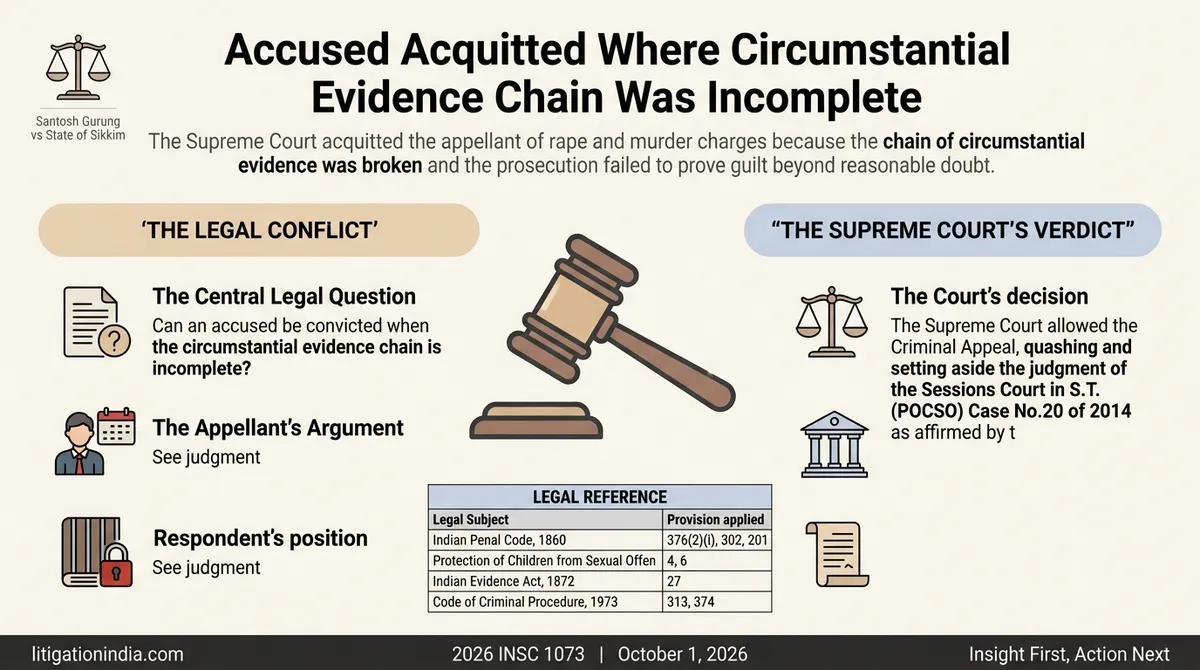
Full text of the judgment
Text extracted from Santosh Gurung vs State of Sikkim. For the authoritative version refer to the Supreme Court of India's official website.
2026 INSC 1073 Page 1 of 22 Criminal Appeal No.107 of 2018 REPORTABLE
IN THE SUPREME COURT OF INDIA CRIMINAL APPELLATE JURISDICTION
CRIMINAL APPEAL NO.107 OF 2018
SANTOSH GURUNG
APPELLANT VERSUS STATE OF SIKKIM
RESPONDENT J U D G M E N T
ATUL S. CHANDURKAR, J. 1. The appellant assails his conviction for the offence punishable under Sections 376(2)(i), 302 and 201 of the Indian Penal Code, 18601 along with his conviction under Sections 4 and 6 of the Protection of Children from Sexual Offences Act, 2012. The Sessions Court sentenced him to undergo life imprisonment in view of his conviction and the High Court of Sikkim2 in appeal has maintained the same. 2. The case of the prosecution is that on 06.11.2013 at about 09.00 a.m., the appellant was asked by his mother3 to go and purchase some vegetables. The appellant asked his maternal
1 For short, ‘the Penal Code’ 2 For short, ‘the High Court’ 3 For short, ‘the complainant’ Digitally signed by ABHINAV KUMAR Date: 2026.10.01 14:22:21 IST Reason: Signature Not Verified
Page 2 of 22 Criminal Appeal No.107 of 2018 niece4 to accompany him. However, the complainant did not permit him to take her along. According to the prosecution, the appellant, however, took the victim from the house. When the appellant and the victim did not return after some time, the complainant searched for them. She informed the victim’s mother that her child was missing. On 12.11.2013, the complainant lodged a Missing Report at Rongli Police Station giving details of the victim as well as her maternal uncle, the appellant. The appellant was traced at Siliguri much later. As per the First Information Report5 dated 13.05.2014, the appellant while being brought back from Siliguri to Rongli had stated that he had raped the victim and had, thereafter, throttled her to death on 06.11.2013. An offence was, accordingly, registered and investigation was conducted. At the conclusion of the investigation, the chargesheet was filed. The appellant denied the charge and was, accordingly, tried. The prosecution examined sixteen witnesses and relied upon various circumstances to bring home the guilt of the appellant. The defence of the appellant was of denial. The learned Judge of the Sessions Court by the judgement dated 20.04.2016 held the appellant guilty and, accordingly, sentenced him in the manner
4 For short, ‘the victim’ 5 For short, ‘FIR’
Page 3 of 22 Criminal Appeal No.107 of 2018 stated hereinabove. 3. Being aggrieved, the appellant preferred an appeal under Section 374 of the Code of Criminal Procedure, 19736 challenging his conviction. The High Court, on a re-appreciation of the entire evidence on record, affirmed the order passed by the Sessions Court and upheld the appellant’s conviction. Being aggrieved, the appellant has come up in appeal. 4. Ms. Sangeeta Kumar, learned counsel for the appellant submitted that the Sessions Court as well as the High Court erred in convicting the appellant on the basis of circumstantial evidence. The various circumstances referred to by the prosecution were not sufficient to bring home the guilt of the appellant. Though according to the prosecution, the appellant was last seen with the victim, the evidence on record indicated otherwise. The prosecution witnesses were not confident as to whether they had last seen the appellant with the victim. Referring to the delay in registration of the FIR, she submitted that the prosecution failed to explain the steps taken since lodging of the Missing Report on 12.11.2013 and registration of the FIR on 13.05.2014. She referred to the deposition of the prosecution witnesses to urge that the
6 For short, ‘the Code’
Page 4 of 22 Criminal Appeal No.107 of 2018 chain of circumstances was not complete and that on the basis of such evidence, the appellant could not have been convicted. The recovery effected under Section 27 of the Indian Evidence Act, 18727 was doubtful inasmuch as the items recovered were not related to the victim. Even the spot from where the recovery was effected was frequented by members of the public and, therefore, it would not be safe to rely upon such recovery. The learned counsel placed reliance on the decision in Kattavellai @ Devakar Vs. State of Tamil Nadu8 in this regard. The report of the Forensic Science Laboratory9 as well as the DNA testing report did not support the case of the prosecution. Thus, in absence of any material evidence connecting the appellant with the incident in question, he had been convicted. It was, thus, submitted that the impugned judgments were liable to be set aside and the appellant ought to be acquitted. 5. On the other hand, Mr. Sameer Abhyankar, learned counsel appearing for the State of Sikkim supported the impugned judgments. According to him, in absence of any eye-witness, the prosecution was justified in relying upon various clinching
7 For short, ‘the Act of 1872’ 8 2025 INSC 845 9 For short, ‘FSL’
Page 5 of 22 Criminal Appeal No.107 of 2018 circumstances that pointed to the guilt of the appellant. Each circumstance relied upon by the prosecution clearly indicated the involvement only of the appellant and, therefore, both the Courts were justified in holding him guilty. The learned counsel referred to relevant portions of the evidence of the prosecution witnesses to substantiate his contentions. He also submitted that in his statement under Section 313 of the Code, the appellant failed to give proper explanation of the various circumstances against him. His admissions in that regard were also relevant and the same strengthened the chain of circumstances. He, therefore, submitted that as both the Courts had concurrently found the appellant guilty, no interference with his conviction was called for. He placed reliance on the decisions in Naib Singh Vs. State of Punjab and Ors.10, State of Rajasthan Vs. Kashi Ram11 and Manik & Ors. Vs. The State of Maharashtra12 and sought for dismissal of the appeal. 6. We have heard the learned counsel for the parties at length. With their assistance, we have also gone through the records of the case including the deposition of all witnesses. We have, thereafter,
10 1983 INSC 41 11 2006 INSC 794 12 2024 INSC 734
Page 6 of 22 Criminal Appeal No.107 of 2018 given due consideration to the entire material on record. In our view, the conviction of the appellant solely on the basis of circumstantial evidence deserves to be interfered with since the chain of circumstances does not appear to be complete. Rather, the said chain of circumstances appears broken at various places. 7. Before proceeding to assess the entire material on record brought by the prosecution to establish the guilt of the appellant, it would be fruitful to bear in mind the following extract from the decision of this Court in Hanumant Vs. The State of Madhya Pradesh13 rendered by Bench of three learned Judges: “In dealing with circumstantial evidence the rules specially applicable to such evidence must be borne in mind. In such cases there is always the danger that conjecture or suspicion may take the place of legal proof and therefore it is right to recall the warning addressed by Baron Alderson, to the jury in Reg v. Hodge14, where he said :-
"The mind was apt to take a pleasure in adapting circumstances to one another, and even in straining them a little, if need be, to force them to from parts of one connected whole; and the more ingenious the mind of the individual, the more likely was it, considering such matters to overreach and mislead itself, to supply some little link that is wanting, to take for granted some fact consistent with its previous theories and necessary to render them complete."
It is well to remember that in cases where the evidence in of a circumstantial nature, the circumstances from which the conclusion of guilt is to be drawn should in the first instance be fully established, and all the facts so established should be consistent only with the hypothesis of the guilt of the accused. Again, the circumstances should be of a conclusive nature and pendency and they should be such as to exclude every hypothesis but the one proposed to be proved. In other words, there must be a chain of evidence so far complete as not to leave any reasonable ground for a conclusion consistent with the innocence of the accused and it must be such as
13 1952 INSC 41 14 (1838) 2 Lew. 227
Page 7 of 22 Criminal Appeal No.107 of 2018 to show that within all human probability the act must have been done by the accused.”
8. According to the prosecution, the following circumstances form a chain that links the appellant with the offence with which he is charged: a) The appellant was last seen with the victim. b) The recovery of various articles on discovery under Section 27 of the Act of 1872. c) The DNA report conducted on the bones and teeth recovered at the instance of the appellant. d) The report of the FSL conducted on various articles recovered from the place of occurrence. e) The brown shawl recovered at the instance of the appellant which was used by him after killing the victim. f) Silence of the appellant while recording his statement under Section 313 of the Code. It would, therefore, be necessary to consider each circumstance independently to determine whether all such circumstances when taken together form a complete chain so as to point out only to one hypothesis, namely the guilt of the appellant and no one else.
Page 8 of 22 Criminal Appeal No.107 of 2018 9. We may now consider each circumstance relied upon by the prosecution for seeking the conviction of the appellant: a) Appellant last seen with the victim: (i) It is the case of the prosecution that since the appellant was last seen with the victim, it was for him to dispel the grave doubt created against him in this regard. PW2- Kunti Maya Gurung, the grandmother of the victim, stated that the victim was residing with her. On the day when the victim was found missing, she thought that the appellant, who was the victim’s maternal uncle, was likely to have taken her somewhere. While she did not find the victim, she also noticed that the appellant was not seen around. The prosecution relies upon the deposition of PW2 to substantiate this circumstance. In her cross-examination, this witness stated that on the relevant day, apart from the appellant, herself and the victim, there was nobody else in the house. She, however, stated that at the relevant time, two other persons from her village had also visited her house. She further stated that after she started performing her household chores, she did not notice whether the appellant and the victim went together or whether they left separately. She did not suspect the appellant to have killed the victim. To a question asked by the Court, the witness stated that
Page 9 of 22 Criminal Appeal No.107 of 2018 when she along with the appellant and the victim were at home, the two other persons from the village mentioned by her had already left. From the deposition of PW2, it can be gathered that she was not very sure as to whether the appellant and the victim left together or that they had left the house separately. (ii) PW1-Hari Prasad Gurung was posted as a Head Constable at the village at the relevant point of time. In his crossexamination, he admitted that it was true that there was no witness who had seen the appellant taking the victim from the complainant’s house. He further stated that no witness had seen the appellant missing from the village on the day of the incident. He also admitted that there was no complaint that the appellant was missing from the village. This witness, therefore, admits that there was no person who had witnessed the appellant taking the victim from the complainant’s house. (iii) PW3 is the mother of the victim. She stated that her mother did not tell her as to from when her daughter had gone missing. She also did not ask her mother as to with whom her daughter had gone on the relevant day. In her cross-examination, she admitted that her mother had told her that before the victim was found missing, two persons from the village had visited their
Page 10 of 22 Criminal Appeal No.107 of 2018 house. However, she was not told their names. She further stated that it was true that she could not say whether her daughter had gone with the said two persons. The deposition of this witness again creates a doubt as to whether the appellant was the only person who was ‘last seen’ with the victim. (iv) PW16 is the Investigating Officer who had conducted the necessary investigation into the offence. In his cross-examination, he admitted that there was no person who had seen the accused taking the victim away from the house. He also stated that Missing Report was lodged at Rongli Police Station on 12.11.2013 while the victim had gone missing since 06.11.2013. This witness, therefore, reiterates what was stated by the earlier witnesses that the appellant was not seen by anyone taking away the victim. Considering the aforesaid material on record relied upon by the prosecution, a grave doubt is created as to whether the appellant was, in fact, ‘last seen’ with the victim. There is no specific evidence on record on the basis of which it could be asserted that it was indeed the appellant who had taken the victim from the house or that he was last seen with the victim after which she was found missing.
Page 11 of 22 Criminal Appeal No.107 of 2018 (v) Another relevant factor to be borne in mind is that the FIR is dated 13.05.2014. It states that besides the victim who was missing, the appellant, her maternal uncle, had also been missing. The appellant was traced on 12.05.2014 and on investigation, it was revealed that he had raped the victim and had thereafter killed her. The appellant was, thus, charged with causing her death on 06.11.2013. Admittedly, the corpus of the victim could not be traced. According to the prosecution, the appellant was last seen with the victim on 06.11.2013 and the victim was not discovered to be dead at least till 15.05.2014 when certain bones and teeth were discovered on memorandum under Section 27 of the Act of 1872. In the context of the period when it was claimed that the appellant was last seen with the victim and discovery of the bones and teeth by the prosecution six months thereafter, reference can be made to the decision in State of U.P. Vs. Satish15, wherein it was held as under: “The last seen theory comes into play where the time-gap between the point of time when the accused and the deceased were seen last alive and when the deceased is found dead is so small that possibility of any person other than the accused being the author of the crime becomes impossible. It would be difficult in some cases to positively establish that the deceased was last seen with the accused when there is a long gap and possibility of other persons coming in between exists. In the absence of any other positive evidence to conclude that the accused and the deceased were last seen together, it would be hazardous to come to a conclusion of guilt in those cases.”
15 2005 INSC 68
Page 12 of 22 Criminal Appeal No.107 of 2018
This circumstance, thus, is doubtful and it would be unsafe to conclude that the appellant alone was the person who was ‘last seen’ with the victim on the basis of the aforesaid material. b) Recovery under Section 27 of the Act of 1872: (i) According to the prosecution, on 15.05.2014, at the instance of the appellant, discovery of clothes worn by victim and other articles were made on memorandum. As per his statement at Exhibit-4, the appellant volunteered to show the place where he had kept the aforesaid articles. These articles were seized and numbered as MO-I to MO-VIII. (ii) PW5-Anirudh Gurung was witness to the aforesaid recovery. He stated that the said recovery was effected in his presence. In his cross-examination, he admitted that the spot from where the aforesaid articles were recovered could be easily seen if a person visits the said spot. The relevant portion of his cross-examination reads as under: “It is true that there is an old road and a footpath used by cattle herders who collect fodder in the said area. It is true that the spot from where the articles marked MO I to MO VIII were recovered is not a thick jungle. It is true that people collecting fodder visit the said area. It is true that the spot from where MO I to MO VIII were recovered could be easily seen if a person visits the said spot.”
Page 13 of 22 Criminal Appeal No.107 of 2018 The deposition of this witness indicates that the place from where the recovery was effected was frequently visited by people for collecting fodder. (iii) PW8-Surjay Rai was another witness when the recovery was effected. In his cross-examination, he too reiterated that the spot from where the recovery was effected was not covered with thick forest growth and cow herders used to visit the said place for collecting fodder. (iv) PW2-Kunti Maya Gurung in her cross-examination admitted that the place from where the said articles were recovered had a water channel nearby. She admitted that people used to visit the said spot to collect fodder and to graze their cattle. Whenever the water channel was blocked, people used to come there to repair the same. (v) The aforesaid evidence indicates that recovery of the aforesaid articles made under Section 27 of the Act of 1872 was from a place that was frequented by people and the said spot could be easily seen by any person visiting the same. The reliability of a recovery effected under Section 27 of the Act of 1872 from a place ordinarily visible to others should be examined with care. A note
Page 14 of 22 Criminal Appeal No.107 of 2018 of caution in this regard has been sounded in State of Himachal Pradesh Vs. Jeet Singh16. It was observed as under: “There is nothing in Section 27 of the Evidence Act which renders the statement of the accused inadmissible if recovery of the articles was made from any place which is “open or accessible to others”. It is a fallacious notion that when recovery of any incriminating article was made from a place which is open or accessible to others, it would vitiate the evidence under Section 27 of the Evidence Act. Any object can be concealed in places which are open or accessible to others. For example, if the article is buried on the main roadside or if it is concealed beneath dry leaves lying on public places or kept hidden in a public office, the article would remain out of the visibility of the others in normal circumstances. Until such article is disinterred its hidden state would remain unhampered. The person who hid it alone knows where it is until he discloses that fact to any other person. Hence the crucial question is not whether the place was accessible to others or not but whether it was ordinarily visible to others. If it is not, then it is immaterial that the concealed place is accessible to others.”
This factor will have to be borne in mind while assessing all the circumstances together. c) DNA report: (i) The various items seized at the instance of the appellant were subjected to DNA analysis. These included two pieces of bones and a bunch of black hair. The said items were subjected to DNA isolation by organic extraction method. The conclusion recorded by the Deputy Director-cum-Assistant Chemical Examiner to the Government of Tripura in report dated 27.11.2014 at Exhibit-37 is as under: “Conclusion: - On the basis of the above observations it can be concluded that:-
16 1999 INSC 104
Page 15 of 22 Criminal Appeal No.107 of 2018 i) The exhibit marked - A2 (source two pieces of bone ) was human male origin and are not biologically related with the exhibit marked - A6 (source : blood stain filter paper said to be the blood sample of Mrs. Rita Gurung) and exhibit -A7 (source : blood stain filter paper said to be the blood sample of Miss. Prabha Gurung).
ii) The autosomal STR analysis is not possible from exhibit -A5 (source : Bunch of black hairs)
iii) It is not possible to reply the queries No.iv, v, vi and viii” (ii) PW13-Dr. O.T. Lepcha was working as Medico-legal Specialist, STNM Hospital, Gangtok, who stated that various specimens forwarded by Rongli Police Station were examined by him and he had prepared his medical opinion report at Exhibit- 23. He admitted in his cross-examination that in his report, he did not mention as to whether the three suspected flat bones were human bones or animal bones. He further admitted that he could not say as to whether the tooth mentioned in Exhibit-23 was that of a human. Similarly, he stated that he was not sure as to whether the piece of nail was, in fact, a nail or a piece of wood. (iii) PW16, the Investigating Officer admitted that he could not state as to whether the bones and the teeth found at the place of occurrence belonged to the victim. From the aforesaid material on record, it is clear that the two pieces of bones marked as A2 were stated to be of human male origin. They were not biologically related with Exhibit-A6 which
Page 16 of 22 Criminal Appeal No.107 of 2018 was a blood stain filter paper having the blood sample of the victim’s mother and Exhibit- A7 which was a blood stain filter paper with the blood sample of the victim’s sister. The prosecution, therefore, has not been able to bring on record the fact that the bones and teeth recovered at the instance of the appellant, in fact, were of the victim. The DNA report at Exhibit- 37, on the contrary, indicates that the pieces of bone were of male origin while the victim was a female. They naturally did not match the blood samples of the victim’s mother and sister. The DNA report at Exhibit-37, therefore, cannot be relied upon as a circumstance against the appellant. d) Report from the FSL: (i) As noted above, articles MO-I to MO-VIII were sent for examination at the Regional FSL. PW11-Pooja Lohar, who was working as Analyst-cum-Assistant Chemical Examiner at village at RFSL Saramsa deposed in this regard. As per her report, she was unable to ascertain whether the dried blood found on the brown shawl, MO-VI was either human blood or animal blood. She further admitted that she was unable to ascertain the age of the human scalp hair found on the shawl as well as other separate strands of hair at MO-VII. Similarly, human remains could not be
Page 17 of 22 Criminal Appeal No.107 of 2018 detected in the soil sample at MO-VIII. The FSL report at Exhibit 16, thus, also cannot be relied upon as a circumstance. e) Brown shawl: (i) According to the prosecution, the appellant had taken a brown shawl from the house of his sister and had laid down the victim on the said shawl. He had, thereafter, covered the victim with his black jacket. This according to the prosecution was stated by the appellant while discovering various items on memorandum under Section 27 of the Act of 1872. PW2, the mother of the victim, however, could not identify the said brown shawl shown to her when she was examined in the Court. She stated that she did not know to whom the said shawl belonged to. PW16, the Investigating Officer also admitted in his cross-examination that the said shawl did not belong to the mother of the appellant though the appellant had stated it belonged to his mother. He also admitted that he did not find any witness who had seen the accused going to the victim’s house to get the shawl. As noted above, as per the report of Regional FSL dated 19.06.2014 at Exhibit-16, the origin and blood group found on the said shawl could not be detected. This circumstance again creates a doubt on the stand taken by the
Page 18 of 22 Criminal Appeal No.107 of 2018 prosecution regarding the appellant taking away a brown shawl from the house and laying the victim on it. f) Statement of appellant under Section 313 of the Code: (i) The statement of appellant was recorded under Section 313 of the Code and various circumstances against him were put to him. At Question 11, the appellant was referred to the deposition of PW2 that while going for making some purchases, he wanted to take the victim along with him. However, PW2 did not permit him to do so. The appellant admitted this to be true. At Question 12, it was put to the appellant that as per the evidence of PW2, when she went inside the house after telling the appellant not to take the victim with him, he was standing near the house while the victim was standing near the door of the house. The appellant stated that this was true but further stated that he had gone to the shop alone. The appellant admitted while answering Question Nos.24 and 25 that he had gone to the residence of PW4 at about 01.00 p.m. on the relevant day and that he was heavily drunk. The appellant ultimately stated that he was falsely implicated at the behest of PW4 and that he was innocent. He had been arrested on suspicion. On a reading of the entire statement of appellant under Section 313 of the Code, we do not find that there has been any
Page 19 of 22 Criminal Appeal No.107 of 2018 failure on his part to explain any incriminating circumstance against him. It has to be borne in mind that only if an accused fails to offer reasonable explanation in discharge of burden placed on him in a case resting on circumstantial evidence, the same would provide an additional link in the chain of circumstances proved against him. Thus, the appellant’s silence or failure to provide any reasonable explanation can merely act as an additional link that would complete the chain. This, however, would not shift the burden of proof on an accused in a criminal trial. This position has been explained in Kashi Ram (supra) that was relied upon by the learned counsel for the respondent. (ii) We may in this connection refer to the decision in Raj Kumar Singh @ Raju @ Batya Vs. State of Rajasthan17. While explaining the relevance of statements made by the accused under Section 313 of the Code, it was held as under: “36. In view of the above, the law on the issue can be summarised to the effect that statement under Section 313 Cr.P.C. is recorded to meet the requirement of the principles of natural justice as it requires that an accused may be given an opportunity to furnish explanation of the incriminating material which had come against him in the trial. However, his statement cannot be made a basis for his conviction. His answers to the questions put to him under Section 313 Cr.P.C. cannot be used to fill up the gaps left by the prosecution witnesses in their depositions. Thus, the statement of the accused is not a substantive piece of evidence and therefore, it can be used only for appreciating the evidence led by the prosecution, though it cannot be a substitute for the evidence of the prosecution. In case the prosecution’s evidence is not found sufficient to sustain conviction of
17 2013 INSC 313
Page 20 of 22 Criminal Appeal No.107 of 2018 the accused, the inculpatory part of his statement cannot be made the sole basis of his conviction. The statement under Section 313 Cr.P.C. is not recorded after administering oath to the accused. Therefore, it cannot be treated as an evidence within the meaning of Section 3 of the Evidence Act, though the accused has a right if he chooses to be a witness, and once he makes that option, he can be administered oath and examined as a witness in defence as required under Section 315 Cr.P.C.
An adverse inference can be taken against the accused only and only if the incriminating material stood fully established and the accused is not able to furnish any explanation for the same. However, the accused has a right to remain silent as he cannot be forced to become witness against himself.”
Thus, when it is found that the chain of circumstances relied upon by the prosecution is not complete and that the same does not inspire confidence for its acceptance, the response of the appellant recorded in his statement under Section 313 of the Code cannot be a circumstance against him, especially when other circumstantial evidence is not found to be satisfactory pointing out to the guilt of the appellant alone and none other. 10. On an overall consideration of all the circumstances relied upon by the prosecution, we find that the evidence led by the prosecution is woefully short of pointing to the guilt of the appellant. The witnesses examined were not sure as to whether the appellant was last seen with the victim as they had their own doubts in that regard. The discovery effected under Section 27 of the Act of 1872 was from a place that was ordinarily visible to others, thus, requiring such discovery to be considered with
Page 21 of 22 Criminal Appeal No.107 of 2018 caution. The DNA report in clear terms refers to the bone extracts being of male origin while the victim was a female. The said bones naturally did not match with the blood samples of the victim’s mother and sister. The report from the FSL also does not take the case of the prosecution any further. There is a doubt created as to whether the brown shawl claimed by the prosecution to be brought by the appellant from his mother was the same as the appellant’s mother had denied that it belonged to her. Therefore, the appellant’s statement under Section 313 of the Code cannot be taken as an additional link in the chain of circumstances. In other words, the chain of circumstances has not been formed on the basis of the prosecution evidence. The Sessions Court, in our view, failed to notice these material factors that were very much available on record. It, therefore, erred in convicting the appellant on the basis of circumstantial evidence. The High Court too failed to notice all these infirmities in the case of the prosecution. The guilt of the appellant has not been established beyond reasonable doubt. A strong doubt about his involvement in the offence is created in view of the prosecution evidence. It is also true that the victim met an unfortunate end. However, on the basis of such material on record, it would hardly be justifiable to convict the
Page 22 of 22 Criminal Appeal No.107 of 2018 appellant for the same when none of the circumstances point towards his involvement. In the circumstances, he has to be given the benefit of doubt. 11. Resultantly, the judgment of the Sessions Court in S.T. (POCSO) Case No.20 of 2014 as affirmed by the High Court in Criminal Appeal No.19 of 2016 is quashed and set aside. The appellant is acquitted of the offence for which he was tried and convicted. He shall be set free forthwith, if not required in any other case. The Criminal Appeal is, accordingly, allowed in the aforesaid terms.
…...………………………..J. [ UJJAL BHUYAN ]
.…..………………………..J. [ATUL S. CHANDURKAR]
NEW DELHI, OCTOBER 1, 2026.