
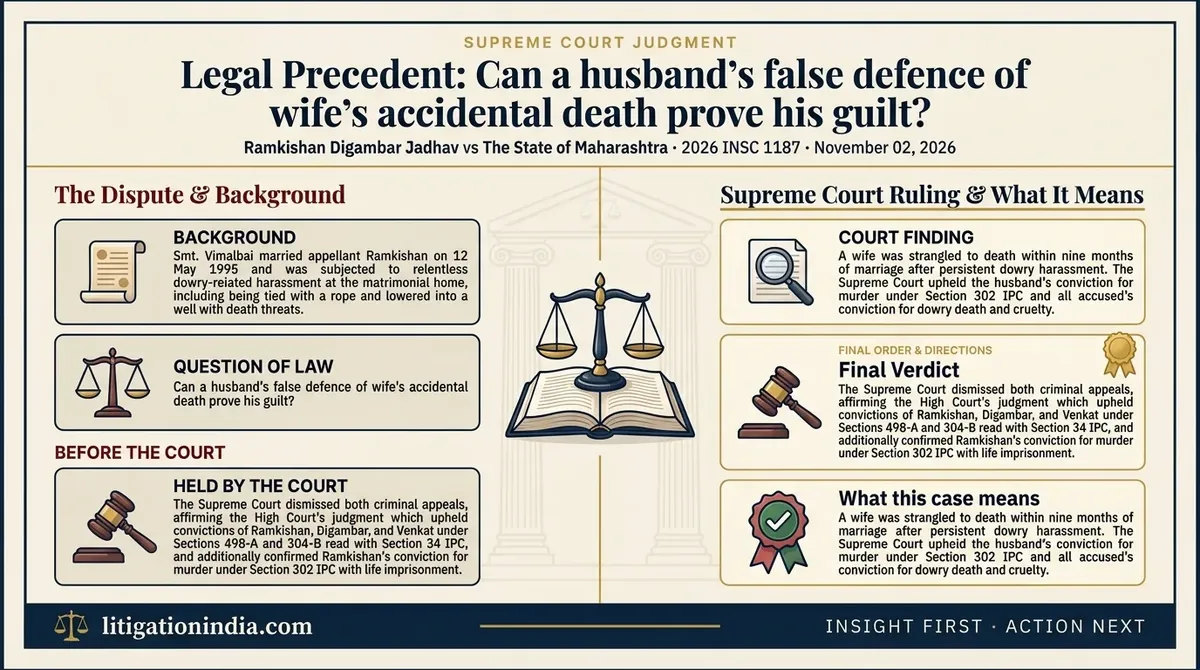
Full text of the judgment
Text extracted from Ramkishan Digambar Jadhav vs The State of Maharashtra. For the authoritative version refer to the Supreme Court of India's official website.
2026 INSC 1187 1
NON-REPORTABLE IN THE SUPREME COURT OF INDIA CRIMINAL APPELLATE JURISDICTION
CRIMINAL APPEAL NO(S). 1849 OF 2013
RAMKISHAN DIGAMBAR JADHAV
….APPELLANT(S)
THE STATE OF MAHARASHTRA ….RESPONDENT(S)
CRIMINAL APPEAL NO(S). 962 OF 2014
J U D G M E N T Mehta, J. 1. Heard. 2. These connected criminal appeals are filed by the appellants assailing the common judgment dated 3rd July, 2013 passed by the High Court of Bombay at Aurangabad1 in Criminal Appeal No. 311 of 1998 and 395 of 1998. 3. By the impugned judgment, the High Court dismissed Criminal Appeal No. 311 of 1998 preferred
1 Hereinafter, referred to as “the High Court”. Digitally signed by SONIA BHASIN Date: 2026.11.02 17:43:09 IST Reason: Signature Not Verified
2 CRL. APPEAL NO(S). 1849/2013 with connected matter
by the appellants, Ramkishan Digambar Jadhav (accused No. 1)2, Digambar Narba Jadhav (accused No. 2)3, and Venkat (accused No. 5)4, thereby affirming their conviction and sentence for the offences punishable under Sections 498-A and 304- B read with Section 34 of the Indian Penal Code, 18605. 4. At the same time, the High Court partly allowed Criminal Appeal No. 395 of 1998 filed by the State of Maharashtra6 by setting aside the partial acquittal of the appellant-Ramkishan by the trial Court, and convicted him for the offence punishable under Section 302 of the IPC for the murder of his wife Vimalbai, and sentenced him to imprisonment for life with a fine of Rs.5,000/- with a default stipulation, while maintaining the acquittal of accused Nos. 2 to 6 under Section 302 read with Section 34 of the IPC. 5. Criminal Appeal No. 1849 of 2013 has been preferred by the appellant-Ramkishan, whereas Criminal Appeal No.962 of 2014 has been preferred by co-convicts Digambar and Venkat before this
2 Hereinafter, referred to as “appellant-Ramkishan”. 3 Hereinafter, referred to as “appellant-Digambar”. 4 Hereinafter, referred to as “appellant-Venkat”. 5 For short, “IPC”. 6 Hereinafter, referred to as “respondent-State”.
3 CRL. APPEAL NO(S). 1849/2013 with connected matter
Court. Ramkishan and Venkat are the sons of Digambar. 6. At the outset, it is pertinent to note that the appellant-Digambar in Criminal Appeal No. 962 of 2014 passed away during the pendency of the appeal and hence the appeal qua him stands abated. BRIEF FACTS 7. Succinctly stated, the facts relevant and essential for disposal of these appeals are noted hereinbelow. 8. The marriage of the appellant-Ramkishan with Smt. Vimalbai7 was solemnised on 12th May, 1995. The prosecution alleges that, shortly after marriage, Smt. Vimalbai was subjected to continuous harassment, maltreatment, and physical as well as mental torture at the matrimonial home in connection with unlawful demands for dowry, specifically comprising a television set, a tape deck, a plot of land in the MIDC area, and cash amounting to Rs. 50,000/-, so that the husband, i.e. the appellant- Ramkishan could get some employment. However, within barely nine months of the marriage, on 1st
7 Hereinafter, also referred to as “deceased-Vimalbai”.
4 CRL. APPEAL NO(S). 1849/2013 with connected matter
February, 1996, Smt. Vimalbai met an unnatural and homicidal death at the matrimonial home. 9. The prosecution also alleges that whenever the deceased-Vimalbai visited her parental home, she used to complain to her brother Narayan, the first informant (PW-2)8, that the accused persons were coercing her with unlawful demands for cash and other valuables, and that she was being subjected to unrelenting harassment and humiliation on this account. 10. The complainant-Narayan expressed his inability to meet these demands and sent his sister back to the matrimonial home after consoling her. On 12th January, 1996, Smt. Vimalbai had been brought to the parental home on the festival of Sankrant. Even at that time, she complained of maltreatment at the matrimonial home. She also expressed that she was being beaten and was being starved. On one occasion, she was strung with a rope and was hung in the well with a threat that if the demands were not met, she would be killed.
8 Hereinafter, referred to as “complainant-Narayan”.
5 CRL. APPEAL NO(S). 1849/2013 with connected matter
11. In the early hours of 1st February, 1996, at about 01:00 a.m, the appellant-Ramkishan came to the house of the complainant-Narayan and informed him that Smt. Vimalbai was experiencing convulsions and was being taken to Naigaon for medical treatment. On hearing so, the complainant- Narayan, accompanied by his father Ramrao, mother Anjanabai, brother Chandraprakash, and several covillagers, proceeded to Naigaon in a jeep. En route, near the agricultural field of one Udhav Sawarkar, they intercepted a bullock cart whereupon the deceased-Vimalbai was lying lifeless, with blood oozing from her nostrils and right hand’s fingers. She was immediately taken to the Naigaon Hospital, where, upon medical examination, the doctors declared her as brought dead. The complainant- Narayan lodged an oral complaint against the appellants and other family members at the Police Station Naigaon which was reduced to writing by Police Sub-Inspector Anwar Khan (PW-7) and based thereupon, Crime No. 11 of 1996 came to be registered for the offences punishable under Sections 302, 498-A, and 34 of the IPC.
6 CRL. APPEAL NO(S). 1849/2013 with connected matter
12. Prior to the lodging of the complaint by the complainant-Narayan, the appellant-Ramkishan had presented an application at the Police Station Naigaon on 1st February, 1996 at 08.00 a.m., setting up a theory that his wife met an accidental death. He alleged in the application that while he was having sexual intercourse with his wife Vimalbai, she experienced sudden giddiness, her jaws got locked and she passed away. Based on this information, the police recorded an entry in the Accidental Death Register and commenced a preliminary inquiry, during which an inquest panchnama was drawn up. Thereafter, two medical officers of Rural Hospital Naigaon conducted post-mortem examination on the dead body and the cause of death was opined as “asphyxia due to throttling”. 13. Upon completion of the investigation, a chargesheet was submitted against six accused persons including the appellants herein. The case was committed to the Court of Additional Sessions Judge, Biloli9, where charges were initially framed under Sections 498-A and 302 read with Section 34
9 Hereinafter, referred to as “trial Court”.
7 CRL. APPEAL NO(S). 1849/2013 with connected matter
of the IPC, and an additional charge for the offence punishable under Section 304-B read with Section 34 of the IPC was subsequently added on an application filed by the prosecution. The accused persons denied the charges and were accordingly subjected to trial. 14. By judgment and order dated 21st September, 1998, the trial Court convicted the appellant- Ramkishan (accused No. 1-husband), the appellant- Digambar (accused No. 2-father-in-law) and the appellant-Venkat (accused No. 5-brother-in-law) for the offences punishable under Sections 498-A and 304-B read with Section 34 of the IPC. For the offence punishable under Section 498-A of the IPC, each of the three convicts was sentenced to rigorous imprisonment for one year and a fine of Rs. 500/-, with a further term of rigorous imprisonment for one month in default of payment of fine. For the offence punishable under Section 304-B of the IPC, each accused was sentenced to rigorous imprisonment for seven years. The substantive sentences were directed to run concurrently. 15. At the same time, all six accused persons were acquitted of the offence punishable under Section 302 read with Section 34 of the IPC, while the three
8 CRL. APPEAL NO(S). 1849/2013 with connected matter
female relatives (accused Nos. 3, 4, and 6) were exonerated and acquitted of all charges. 16. Aggrieved by the judgment of conviction and order of sentence rendered by the trial Court, the convicted accused i.e., the appellant-Ramkishan (accused No. 1-husband), appellant-Digambar (accused No. 2-father-in-law), and appellant-Venkat (accused No. 5-brother-in-law), preferred Criminal Appeal No. 311 of 1998 before the High Court, assailing the findings of the trial Court holding them guilty of the offences punishable under Sections 498- A and 304-B read with Section 34 of the IPC. Simultaneously, the respondent-State also filed Criminal Appeal No. 395 of 1998, challenging the judgment of acquittal recorded in favour of the accused persons in respect of the offence punishable under Section 302 read with Section 34 of the IPC. 17. The High Court, by the impugned judgment, disposed of both appeals in the manner indicated hereinabove10.
10 Supra para Nos. 3-4.
9 CRL. APPEAL NO(S). 1849/2013 with connected matter
18. The said judgment dated 3rd July, 2013 passed by the High Court is the subject matter of challenge in the present appeals with special leave. SUBMISSIONS ON BEHALF OF THE APPELLANTS 19. Learned counsel appearing for the appellants submitted that the prosecution case hinges entirely on circumstantial evidence, and that the prosecution has miserably failed to establish a complete and unbroken chain of incriminating circumstances pointing conclusively and unerringly towards the guilt of the appellants. 20. Learned counsel appearing for the appellant- Ramkishan submitted that the deceased-Vimalbai met with a tragic, accidental death, having suffered a sudden epileptic seizure while the appellant was engaged in sexual intercourse with her. 21. Learned counsel appearing for the appellant- Digambar and appellant-Venkat submitted that these accused have been roped in solely on account of their familial relationship with the appellant- Ramkishan, without any specific overt act or definite role being ascribed to them regarding the alleged harassment of the deceased on account of demands of dowry soon before her death.
10 CRL. APPEAL NO(S). 1849/2013 with connected matter
22. It was contended that since the Courts below had already acquitted three other family members, namely the mother-in-law (accused No. 3), sister-inlaw (accused No. 4), and co-sister (accused No. 6) on the very same evidence, the appellants-Digambar and Venkat are also entitled to acquittal on parity. 23. On the strength of the above submissions, learned counsel for the appellants prayed that the impugned judgment passed by the High Court be set aside and the appellants be acquitted of the charges levelled against them. SUBMISSIONS ON BEHALF OF THE RESPONDENT 24. Per contra, learned counsel appearing for the respondent-State vehemently and fervently opposed the submissions advanced on behalf of the appellants. 25. Learned counsel submitted that the deceased- Vimalbai met with an unnatural, homicidal death within barely nine months of marriage inside her matrimonial home, while in the exclusive custody and company of her husband, i.e., the appellant- Ramkishan. It was urged that by virtue of Section
11 CRL. APPEAL NO(S). 1849/2013 with connected matter
106 of the Indian Evidence Act, 187211, a heavy burden rested upon the appellant-Ramkishan to explain the circumstances under which his wife suffered fatal injuries by strangulation in the privacy of the matrimonial home, which burden he conspicuously failed to discharge. 26. It was submitted that, rather than discharging the statutory onus cast upon him under Section 106 of the Evidence Act, to offer a plausible explanation regarding the circumstances resulting in death of Smt. Vimalbai, the appellant-Ramkishan presented a demonstrably false and concocted narrative claiming that the deceased-Vimalbai suffered giddiness and convulsions during sexual intercourse which led to a seizure and death. Such a false and far-fetched explanation serves to fortify the prosecution’s case and provides a vital additional link reinforcing the inference of his guilt. 27. It was further submitted that the post-mortem examination conducted by Dr. Shyam Nagapurkar (PW-1) conclusively established the cause of death as “asphyxia due to throttling”, demonstrating clear
11 Hereinafter, referred to as “Evidence Act”.
12 CRL. APPEAL NO(S). 1849/2013 with connected matter
evidence of death by strangulation that could not have been self-inflicted or accidental as claimed by the defence. 28. Learned counsel contended that since the unnatural death occurred within nine months of solemnisation of marriage, preceded by persistent cruelty and harassment in connection with dowry demands soon before death, attributed to the appellants herein, all the foundational facts for invoking the statutory presumption under Section 113-B of the Evidence Act, stand fully established. 29. It was accordingly contended by learned counsel representing the respondent-State that in absence of any demonstrable perversity or miscarriage of justice in the impugned judgment, no case for exercise of power under Article 136 of the Constitution of India is made out, and the present appeals ought to be dismissed.
30. We have heard and considered the submissions advanced by learned counsel appearing for the appellants and learned counsel representing the
13 CRL. APPEAL NO(S). 1849/2013 with connected matter
respondent-State and have gone through the impugned judgment and the material placed on record. 31. Aggrieved by their conviction and sentences awarded to them by the trial Court, for the offences punishable under Sections 498-A and 304-B read with Section 34 of the IPC, the convicted accused persons, namely Ramkishan (accused No. 1husband), Digambar (accused No. 2-father-in-law), and Venkat (accused No. 5-brother-in-law) preferred Criminal Appeal No. 311 of 1998 before the High Court. Concurrently, the respondent-State preferred Criminal Appeal No. 395 of 1998, assailing the acquittal of the accused persons of the charge of murder punishable under Section 302 read with Section 34 of the IPC. 32. The High Court vide the impugned judgment dismissed the appeal preferred by the convicts (Ramkishan, Digambar, and Venkat) and partly allowed the appeal preferred by the respondent-State. Finding that the acquittal of the appellant- Ramkishan, husband of the deceased-Vimalbai, for the offence punishable under Section 302 of the IPC tantamounted to perversity and suffered from a total
14 CRL. APPEAL NO(S). 1849/2013 with connected matter
failure of justice, the High Court set aside his acquittal, and accordingly convicted him for the offence punishable under Section 302 of the IPC, and sentenced him to life imprisonment with a fine of Rs. 5,000/- with default stipulation, while upholding the acquittal of the co-accused persons under Section 302 of the IPC. 33. Consequently, Criminal Appeal No. 1849 of 2013 filed by the appellant-Ramkishan assails his conviction for the offences punishable under Sections 302, 498-A, and 304-B of the IPC, whereas Criminal Appeal No. 962 of 2014 filed by the appellants, Digambar and Venkat, before this Court, challenges their conviction for the offences punishable under Sections 498-A and 304-B read with Section 34 of the IPC. 34. It is an admitted fact that the deceased- Vimalbai had been married to the appellant- Ramkishan on 12th May, 1995. She met with an unnatural death in her matrimonial home on 1st February, 1996, i.e., within nine months of the marriage. The fact that the cause of death of the deceased-Vimalbai was homicidal has been emphatically stated by Dr. Shyam Nagapurkar (PW-
15 CRL. APPEAL NO(S). 1849/2013 with connected matter
1), who deposed that he, along with Dr. Gunturkar (DW-3), performed a post-mortem on the dead body of the deceased-Vimalbai and found multiple injuries, including subcutaneous haemorrhage over the laryngeal area, bruises over the thyroid cartilages, and fracture of the left cornua of the hyoid bone. An explicit opinion was given by the doctor that the cause of death was “asphyxia due to throttling”. 35. The appellant-Ramkishan took a patently false plea in defence that the deceased-Vimalbai was suffering from epilepsy and that she suffered the fatal injuries during an epileptic fit, which was triggered when he was indulging in a carnal act with his wife. However, the medical jurist emphatically denied this suggestion noting that there was no lock-jaw or displacement of the tongue, and that the internal neck injuries could not be caused by an epileptic fit. 36. Consequently, the defence theory of death as a result of an epileptic fit suffered during a sexual act was found to be false and concocted by both the trial Court and the High Court. 37. It is undisputed that none of the accused denied their presence inside the residential premises at the
16 CRL. APPEAL NO(S). 1849/2013 with connected matter
time of the occurrence. The appellant-Ramkishan, in fact, took a positive stance in defence that he was indulging in sexual intercourse with his wife who went into a seizure, resulting into her meeting accidental death. He also lodged a report at the Police Station with these very assertions. 38. In these circumstances, the fact that the deceased-Vimalbai was in the exclusive company of the appellant-Ramkishan at the matrimonial home when she met her unnatural death assumes significance. By virtue of Section 106 of the Evidence Act, the statutory burden rested heavily upon the appellant-Ramkishan, who was in the exclusive company and holding custody of his wife Vimalbai in the privacy of the matrimonial home when she met with unnatural death, to offer a cogent, credible, and satisfactory explanation regarding the circumstances culminating into her death. Instead of discharging this statutory burden, the appellant-Ramkishan set up a demonstrably false and concocted defence, alleging that the deceased-Vimalbai suffered an epileptic seizure and giddiness while they were engaged in sexual intercourse, a plea categorically
17 CRL. APPEAL NO(S). 1849/2013 with connected matter
excluded and refuted by the medical evidence and post-mortem findings. 39. In this regard, we may gainfully refer to the following observations made by this Court in Trimukh Maroti Kirkan v. State of Maharashtra12:- “14. If an offence takes place inside the privacy of a house and in such circumstances where the assailants have all the opportunity to plan and commit the offence at the time and in circumstances of their choice, it will be extremely difficult for the prosecution to lead evidence to establish the guilt of the accused if the strict principle of circumstantial evidence, as noticed above, is insisted upon by the courts. A judge does not preside over a criminal trial merely to see that no innocent man is punished. A judge also presides to see that a guilty man does not escape. Both are public duties. (See Stirland v. Director of Public Prosecutions [1944 AC 315 : (1944) 2 All ER 13 (HL)] — quoted with approval by Arijit Pasayat, J. in State of Punjab v. Karnail Singh [(2003) 11 SCC 271 : 2004 SCC (Cri) 135] .) The law does not enjoin a duty on the prosecution to lead evidence of such character which is almost impossible to be led or at any rate extremely difficult to be led. The duty on the prosecution is to lead such evidence which it is capable of leading, having regard to the facts and circumstances of the case. Here it
12 (2006) 10 SCC 681.
18 CRL. APPEAL NO(S). 1849/2013 with connected matter
is necessary to keep in mind Section 106 of the Evidence Act which says that when any fact is especially within the knowledge of any person, the burden of proving that fact is upon him. Illustration (b) appended to this section throws some light on the content and scope of this provision and it reads: “(b) A is charged with travelling on a railway without ticket. The burden of proving that he had a ticket is on him.” 15. Where an offence like murder is committed in secrecy inside a house, the initial burden to establish the case would undoubtedly be upon the prosecution, but the nature and amount of evidence to be led by it to establish the charge cannot be of the same degree as is required in other cases of circumstantial evidence. The burden would be of a comparatively lighter character. In view of Section 106 of the Evidence Act there will be a corresponding burden on the inmates of the house to give a cogent explanation as to how the crime was committed. The inmates of the house cannot get away by simply keeping quiet and offering no explanation on the supposed premise that the burden to establish its case lies entirely upon the prosecution and there is no duty at all on an accused to offer any explanation.”
40. The failure of the appellant-Ramkishan to furnish a plausible explanation and in discharging the burden cast upon him by virtue of Section 106 of the Evidence Act coupled with the introduction of a
19 CRL. APPEAL NO(S). 1849/2013 with connected matter
false defence, provides an additional incriminating link that completes the chain of circumstantial evidence, and thereby establishing his guilt for the offence of murder punishable under Section 302 of the IPC. 41. Having concluded that the charge of murder stands proved beyond reasonable doubt, against the appellant-Ramkishan, this Court is also of the firm view that the prosecution has duly proved the essential ingredients of the offences punishable under Section 498-A and Section 304-B read with Section 34 of the IPC against the appellants. 42. The deceased-Vimalbai was married to the appellant-Ramkishan on 12th May, 1995. She was strangulated and done to death inside the matrimonial home in the early hours of 1st February, 1996 i.e., within approximately nine months of her marriage (and well within the statutory period of seven years prescribed under Section 304-B of the IPC). 43. There is clear, consistent, and mutually corroborative evidence establishing that the deceased-Vimalbai was subjected to persistent physical cruelty, mental torture and even starvation
20 CRL. APPEAL NO(S). 1849/2013 with connected matter
at her matrimonial home over unlawful demands for dowry, specifically comprising Rs. 50,000/- in cash (to secure employment/service for her husband), a television set, a tape deck, and the transfer of a plot in the MIDC area at village Ghungrala. 44. Evidence regarding the persistent harassment and cruelty to which the deceased-Vimalbai was subjected in connection with unlawful demands for dowry was given in unequivocal terms by the complainant-Narayan (PW-2) who testified that, during her visits to the parental home, the deceased- Vimalbai complained of being beaten by the accused persons, tortured mentally, starved, and a horrifying incident where she was tied with a rope and lowered into a well accompanied by a threat to kill her if the demands raised by the accused were not satisfied. This unflinching narrative of PW-2 receives strong corroboration from Sambhaji Turatwad (PW-3), the mediator who facilitated the marriage; Ramrao (PW- 4), the father of the deceased-Vimalbai, who affirmed the persistent demands and physical abuse; as well as Vaijnath Sambhaji Marpatwar (PW-5) and Mahajan Munjaji Yembalwad (PW-6), two independent neighbours of the parental home of the
21 CRL. APPEAL NO(S). 1849/2013 with connected matter
deceased-Vimalbai, who also supported the prosecution version regarding the ongoing harassment of Smt. Vimalbai owing to unmet unlawful dowry demands. Hence, we are of the firm opinion that the accused-appellants failed to rebut the statutory presumption under Section 113-B of the Evidence Act and were rightly convicted by the Courts below. CONCULUSION 45. In the wake of the discussion made hereinabove, we find no reason to interfere with the impugned judgment dated 3rd July, 2013, whereby the High Court dismissed Criminal Appeal No. 311 of 1998 preferred by the appellants, Ramkishan, Digambar and Venkat (affirming their conviction under Sections 498-A and 304-B read with Section 34 IPC), and partly allowed Criminal Appeal No. 395 of 1998 preferred by the respondent-State of Maharashtra, setting aside the judgment of acquittal recorded in favour of the appellant-Ramkishan for the offence punishable under Section 302 of the IPC; convicting him for the offence of murder of his wife, and sentencing him to undergo imprisonment for life.
22 CRL. APPEAL NO(S). 1849/2013 with connected matter
46. Resultantly, the appeals fail and are accordingly dismissed as being devoid of merit. 47. During the pendency of the present appeals, the appellants had been released on bail. As a consequence of the dismissal of the appeals, the bail bonds executed by them stand cancelled, and they are directed to surrender before the trial Court concerned within a period of four weeks from today to serve out the remaining period of their sentences, failing which the trial Court shall take all necessary steps, including the issuance of non-bailable warrants, to secure their arrest and take them into custody. 48. Pending application(s), if any, shall stand disposed of. …………………..….……………………J. (SANDEEP MEHTA)
………………….....…………………….J. (DEVENDRA KUMAR UPADHYAYA)
NEW DELHI; NOVEMBER 02, 2026.