Updates
Criminal Law / Bail
Verified 17 views

Supreme Court Sets Aside Bail Orders for Failure to Consider Video Evidence

Nagendra Ray vs. State of Bihar & Anr.

The big legal question

Can a High Court grant bail without considering video evidence identifying the accused?

What this case means

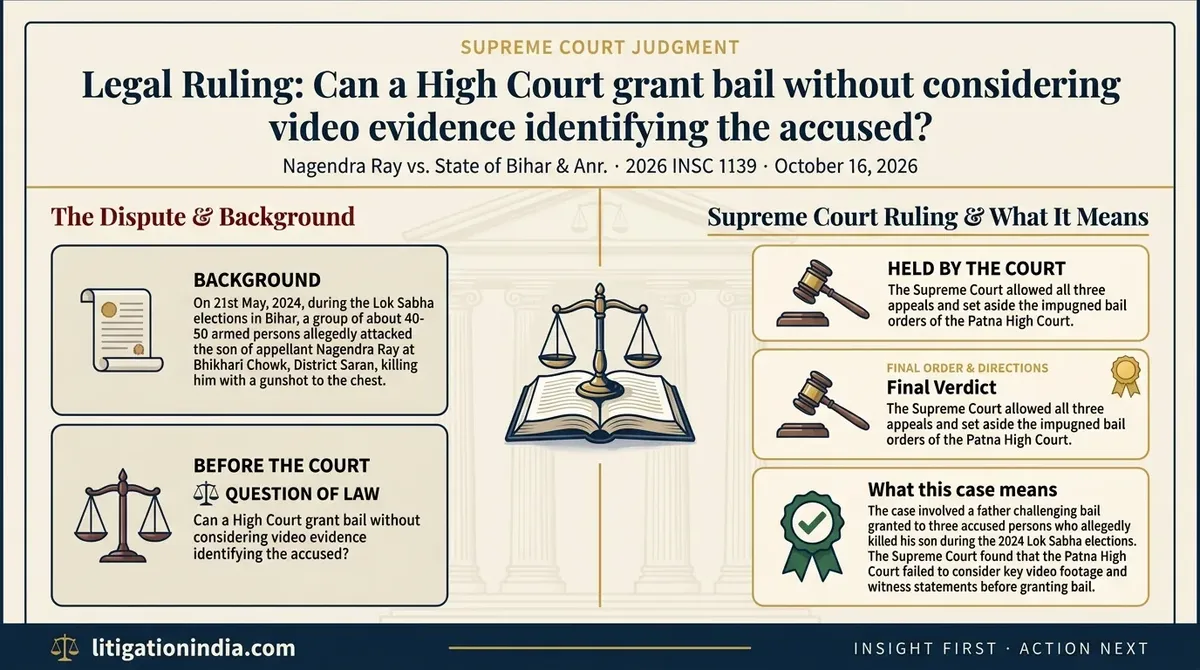
The case involved a father challenging bail granted to three accused persons who allegedly killed his son during the 2024 Lok Sabha elections. The Supreme Court found that the Patna High Court failed to consider key video footage and witness statements before granting bail. The Court set aside the bail orders and sent the matters back to the High Court for fresh consideration.

“The Supreme Court set aside bail orders granted by the Patna High Court for failure to consider video footage and witness statements identifying the accused in a murder case.”

Share:

Story Slides

Case at a glance1 / 6

Supreme Court of India

Bail Set Aside: Video Evidence Ignored by High Court

Nagendra Ray vs. State of Bihar & Anr. | 2026 INSC 1139

Court: Supreme Court of India; Date: October 16, 2026Bench: Justice Dipankar Datta and Justice Sheel NaguArea of Law: Criminal Law / BailFather of murder victim challenged bail granted to three accused by Patna High Court
Nagendra Ray vs. State of Bihar & Anr. · 2026 INSC 1139October 16, 2026
The legal question2 / 6

Can a High Court Grant Bail Without Considering Video Footage?

Core legal issue in this appeal

  • Appellant: High Court ignored police video footage placing accused at the murder scene.
  • Appellant: Witness statements under Section 161 CrPC identifying accused were not considered.
  • Respondent/Accused: High Court exercised discretion and granted bail after hearing parties.
  • Appellant: Sessions court had denied bail specifically relying on the same video footage.
Nagendra Ray vs. State of Bihar & Anr. · 2026 INSC 1139October 16, 2026
The Court's reasoning3 / 6

How the Court Reached Its Decision

Step-by-step reasoning of the Supreme Court

  1. 1Step 1: Sessions court denied bail relying on video footage and witness statements under Section 161 CrPC.
  2. 2Step 2: High Court granted bail but omitted reference to video footage in two of three cases.
  3. 3Step 3: In third case, High Court recorded submissions on footage but gave no independent analysis.
  4. 4Step 4: Supreme Court held that reasons are the backbone of judicial decisions, citing Shukla and Brothers (2010) 4 SCC 785.
  5. 5Step 5: Bail orders set aside; cases remitted to High Court for fresh, reasoned reconsideration.
Nagendra Ray vs. State of Bihar & Anr. · 2026 INSC 1139October 16, 2026
Key points4 / 6

Proper vs. Improper Approach in Bail Orders

Key distinction drawn by the Supreme Court

  • Proper: Court independently analyses all material evidence including video footage and witness statements.
  • Proper: Order must reflect what weighed with the court in granting or declining bail.
  • Improper: Merely recording parties' submissions without any independent assessment.
  • Improper: Ignoring evidence that was central to the sessions court's denial of bail.
Reason is the very life of law — Shukla and Brothers (2010) 4 SCC 785
Nagendra Ray vs. State of Bihar & Anr. · 2026 INSC 1139October 16, 2026
The verdict5 / 6

The Supreme Court's Final Decision

Nagendra Ray vs. State of Bihar & Anr. | 2026 INSC 1139

  • The Fact: Three accused were granted bail by the Patna High Court without considering key video footage and witness statements.
  • The Law: Courts must provide independent reasoning based on all material evidence; recording submissions alone is insufficient.
  • The Result: All three bail orders set aside; matters remitted to High Court for fresh consideration with accused on interim bail.
Appeals allowed; impugned bail orders set aside; matters revived in High Court; accused to remain on interim bail till disposal.
Nagendra Ray vs. State of Bihar & Anr. · 2026 INSC 1139October 16, 2026
Why it matters6 / 6

Why This Judgment Matters for Ordinary People

Practical significance

  • Victims' families can challenge bail orders where courts failed to consider available video or digital evidence.
  • Courts granting bail in serious cases must give reasoned orders, not just record what parties argued.
  • Victims have a right to be heard, and material evidence in their favour cannot be silently ignored.
  • High Courts must independently assess evidence, especially when sessions courts have denied bail on that evidence.
A bail order without independent reasoning on available evidence is legally defective and can be set aside.
Nagendra Ray vs. State of Bihar & Anr. · 2026 INSC 1139October 16, 2026

At a glance (infographic)

Nagendra Ray vs. State of Bihar & Anr. — infographic summary
Download infographic

In short

This case arose from a violent incident on 21st May, 2024, during the Lok Sabha elections, in which a group of approximately 40-50 armed individuals allegedly surrounded and attacked the son of the appellant, Nagendra Ray, at Bhikhari Chowk, District Saran, Bihar. Ramakant Solanki allegedly shot the appellant's son in the chest, killing him, while Ram Pratap Singh allegedly shot another person in the head. An FIR was registered under various sections of the Indian Penal Code, 1860 and the Arms Act, 1959. A chargesheet and a supplementary chargesheet were subsequently filed against the accused. The sessions court denied anticipatory bail to Kamakhya Singh and regular bail to Ram Pratap Singh and Ramakant Solanki, placing significant reliance on video footage of the incident that showed the accused present at the scene; in Ram Pratap Singh's case, the footage showed him holding a rifle. The Patna High Court, however, reversed these orders and granted bail to all three accused. The appellant, father of the deceased, challenged these bail orders before the Supreme Court. The Supreme Court found that the High Court entirely failed to consider the video footage in the cases of Kamakhya Singh and Ram Pratap Singh. As for Ramakant Solanki, while the High Court noted the Investigating Officer's submission about the footage, it provided no independent analysis of its impact on the bail prayer. Relying on Assistant Commissioner, Commercial Tax Department v. Shukla and Brothers (2010) 4 SCC 785, the Court emphasised that reasons are the backbone of judicial decisions and that merely recording submissions without independent assessment is inadequate. The Court set aside all three impugned bail orders and remitted the matters to the High Court for fresh reconsideration, while allowing the accused to remain on interim bail until the High Court finally disposes of the applications.

Background

On 21st May, 2024, during the Lok Sabha elections in Bihar, a group of about 40-50 armed persons allegedly attacked the son of appellant Nagendra Ray at Bhikhari Chowk, District Saran, killing him with a gunshot to the chest. An FIR was registered and a chargesheet filed against the accused under the IPC and the Arms Act. The sessions court denied bail to all three accused partly on the basis of video footage placing them at the scene.

The Decision

The Supreme Court allowed all three appeals and set aside the impugned bail orders of the Patna High Court. The matters were remitted to the High Court for fresh reconsideration of the anticipatory bail and regular bail applications, with the three accused allowed to continue on interim bail subject to the High Court's earlier conditions until final disposal.

Why it matters for you

This judgment reinforces that courts must actively consider all available evidence, including video footage and witness statements, before granting bail in serious criminal cases. It establishes that a bail order which merely records parties' submissions without independent judicial reasoning is legally insufficient. Victims and their families have a right to expect that courts will rigorously assess evidence before releasing accused persons.

Relevant Legal Provisions

Key Acts and sections cited or relied upon in this judgment

“These sections relate to rioting, common intention, murder, and attempt to murder; the FIR and chargesheet against the accused were registered and filed under these provisions.”
“These provisions deal with illegal possession and use of arms; the accused were charged under these sections for allegedly using firearms to kill and injure victims.”
“Section 161 governs recording of statements of witnesses by police; the High Court failed to consider such statements of witnesses who had identified the accused upon being shown video footage, which the Supreme Court found was a critical error.”

Full text of the judgment

Text extracted from Nagendra Ray vs. State of Bihar & Anr.. For the authoritative version refer to the Supreme Court of India's official website.

2026 INSC 1139

1 NON-REPORTABLE IN THE SUPREME COURT OF INDIA CRIMINAL APPELLATE JURISDICTION

CRIMINAL APPEAL NO. _____OF 2026 [ARISING OUT OF SLP (CRL.) NO. 2171 OF 2025]

NAGENDRA RAY …APPELLANT vs.

STATE OF BIHAR & ANR. …RESPONDENTS

CRIMINAL APPEAL NO. _____OF 2026 [ARISING OUT OF SLP (CRL.) NO. 4385 OF 2025]

NAGENDRA RAY …APPELLANT vs.

STATE OF BIHAR & ANR. …RESPONDENTS

CRIMINAL APPEAL NO. _____OF 2026 [ARISING OUT OF SLP (CRL.) NO. 6026 OF 2025]

NAGENDRA RAY …APPELLANT vs.

STATE OF BIHAR & ANR. …RESPONDENTS

O R D E R DIPANKAR DATTA, J.

1. Leave granted. 2. These appeals are at the instance of the father1 of the deceased, Chandan Ram. Appellant challenges the grant, by the Patna High

1 appellant Digitally signed by MANIK KUMAR Date: 2026.10.16 17:23:53 IST Reason: Signature Not Verified

2 Court2, of (i) anticipatory bail to an accused, Kamakhya Singh @ Deepu Singh, vide its order dated 23rd October, 2024 in CRM No. 66294/2024; (ii) regular bail to an accused, Ram Pratap Singh @ Ravi Kant Singh vide its order dated 20th December, 2024 in CRM No. 68542 of 2024 and (iii) regular bail to an accused, Ramakant Solanki @ Ramakant Singh vide its order dated 10th January, 2025 in CRM No.76397 of 2024. All such orders granting bail shall hereafter be referred to as the impugned orders. 3. The prosecution alleges that on 20th May, 2024, during the Lok Sabha elections, some persons misbehaved, abused and attempted to attack supporters of an RJD candidate without any provocation, pursuant to which an FIR was registered. Out of resentment, on 21st May, 2024, at approximately 7:00 AM, a large group of around 40-50 individuals (including accused Kamakhya Singh, Ram Pratap Singh and Ramakant Solanki) armed with deadly weapons surrounded the appellant’s son and others at Bhikhari Chowk. Ramakant Solanki shot the appellant’s son in the chest and Ram Pratap Singh shot Manoj Ram in the head. Deepak Kumar and Guddu Kumar, who were two others in the appellant’s son’s group, were also shot at by other assailants. Hearing the gunshots and the screams, the appellant along with others rushed to the spot while the accused fled the scene, firing indiscriminately as they escaped. Appellant’s son was declared dead at the hospital, with the others required medical attention.

2 High Court

3 4. Pursuant thereto, FIR No.346/2024 dated 21st May, 2024 was registered at Town Police Station, Chhapra Nagar, District Saran under Sections 147, 148, 149, 307, 302, 34 and 120B of the Indian Penal Code, 18603 and Section 27 of the Arms Act,19594 against Kamakhya Singh, Ram Pratap Singh and Ramakant Solanki along with other coaccused. Chargesheet5 was filed under Sections 147, 148, 149, 323, 307, 302 and 120B of the IPC, and Sections 25(1-B)(a), 26, 27 and 35 of the Arms Act against Kamakhya Singh, Ram Pratap Singh, Ramakant Solanki and other co-accused. A supplementary chargesheet6 against other co-accused persons has also been filed, and the trial against the accused herein is presently pending. 5. We have heard the learned counsel for the respective parties and have perused the impugned orders and the records before us. 6. At the outset, we note that Kamakhya Singh had initially approached the sessions court praying for anticipatory bail, while Ram Pratap Singh and Ramakant Solanki separately approached the sessions court praying for regular bail. Vide order dated 7th August, 2024, the sessions court denied anticipatory bail to Kamakhya Singh, and vide orders dated 7th August 2024 and 23rd September 2024, the sessions court denied regular bail to Ram Pratap Singh and Ramakant Solanki, respectively. One of the critical grounds considered by the sessions

3 IPC 4 Arms Act 5 No.510 of 2024 dated 17th August, 2024 6 No. 156 of 2025 dated 10th April, 2025

4 court in denying anticipatory bail to Kamakhya Singh and in denying bail to Ram Pratap Singh and Ramakant Solanki was a video footage of the incident obtained by the police which showed presence of the accused at the site of the incident. In Ram Pratap Singh’s case, the sessions court specifically recorded that he was seen holding a rifle in his hand. 7. On perusal of the impugned orders granting relief to Kamakhya Singh and Ram Pratap Singh, it appears that the High Court completely omitted and failed to consider the aforementioned video footage, though reference to such video footage is found in the sessions court’s orders. It also appears that the High Court, in all the impugned orders, failed to consider the statements of the witnesses under Section 161 of the Code of Criminal Procedure, 19737 who had identified the relevant accused upon being shown the video footage. 8. Insofar as Ramakant Solanki is concerned, even though the High Court recorded the submission of the Investigating Officer in respect of the video footage, it has failed to provide its own independent analysis or reasons as to whether this video footage adversely impacts Ramakant Solanki’s prayer for bail. Merely recording the submissions of the parties without any independent assessment of such submissions is not a proper approach while dealing with applications for bail. Reference to material, however concise they may be, ought to be made to show application of mind. Importantly, it is

5 ‘the reasons’ which form the backbone of all judicial decisions. We may briefly refer to a decision of this Court in Assistant Commissioner, Commercial Tax Department v. Shukla and Brothers8 to emphasize this point. It was held there as follows: 19. In the cases where the courts have not recorded reasons in the judgment, legality, propriety and correctness of the orders by the court of competent jurisdiction are challenged in the absence of proper discussion. The requirement of recording reasons is applicable with greater rigour to the judicial proceedings. The orders of the court must reflect what weighed with the court in granting or declining the relief claimed by the applicant…. … 24. Reason is the very life of law. When the reason of a law once ceases, the law itself generally ceases (Wharton's Law Lexicon). Such is the significance of reasoning in any rule of law. Giving reasons furthers the cause of justice as well as avoids uncertainty. As a matter of fact it helps in the observance of law of precedent. Absence of reasons on the contrary essentially introduces an element of uncertainty, dissatisfaction and give entirely different dimensions to the questions of law raised before the higher/appellate courts. In our view, the court should provide its own grounds and reasons for rejecting claim/prayer of a party whether at the very threshold i.e. at admission stage or after regular hearing, howsoever concise they may be. (emphasis ours)

9. Based on the High Court’s non-consideration of the video footage of the incident obtained by the police in respect of the accused herein, as well as its non-consideration of the statements of the witnesses under Section 161 Cr. PC who had identified the relevant accused upon being shown the video footage, we deem it appropriate to remit the matters to the High Court for fresh reconsideration of the respective prayers of the accused for anticipatory bail/bail.

8 (2010) 4 SCC 785

6 10. In view of the above, the appeals stand allowed and the impugned orders are set aside. Consequently, CRM No. 66294/2024, CRM No. 68542 of 2024 and CRM No.76397 of 2024 shall stand revived and restored on the file of the High Court. 11. Though we have set aside the impugned orders, we clarify that the accused Kamakhya Singh, Ram Pratap Singh and Ramakant Solanki shall continue to remain on interim bail, subject to such terms and conditions as were imposed by the High Court, till such time the roster Bench of the High Court finally disposes of the aforementioned applications for anticipatory bail/bail upon hearing the accused, the complainant and the police. Subject to its convenience, the High Court may list the said applications for being heard together. 12. We clarify that the observations made in this order shall not be treated as findings on the merits of the case. All contentions/objections on merits are kept open.

………………………………J.

(DIPANKAR DATTA)

..……….……………………J. (SHEEL NAGU) NEW DELHI; OCTOBER 16, 2026.

AI-assisted summary, reviewed and verified by our editorial team.

In the Court's words

“Merely recording the submissions of the parties without any independent assessment of such submissions is not a proper approach while dealing with applications for bail.”
“Reference to material, however concise they may be, ought to be made to show application of mind.”
“Reason is the very life of law. When the reason of a law once ceases, the law itself generally ceases.”
“The orders of the court must reflect what weighed with the court in granting or declining the relief claimed by the applicant.”

Need help with your case?

Facing a similar legal challenge in the Supreme Court or High Court? Connect with our pro bono volunteer advocates today.

Request Free Callback
Litigation India

Insight First, Action Next. A public-service initiative to make justice understandable for every Indian.

contact@litigationindia.com

+91 9956486585

New Delhi, India

Quick Links

Our Mission

To empower ordinary citizens, litigants, and junior advocates across India by translating complex Supreme Court of India judgments into editor-verified, plain-language summaries in both English and Hindi. We aim to bridge the gap between judicial proceedings and everyday citizens by delivering verified legal insights and offering free, pro bono guidance from experienced Supreme Court advocates—ensuring no individual suffers injustice merely for lack of correct guidance.

Legal Disclaimer: The information provided on this website is for general informational purposes only and does not constitute legal advice. Accessing this website or receiving any guidance does not create an attorney-client relationship. A formal attorney-client relationship is established only upon signing a formal engagement agreement with a lawyer. Litigation India is an informational platform — it does not provide legal representation, legal services, or legal advice.

Disclaimer: These summaries are provided for general public understanding only and do not constitute legal advice. Please consult a qualified advocate before acting on any information relating to your specific matter.

© 2026 Litigation India. All rights reserved.