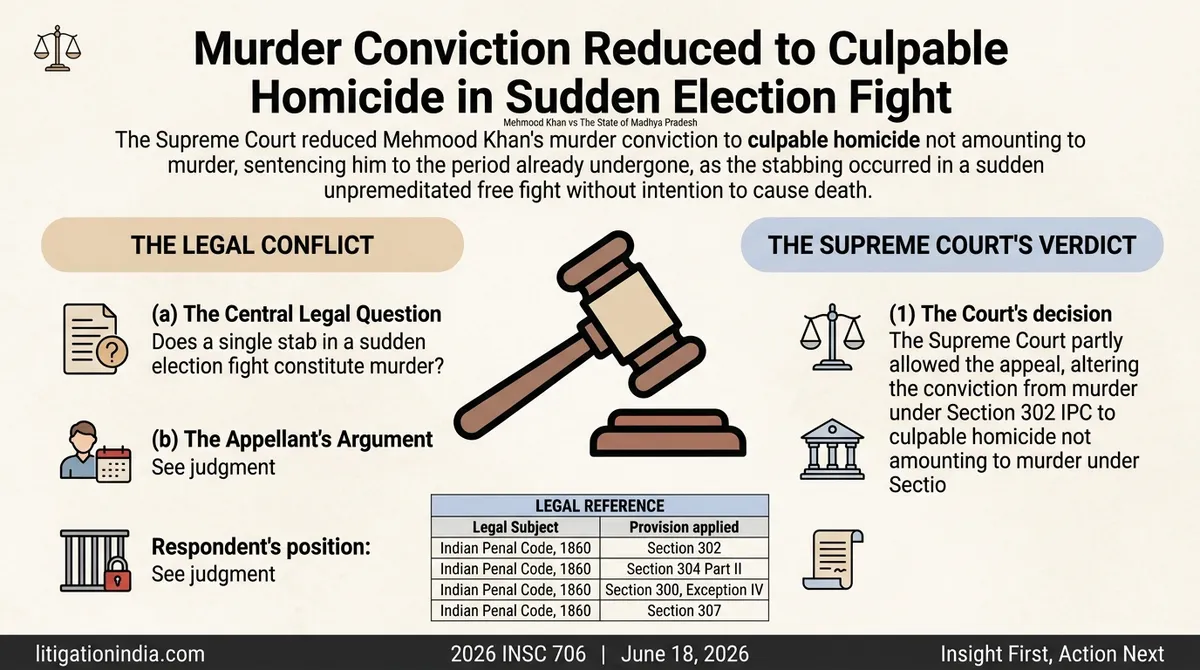
Full text of the judgment
Text extracted from Mehmood Khan vs The State of Madhya Pradesh. For the authoritative version refer to the Supreme Court of India's official website.
2026 INSC 706 Page 1 of 16
REPORTABLE IN THE SUPREME COURT OF INDIA CRIMINAL APPELLATE JURISDICTION CRIMINAL APPEAL NO. 1217 OF 2021
MEHMOOD KHAN
… APPELLANT VERSUS THE STATE OF MADHYA PRADESH
… RESPONDENT
J U D G E M E N T
V. MOHANA, J. 1. The present appeal is directed against the common judgment and order dated 12.03.2019 passed by the High Court of Madhya Pradesh, Bench at Indore, in Criminal Appeal No.1376 of 2008 (preferred by the appellant along with co-accused Kismatulla @ Guddu) and Criminal Appeal No.1331 of 2008 (preferred by coaccused Hatim Khan), which were heard and disposed of together. Insofar as the present appellant is concerned, the High Court upheld his conviction under Section 302 of the Indian Penal Code, 1860 (“IPC”) for the murder of Aziz Khan and affirmed the sentence Digitally signed by NITIN TALREJA Date: 2026.07.15 16:52:34 IST Reason: Signature Not Verified
Page 2 of 16
of imprisonment for life, and upheld his conviction under Section 307 IPC for attempting to murder Riyasat Khan and the sentence of five years’ rigorous imprisonment.
2. The conviction of Hatim Khan under Section 307 IPC was likewise affirmed, while the conviction of Kismatulla @ Guddu under Section 307 IPC was set aside and he was acquitted. Hatim Khan’s own Special Leave Petition, Diary No.19837 of 2019, has since been dismissed by this Court vide order dated 08.11.2019. The present appeal is accordingly confined to the conviction and sentence of the appellant, Mehmood Khan.
3. When the Special Leave Petition came up for admission on 16.09.2020, this Court, after condoning the delay, issued notice confined to the quantum of sentence. By order dated 08.10.2021, leave was granted and the appellant was enlarged on bail, having by then undergone incarceration for more than eleven years.
Page 3 of 16
4. At the final hearing, learned counsel additionally addressed us on whether the conviction under Section 302 IPC warrants alteration to one under Section 304 IPC, and we have considered that issue along with the question of sentence.
5. Consequently, the short question that survives is whether the act attributed to the appellant amounts to murder punishable under Section 302 IPC or culpable homicide not amounting to murder, and what sentence would meet the ends of justice.
A. BRIEF FACTS 6. The case has its origin in the election of the Parent-Teacher Association of the Government High School, Village Kotrikalan, Police Station Kurawar, District Rajgarh (Madhya Pradesh), where candidates set up by two rival groups — one led by the deceased, Aziz Khan, and the other by the appellant — were contesting on 11.10.2006.
Page 4 of 16
7. The appellant’s group allegedly attempted to deter one Devchand from casting his vote and threatened his wife; on this being objected to by Aziz Khan, an exchange of abuses between the two groups escalated into a clash, during which the appellant inflicted a blow with a Gupti (a sword-cane) on the right side of Aziz Khan’s abdomen. Riyasat Khan and Shafiq Khan, who intervened to rescue Aziz Khan, were also assaulted and injured.
8. Cross-FIRs were registered at the same Police Station — FIR No.291 of 2006 by the appellant’s group and FIR No.292 of 2006 by Aziz Khan, the latter also being read as his dying declaration.
9. Aziz Khan was referred, through the Primary Health Centre, Kurawar, to Hamidia and then LBS Hospital, Bhopal; his formal dying declaration recorded on 12.10.2006 by the Executive Magistrate again attributed the Gupti blow to the appellant. He was later shifted to Peoples’ Hospital and then Bhopal Memorial Hospital, where he died on 04.12.2006 —
Page 5 of 16
fifty-four days after the incident — of cardiac arrest resulting from septicemia with duodenal perforation traceable to the stab injury; the postmortem attributed death to failure of the heart and respiratory system consequent upon peritonitis.
10. On his death, the case was converted to one under Section 302 IPC. During investigation, thirteen persons were arrested and several weapons, including a Gupti, were recovered at their instance; a chargesheet was filed and the accused were tried as Sessions Case No.22 of 2007, pleading false implication owing to prior enmity and asserting that the complainant’s side were the aggressors.
B. FINDINGS OF THE TRIAL COURT 11. Holding that the occurrence was a free fight attracting no charge under Section 147 IPC, the Trial Court examined the role of each accused individually.
12. Relying on the deceased’s dying declarations and the medical evidence, it found that the appellant had
Page 6 of 16
inflicted the fatal abdominal injury on Aziz Khan and that the interval of fifty-four days before death did not detract from its gravity or from the absence of any negligence in treatment.
13. It accordingly convicted the appellant under Section 302 IPC, sentencing him to life imprisonment with a fine of Rs.5,000 (in default, one year’s simple imprisonment). On the injuries to Riyasat Khan — caused on vital parts, namely the head and abdomen — the Trial Court convicted the appellant, along with Hatim and Kismatulla, under Section 307 IPC, sentencing each to five years’ rigorous imprisonment with a fine of Rs.1,000 (in default, six months’ simple imprisonment), to run concurrently with the appellant’s other sentence.
14. The prosecution having failed to establish who caused the stab injury to Shafiq Khan, all accused were given the benefit of doubt on that count, and the remaining accused were acquitted.
Page 7 of 16
C. THE IMPUGNED JUDGMENT OF THE HIGH COURT 15. The High Court affirmed that the death of Aziz Khan was homicidal, holding that the interval of fiftyfour days did not break the chain of causation since death resulted from an infection that developed from the very abdominal injury.
16. It rejected the challenge based on an alleged change in the place of occurrence, finding the two locations spoken to by witnesses to be proximate, and noted that the injuries on the appellant’s side were simple and did not establish a case of private defence. On this basis, it upheld the appellant’s conviction under Sections 302 and 307 IPC, as well as Hatim Khan’s conviction under Section 307 IPC, and confirmed the sentences awarded by the Trial Court.
17. However, finding no specific act attributed to Kismatulla @ Guddu, it set aside his conviction under Section 307 IPC and acquitted him.
Page 8 of 16
D. CONTENTIONS 18. Learned counsel for the appellant did not seriously assail the concurrent findings on the homicidal nature of Aziz Khan’s death or the appellant’s authorship of the fatal injury.
19. She primarily submitted that the occurrence was an unpremeditated, sudden fight arising in the heat of passion during an election, in which both sides were armed and injured; that the appellant inflicted only a solitary blow which he neither repeated nor followed up; and that he took no undue advantage and acted in no cruel or unusual manner, bringing the case within Exception IV to Section 300 IPC.
20. She further submitted that death, occurring fiftyfour days later on account of a supervening infection, negatived any intention to cause death, and that the offence would, at the highest, fall under Section 304 Part II IPC.
Page 9 of 16
21. Learned counsel for the respondent-State supported the judgments of the Courts below, submitting that the deliberate and forceful stab into the abdomen — sufficient to injure the duodenum — satisfied the description of murder under Section 300 IPC, and that the interval between injury and death was immaterial once death was shown to result from that injury.
E. ANALYSIS AND FINDINGS 22. We have considered the submissions and perused the record. The question is whether the appellant’s act attracts Section 302 IPC or falls under Section 304 Part I or Part II IPC.
23. The distinction between murder and culpable homicide not amounting to murder has engaged this Court in a catena of decisions. In Virsa Singh v. State of Punjab,1 Vivian Bose, J., held that:
“to bring a case within clause thirdly of Section 300, IPC, the prosecution must establish the presence of bodily injury, its nature, an intention to inflict that
1 1958 SCR 1495.
Page 10 of 16
particular injury (that it was not accidental or unintentional or that some other injury was intended) and that the injury so intended was sufficient in the ordinary course of nature to cause death. It is the intention to inflict the particular injury found to be present that is decisive and it is to be gathered from the totality of the circumstances and not from the mere fact that the injury is inflicted.”
24. This test was authoritatively restated in Pulicherla Nagaraju v. State of A.P.,2 where this Court cautioned that the question of intention must be decided with care, so that cases of murder are not diluted into culpable homicide, nor cases of culpable homicide elevated into murder, and set out a non-exhaustive list of circumstances relevant to that determination:
“…the intention to cause death can be gathered generally from a combination of a few or several of the following, among other, circumstances: (i) nature of the weapon used; (ii) whether the weapon was carried by the accused or was picked up from the spot; (iii) whether the blow is aimed at a vital part of the body; (iv) the amount of force employed in causing injury; (v) whether the act was in the course of sudden quarrel or sudden fight or free for all fight; (vi) whether the incident occurs by chance or whether there was any premeditation; (vii) whether there was any prior enmity or whether the deceased was a stranger; (viii) whether there was any
2 (2006) 11 SCC 444.
Page 11 of 16
grave and sudden provocation, and if so, the cause for such provocation; (ix) whether it was in the heat of passion; (x) whether the person inflicting the injury has taken undue advantage or has acted in a cruel and unusual manner; (xi) whether the accused dealt a single blow or several blows.”
25. In Pulicherla (supra) itself, this Court declined to interfere because the accused had carried a dangerous weapon to the spot, there was prior enmity, the deceased was unarmed, there was no sudden quarrel or fight, and the fatal blow was driven with great force into a vital part just below the neck.
26. The present case is materially different: both the Courts below concurrently found that members of the two groups were present at the polling booth by reason of the election and not by any prior design, that the quarrel over the casting of votes was sudden, and that the encounter was a free fight — findings on which the charges under Sections 148 and 149 IPC themselves failed, being inconsistent with any prior planning.
Page 12 of 16
27. The fight arose from an objection to the restraint of a voter, escalating through an exchange of abuses into a clash in which both groups, already armed, sustained injuries; there was no interval permitting tempers to cool, and the fatal blow was struck in that instantaneous fight. The mere fact that both sides carried weapons in the charged atmosphere of a contested village election does not convert a sudden mutual fight into a premeditated assault.
28. The appellant inflicted a solitary blow, which he neither repeated nor followed up, and there is nothing to suggest that he took undue advantage or acted in a cruel or unusual manner.
29. In Sukhbir Singh v. State of Haryana,3 this Court held that Exception IV applies where the offence is committed without premeditation, in a sudden fight in the heat of passion upon a sudden quarrel, without the offender taking undue advantage or acting cruelly or unusually — a description that fits the case before us.
3 (2002) 3 SCC 327.
Page 13 of 16
30. Applying the test in Virsa Singh (supra), we are satisfied that the prosecution has not established an intention to cause death. The appellant struck a single blow in the course of a sudden free fight; it is not shown that he intended the Gupti to penetrate to the depth that injured the duodenum, and death did not follow on the spot or soon after but only fiftyfour days later, from an infection that developed from the injury.
31. While a single blow does not by itself reduce murder to culpable homicide, it is not relied on in isolation here. Taken together with the sudden and unpremeditated free fight, the mutual provocation, the injuries on both sides, the absence of any prior design to kill, and the absence of repetition or undue advantage, these circumstances establish knowledge that the act was likely to cause death, but not an intention to cause death or to cause an injury sufficient in the ordinary course of nature to cause death. The case therefore falls within Exception IV
Page 14 of 16
to Section 300 IPC and is punishable under Section 304 Part II IPC.
32. As regards the conviction under Section 307 IPC for the injuries to Riyasat Khan, both Courts below concurrently found that the stab wound above the umbilicus, together with four incised wounds including those on the cheek and scalp, established the requisite intention or, at the least, knowledge that death, had it ensued, would have made the assailants guilty of murder — it being the intention or knowledge of the offender, and not the ultimate gravity of the injury, that is determinative under Section 307 IPC. We see no reason to disturb this concurrent finding.
33. On sentence, we may note that the appellant is about fifty-eight years of age; the occurrence was the unpremeditated product of a sudden fight; and he has already undergone more than eleven years of actual incarceration, having been on bail since 08.10.2021. Having altered the conviction to Section 304 Part II IPC, we sentence him to the period already undergone.
Page 15 of 16
CONCLUSION AND DIRECTIONS 34. In the result, the appeal is partly allowed in the following terms:- (i) The conviction of the appellant, Mehmood Khan, under Section 302 IPC is altered to one under Section 304 Part II IPC; (ii) The sentence of imprisonment for life under Section 302 IPC is set aside; for the offence under Section 304 Part II IPC, the appellant is sentenced to the period already undergone; (iii) The conviction under Section 307 IPC is affirmed, and the sentence of five years’ rigorous imprisonment thereunder, having run concurrently, is treated as already undergone; (iv) The fine, if already deposited, shall not be refunded; if not deposited, the default sentence shall not be enforced, having regard to the period of incarceration already undergone; and
Page 16 of 16
(v) The appellant’s bail bonds shall stand discharged. 35. Pending applications, if any, shall stand disposed of.
………………………………………………………,CJI.
[SURYA KANT]
………………………………………………………………,J.
[V. MOHANA]
NEW DELHI; JUNE 18, 2026.