Landmark Supreme Court of India rulings, explained in clear, plain language.
Filter by Act / Section
Showing 12 of 12 judgments
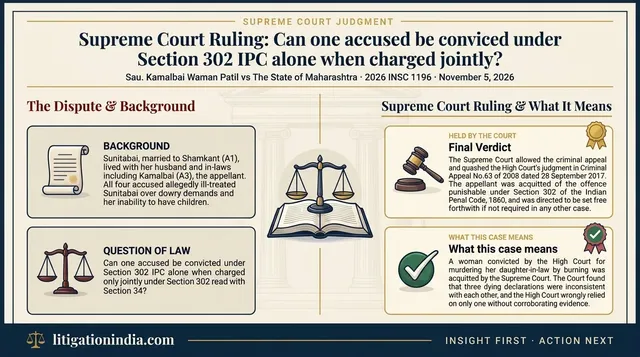
Can one accused be convicted under Section 302 IPC alone when charged only jointly under Section 302 read with Section 34?
Sau. Kamalbai Waman Patil vs The State of Maharashtra
The Supreme Court acquitted the appellant by holding that the High Court wrongly reversed her acquittal by relying on a single inconsistent dying declaration without corroboration and by convicting her under Section 302 IPC alone when the charge was only under Section 302 read with Section 34 IPC.
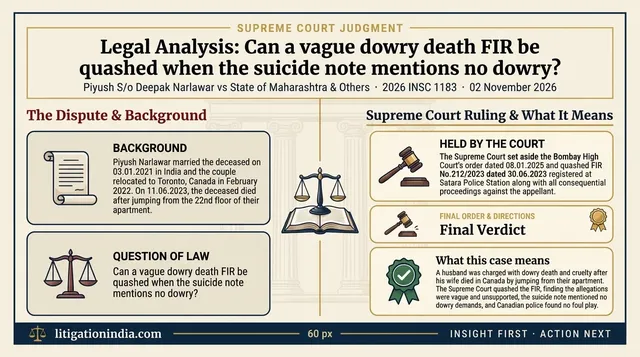
Can a vague dowry death FIR be quashed when the suicide note mentions no dowry?
Piyush S/o Deepak Narlawar vs State of Maharashtra & Others
The Supreme Court quashed the dowry death FIR against the husband, holding the allegations were vague, unsupported by evidence, and continuation of prosecution would be an abuse of process.
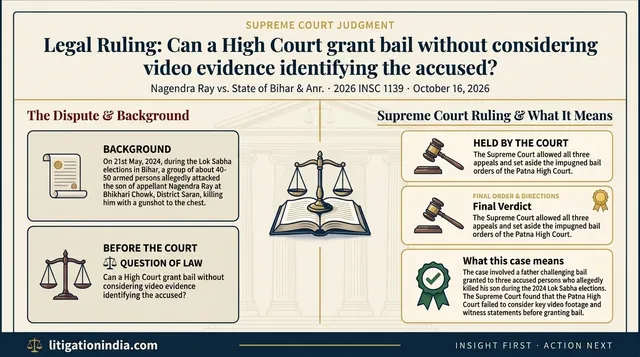
Can a High Court grant bail without considering video evidence identifying the accused?
Nagendra Ray vs. State of Bihar & Anr.
The Supreme Court set aside bail orders granted by the Patna High Court for failure to consider video footage and witness statements identifying the accused in a murder case.
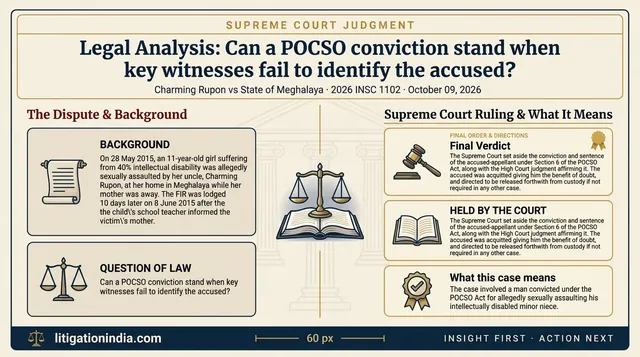
Can a POCSO conviction stand when key witnesses fail to identify the accused?
Charming Rupon vs State of Meghalaya
The Supreme Court acquitted the accused under POCSO Act, finding the prosecution evidence riddled with identification failures, witness tutoring, and unexplained omissions.
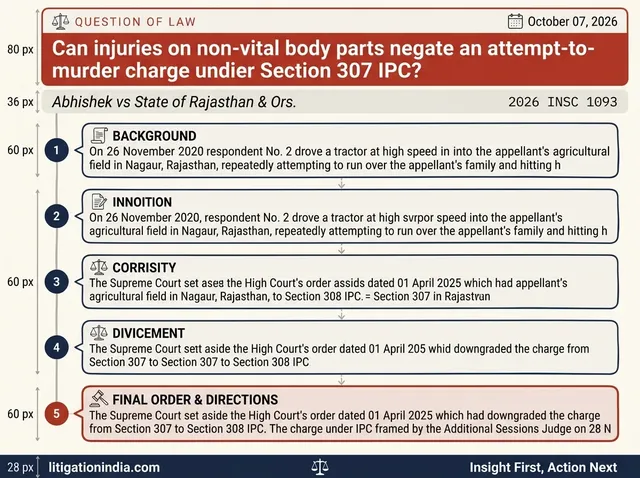
Can injuries on non-vital body parts negate an attempt-to-murder charge under Section 307 IPC?
Abhishek vs State of Rajasthan & Ors.
The Supreme Court restored the Section 307 IPC charge, holding that injuries on non-vital body parts do not negate an attempt-to-murder charge if the requisite intention is evident.
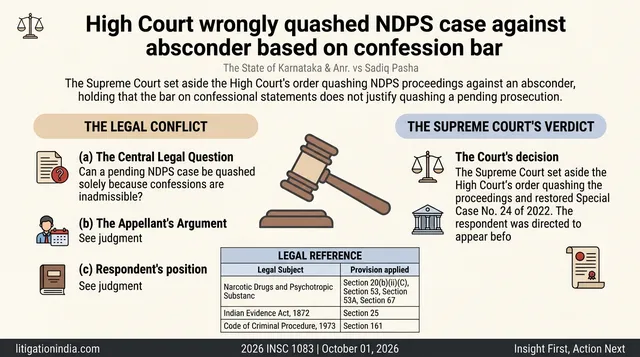
Can a pending NDPS case be quashed solely because confessions are inadmissible?
The State of Karnataka & Anr. vs Sadiq Pasha
The Supreme Court set aside the High Court's order quashing NDPS proceedings against an absconder, holding that the bar on confessional statements does not justify quashing a pending prosecution.
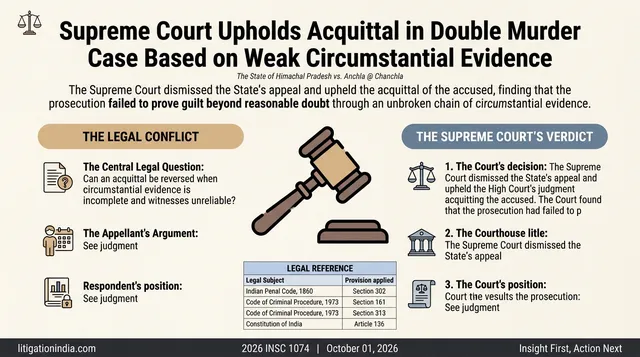
Can an acquittal be reversed when circumstantial evidence is incomplete and witnesses unreliable?
The State of Himachal Pradesh vs. Anchla @ Chanchla
The Supreme Court dismissed the State's appeal and upheld the acquittal of the accused, finding that the prosecution failed to prove guilt beyond reasonable doubt through an unbroken chain of circumstantial evidence.
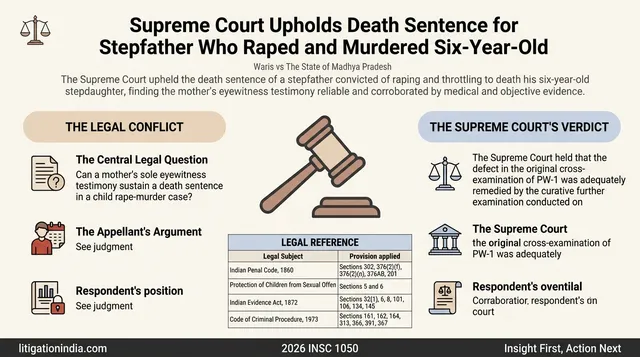
Can a mother's sole eyewitness testimony sustain a death sentence in a child rape-murder case?
Waris vs The State of Madhya Pradesh
The Supreme Court upheld the death sentence of a stepfather convicted of raping and throttling to death his six-year-old stepdaughter, finding the mother's eyewitness testimony reliable and corroborated by medical and objective evidence.
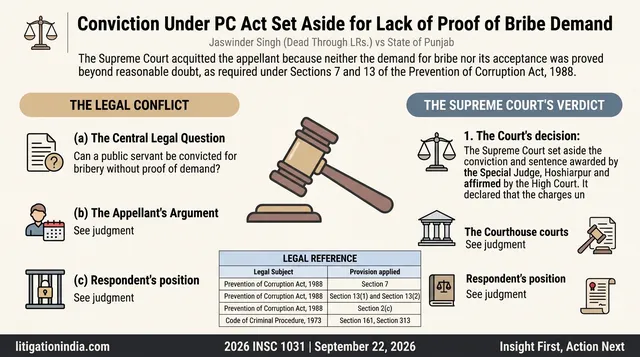
Can a public servant be convicted for bribery without proof of demand?
Jaswinder Singh (Dead Through LRs.) vs State of Punjab
The Supreme Court acquitted the appellant because neither the demand for bribe nor its acceptance was proved beyond reasonable doubt, as required under Sections 7 and 13 of the Prevention of Corruption Act, 1988.
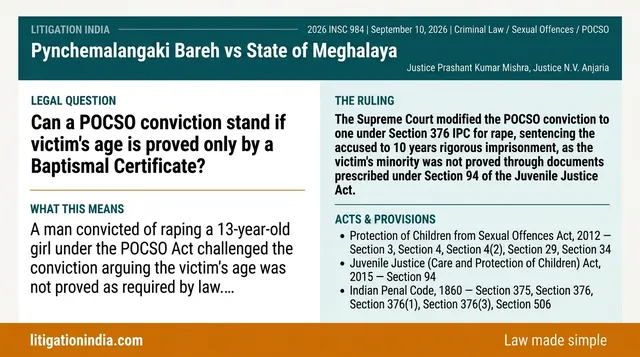
Can a POCSO conviction stand if victim's age is proved only by a Baptismal Certificate?
Pynchemalangaki Bareh vs State of Meghalaya
The Supreme Court modified the POCSO conviction to one under Section 376 IPC for rape, sentencing the accused to 10 years rigorous imprisonment, as the victim's minority was not proved through documents prescribed under Section 94 of the Juvenile Justice Act.
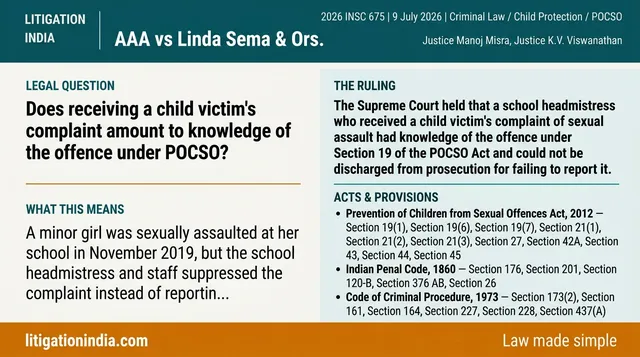
Does receiving a child victim's complaint amount to knowledge of the offence under POCSO?
AAA vs Linda Sema & Ors.
The Supreme Court held that a school headmistress who received a child victim's complaint of sexual assault had knowledge of the offence under Section 19 of the POCSO Act and could not be discharged from prosecution for failing to report it.
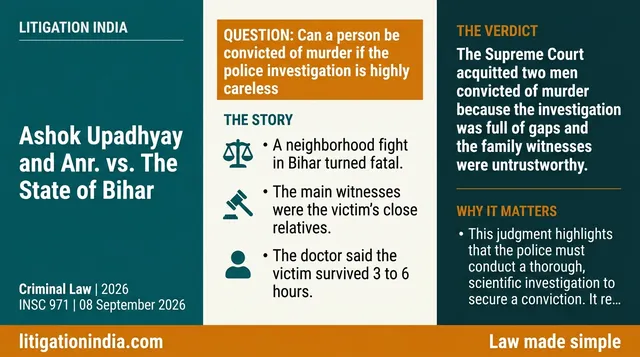
Can a person be convicted of murder if the police investigation is highly careless
Ashok Upadhyay and Anr. vs. The State of Bihar
The Supreme Court acquitted two men convicted of murder because the investigation was full of gaps and the family witnesses were untrustworthy.
You have reached the end — all 12 judgments loaded.