
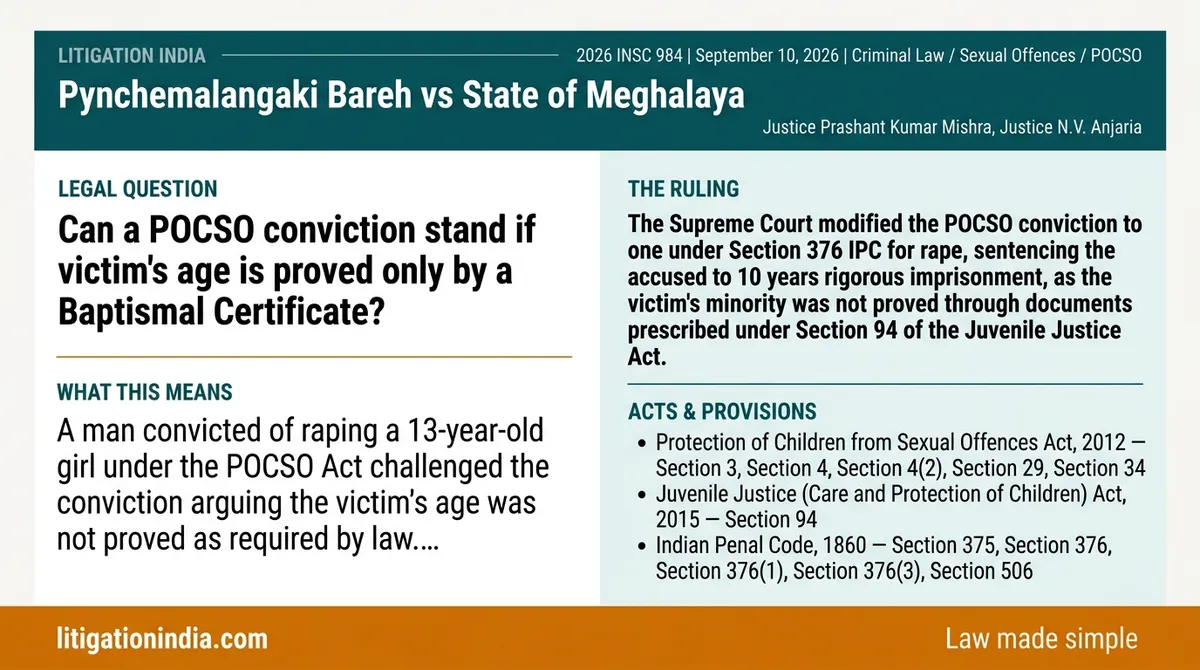
Can a POCSO conviction stand if victim's age is proved only by a Baptismal Certificate?
POCSO Conviction Modified to IPC Rape Where Victim Age Not Proved Under JJ Act
Case: Pynchemalangaki Bareh vs State of MeghalayaCitation: 2026 INSC 984Decided on: September 10, 2026
What this case means
A man convicted of raping a 13-year-old girl under the POCSO Act challenged the conviction arguing the victim's age was not proved as required by law. The Supreme Court held that since only a Baptismal Certificate was used and not the documents prescribed under Section 94 of the Juvenile Justice Act, the POCSO charge failed. However, the Court convicted him under Section 376 IPC for rape, sentencing him to 10 years rigorous imprisonment.
“The Supreme Court modified the POCSO conviction to one under Section 376 IPC for rape, sentencing the accused to 10 years rigorous imprisonment, as the victim's minority was not proved through documents prescribed under Section 94 of the Juvenile Justice Act.”
Story Slides
In short
The appellant Pynchemalangaki Bareh was convicted by the Special POCSO Court and the Meghalaya High Court for penetrative sexual assault on a 13-year-old girl under Section 3/4 of the POCSO Act and criminal intimidation under Section 506 IPC, sentenced to 20 years rigorous imprisonment. Before the Supreme Court, he challenged the conviction primarily arguing that the victim's minority was not proved in accordance with Section 94 of the Juvenile Justice (Care and Protection of Children) Act, 2015, since the prosecution relied solely on a Baptismal Certificate issued by the Khasi Jaintia Presbyterian Assembly rather than on school birth certificates, matriculation certificates, municipal birth certificates, or an ossification test as required by law. The Supreme Court accepted this argument, holding that a Baptismal Certificate is not one of the documents prescribed under Section 94 of the JJ Act for proving a victim's age in POCSO cases. Referring to its earlier judgments in Jarnail Singh, State of M.P. v. Anoop Singh, and P. Yuvaprakash, the Court reaffirmed the mandatory hierarchy of documents for age determination. However, the Court held that the factum of rape was conclusively established by medical evidence, FSL reports, the victim's testimony, and corroboration from multiple witnesses. Applying Section 464 and Section 386 of the Cr.PC and Section 222, the Court held that the accused could be convicted under Section 376 IPC for rape even without a separate charge being framed, since the ingredients of Section 3 POCSO Act and Section 375 IPC are identical, and the accused had a full opportunity to defend himself. The Court accordingly modified the conviction, sentencing the appellant to 10 years rigorous imprisonment and a fine of Rs. 10,000 under Section 376 IPC, while confirming the conviction and sentence under Section 506 IPC.
Need clarity on a similar legal issue?
Request free pro bono guidance from a Supreme Court Advocate.
Background
On 26 November 2019, the victim, a 13-year-old girl from Sutnga village, East Jaintia Hills, Meghalaya, was allegedly raped by the appellant, a resident of the same village, at Mokoidaling. An FIR was lodged on 27 November 2019 by the victim's mother. The case was investigated by Khliehriat Women Police Station and a charge-sheet was filed. The Trial Court convicted the appellant under POCSO Act and Section 506 IPC after examining 14 prosecution witnesses, and the High Court of Meghalaya upheld the conviction in 2024.
The Decision
The Supreme Court held that the prosecution failed to prove the victim's minority as required under Section 94 of the JJ Act since only a Baptismal Certificate was produced, and accordingly the POCSO conviction was not sustainable. However, finding rape conclusively established by medical and other evidence, the Court convicted the appellant under Section 376 IPC and sentenced him to 10 years rigorous imprisonment with a fine of Rs. 10,000, while confirming the conviction under Section 506 IPC. The appeal was partly allowed.
Why it matters for you
This judgment clarifies that in POCSO cases, a victim's age cannot be proved merely through a Baptismal Certificate — only school certificates, municipal birth certificates, or medical tests as prescribed by Section 94 of the JJ Act are acceptable. It also establishes that when a POCSO charge fails due to inability to prove the victim's minority, courts can still convict the accused for rape under IPC if the act is otherwise proved, preventing guilty persons from escaping punishment on technical grounds.
Relevant Legal Provisions
Key Acts and sections cited or relied upon in this judgment
“Section 3 defines penetrative sexual assault and Section 4 prescribes punishment; the Court found the POCSO charge unsustainable as the victim's minority was not proved under the prescribed statutory procedure, and modified the conviction accordingly.”
“Section 94 prescribes the mandatory procedure for age determination — first using school birth certificate or matriculation certificate, then municipal birth certificate, and only lastly an ossification test; the Court held the prosecution failed to follow this procedure, rendering the POCSO conviction unsustainable.”
“Section 375 defines rape and Section 376 prescribes punishment; the Court held that since the actus reus under Section 375 IPC and Section 3 POCSO Act is the same, the accused could be convicted under Section 376 IPC even without a specific charge, and confirmed the Section 506 criminal intimidation conviction.”
“Section 464 provides that omission to frame a charge does not vitiate trial unless failure of justice is occasioned; Section 386 gives appellate courts power to alter findings and sentences; Section 222 allows conviction for minor cognate offences — all applied to convict the accused under Section 376 IPC despite no charge being framed under it.”
“The defence argued the Baptismal Certificate was inadmissible as a private document not falling under Section 35 as a public document; the Court did not rely on the Baptismal Certificate but rejected it for a different reason — it is not one of the documents prescribed under Section 94 of the JJ Act for proving age in POCSO cases.”
AI-assisted summary, reviewed and verified by our editorial team.
In the Court's words
“Since the document itself is not the one prescribed under Section 94 of the JJ Act, we are of the considered view that the prosecution has failed to prove the age of the victim in the manner required under Section 94 of the JJ Act.”
“Exaggerated devotion to the rule of benefit of doubt must not nurture fanciful doubts or lingering suspicion and thereby destroy social defence. Justice cannot be made sterile on the plea that it is better to let a hundred guilty escape than punish an innocent.”
“When the accused has been given an opportunity to defend himself against an offence under Section 3 of the POCSO Act, being of the same nature as offence under Section 376 of the IPC, there is no hesitation in holding that in event of prosecution's failure to prove victim's minority, there would be no failure of justice in proceeding against him under a charge of Section 376 of the IPC.”
“The object of the Code is to ensure that an accused person gets a full and fair trial along certain well-established and well-understood lines that accord with our notions of natural justice.”
Need help with your case?
Facing a similar legal challenge in the Supreme Court or High Court? Connect with our pro bono volunteer advocates today.
Related Supreme Court services