Accused acquitted of murder due to poor investigation and suspicious witness testimonies
Ashok Upadhyay and Anr. vs. The State of Bihar
The big legal question
Can a person be convicted of murder if the police investigation is highly careless
What this case means
This case is about two men convicted of murder during a family brawl. The Supreme Court cleared them because the police investigation was extremely poor, and the family's stories had major contradictions. It shows that courts will not convict anyone if there is any reasonable doubt or unfair framing.
“The Supreme Court acquitted two men convicted of murder because the investigation was full of gaps and the family witnesses were untrustworthy.”
Story Slides
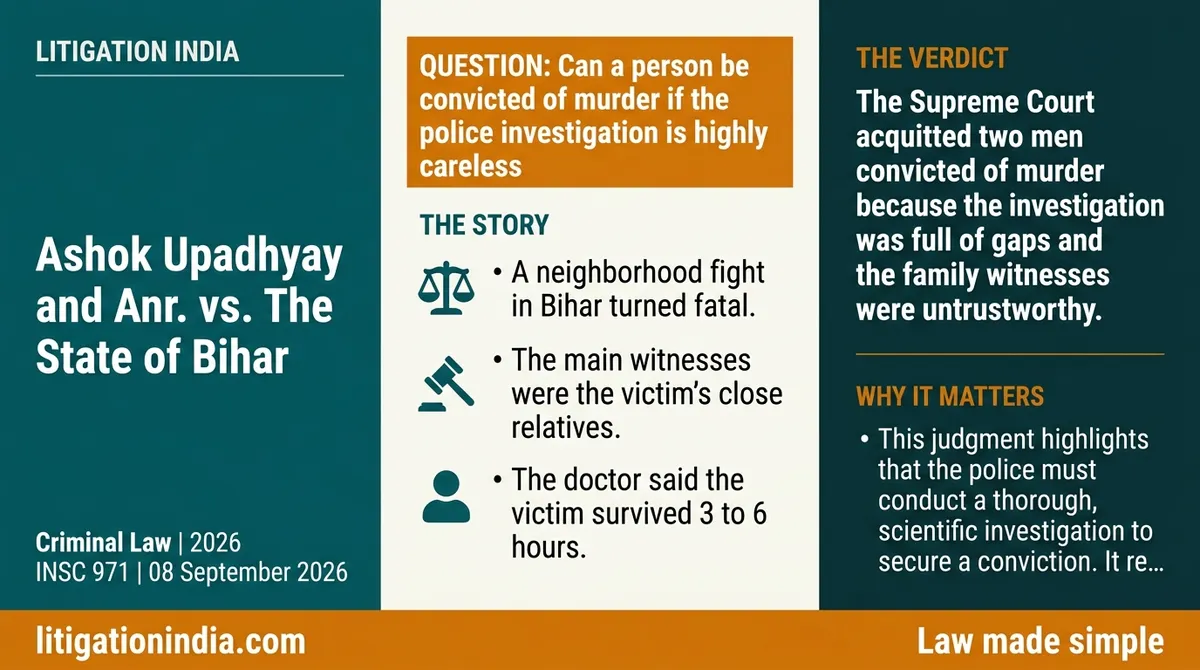
In short
This case arose from a dispute between two families over a blocked drain causing waterlogging in Bihar. During a fight, a man was shot and killed. The Trial Court and High Court convicted two accused persons for murder and using illegal weapons. However, the Supreme Court reversed this decision and acquitted them. The Court noticed major flaws in the prosecution's story. First, the medical report showed that the victim did not die instantly and could have survived for three to six hours. Despite this, his sons carried his body to the police station instead of rushing him to a hospital, which is highly unnatural behavior. Second, the eyewitnesses, who were close relatives, gave contradictory statements. Some said they took him to the hospital, while others admitted taking him to the police station. An independent neighbor claimed to be with a son, but the son never mentioned him. Third, the police investigation was extremely poor. The Investigating Officer did not prepare a map of the crime scene, failed to recover the weapons, and did not find any blood stains because of rain, nor did he seize blood-stained clothes. The witnesses also claimed the accused carried a licensed weapon, but nobody can identify a licensed gun just by looking at it, suggesting a conspiracy to frame them. Since there was a strong chance of innocence and several gaps in the story, the Supreme Court gave the accused the benefit of the doubt and ordered their immediate release.
Background
A fight broke out between neighbors in Bihar over a blocked drain. The victim was shot and died, leading to the conviction of two men for murder based on family members' eyewitness testimonies.
The Decision
The Supreme Court set aside the conviction and acquitted both appellants. The Court ordered their immediate release from custody as the prosecution failed to prove their guilt beyond reasonable doubt.
Why it matters for you
This judgment highlights that the police must conduct a thorough, scientific investigation to secure a conviction. It reinforces the rule that family members' testimony must be highly reliable, and any reasonable doubt must benefit the accused.
Relevant Legal Provisions
Key Acts and sections cited or relied upon in this judgment
“This law punishes murder and applies when multiple people commit a crime with a common intention.”
“This allows the police to record statements of witnesses during their investigation.”
“This law punishes the illegal use of guns or other weapons.”
AI-assisted summary, reviewed and verified by our editorial team.
In the Court's words
“Related witnesses merely for their relationship with the deceased cannot be called interested witnesses. But when... there is found a ring of falsity in their testimonies, a closer scrutiny is warranted.”
“The circumstances, as we see, do not lead solely to the hypothesis of guilt and a lingering doubt, quite reasonable in the facts and circumstances...”
“Due to the discrepancies and the inconsistencies, we are unable to place faith on the oral testimony of eyewitnesses.”
Need help with your case?
Facing a similar legal challenge in the Supreme Court or High Court? Connect with our pro bono volunteer advocates today.
Related Supreme Court services