School Headmistress Cannot Be Discharged for Failing to Report Child Sexual Assault
AAA vs Linda Sema & Ors.
The big legal question
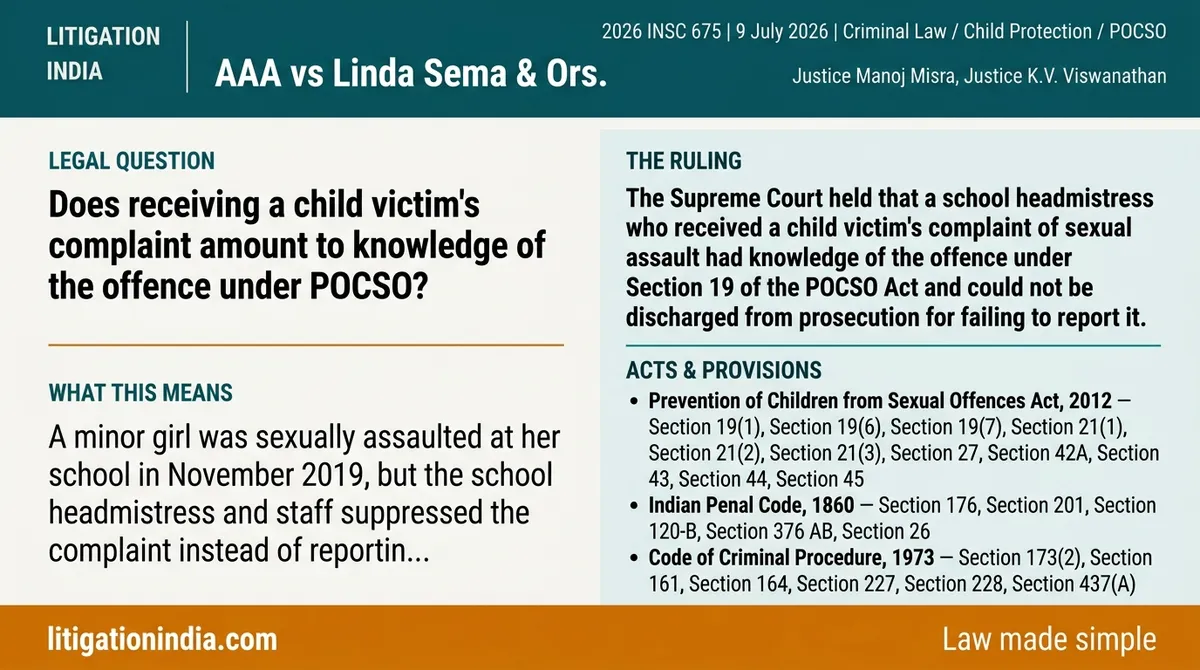
Does receiving a child victim's complaint amount to knowledge of the offence under POCSO?
What this case means
A minor girl was sexually assaulted at her school in November 2019, but the school headmistress and staff suppressed the complaint instead of reporting it to police. The Supreme Court held that receiving a complaint directly from a child victim amounts to knowledge of the offence under Section 19 of the POCSO Act, and the headmistress could not be discharged. This ruling clarifies that school authorities must report child sexual assault complaints immediately and cannot conduct their own inquiry before reporting.
“The Supreme Court held that a school headmistress who received a child victim's complaint of sexual assault had knowledge of the offence under Section 19 of the POCSO Act and could not be discharged from prosecution for failing to report it.”
Story Slides
In short
This appeal was filed by the mother of an 8-year-old girl who was sexually assaulted by a senior student (a Juvenile in Conflict with Law) at SRS School, Arunachal Pradesh, in November 2019. The incident was reported to the school's Headmistress, Linda Sema, and other staff, but instead of reporting it to the police, they conducted their own internal verification and decided to suppress the matter. The victim's mother came to know about the incident in April 2020 and lodged an FIR. A chargesheet was filed against the school principal, headmistress, teachers, and warden under Sections 176, 201, 120-B IPC read with Section 21(2) of the POCSO Act. The Trial Court discharged all these accused persons finding no prima facie case. The Gauhati High Court's Itanagar Bench upheld the discharge. The Supreme Court partly allowed the appeal. It held that the phrase 'knowledge that such an offence has been committed' in Section 19(1) of the POCSO Act must be construed to include awareness based on receipt of credible information from the victim, and is not limited to direct sensory knowledge. Where information is received directly from the victim, it is deemed credible. The Court held that the headmistress, Linda Sema, who received the complaint directly from the victim, had knowledge of the offence and was under a legal obligation to report it. Her discharge was set aside and the Trial Court was directed to proceed against her. However, the other teachers and office bearers who did not receive direct information from the victim were held not liable for prosecution since they had no direct credible knowledge of the incident. The Court also emphasised that investigation into whether the incident occurred must follow reporting and not precede it, as prior internal inquiry defeats the Act's purpose.
Background
In November 2019, an 8-year-old girl studying at SRS School in Arunachal Pradesh was sexually assaulted by a Class VIII student (a juvenile). The victim informed her elder sister, her friend, the Head Girl, and ultimately the school Headmistress, Linda Sema. Instead of reporting the matter to police, the school authorities conducted their own internal inquiry, found no conclusive evidence, and instructed everyone to stay silent. The victim's mother learned of the incident in April 2020 and registered an FIR in April 2020, leading to a chargesheet against the school staff.
The Decision
The Supreme Court partly allowed the appeal and set aside the discharge of Respondent No.1, Linda Sema, from prosecution under Section 21 read with Section 19(1) of the POCSO Act and Section 176 of IPC, directing the Trial Court to proceed against her in accordance with law. The discharge of the other teachers and office bearers was upheld because the victim had not given them direct information about the assault. The Court clarified that its observations shall not be taken as an opinion on the merits of the allegations.
Why it matters for you
This ruling establishes that school authorities and any adult who receives a complaint directly from a child victim of sexual assault are legally obligated to report it to police immediately under POCSO, without conducting their own inquiry first. It makes clear that internal verification before reporting is not an acceptable defence and defeats the protective purpose of the Act. This strengthens child protection by ensuring that those in positions of authority over children cannot silence or investigate complaints on their own.
Relevant Legal Provisions
Key Acts and sections cited or relied upon in this judgment
“Section 19(1) mandates any person with knowledge that an offence under the Act has been committed to report it to the Special Juvenile Police Unit or local police; the Court construed 'knowledge' to include awareness based on direct information received from the child victim, and held that the headmistress who received the victim's complaint was obligated to report and her failure made her liable under Section 21.”
“Section 176 penalises omission to give legally required information to a public servant; Section 201 penalises causing disappearance of evidence; Section 120-B penalises criminal conspiracy; Section 376 AB was charged against the juvenile offender; the Court found sufficient material to frame charges under Section 176 against the headmistress but found no cogent material for Section 201 or Section 120-B against the other accused.”
“Section 227 and 228 govern the stage of framing of charge and discharge; the Court applied the settled legal position that at the discharge stage the court must take prosecution materials at face value and assess whether grave suspicion exists, without conducting a mini trial.”
“Rule 4 details the procedure to be followed by the Special Juvenile Police Unit or local police on receipt of information under Section 19(1); the Court relied on these rules to reinforce that prompt reporting is a sine qua non and that investigative exercises should follow reporting, not precede it.”
AI-assisted summary, reviewed and verified by our editorial team.
In the Court's words
“For the purposes of this Act, when a child victim reports to a person that he or she has been subjected to an offence, or is likely to be subjected to an offence, punishable under the Act, it could safely be concluded that the person to whom such information is provided by the child victim has knowledge that such an offence has been committed or is likely to be committed.”
“The defence that an effort was made to ascertain the truth and in absence of signs of sexual assault, report was not made is not acceptable, at this stage, to stifle a prosecution under Section 21 of the POCSO Act.”
“An investigation to ascertain whether such an incident has actually occurred or not must take place after reporting of the incident and not before, as such an exercise would defeat the very purpose for which the POCSO Act has been enacted.”
“Prompt reporting of the incident is a sine qua non for effective implementation of the Act.”
Need help with your case?
Facing a similar legal challenge in the Supreme Court or High Court? Connect with our pro bono volunteer advocates today.
Related Supreme Court services