Full text of the judgment
Text extracted from The State of Karnataka & Anr. vs Sadiq Pasha. For the authoritative version refer to the Supreme Court of India's official website.
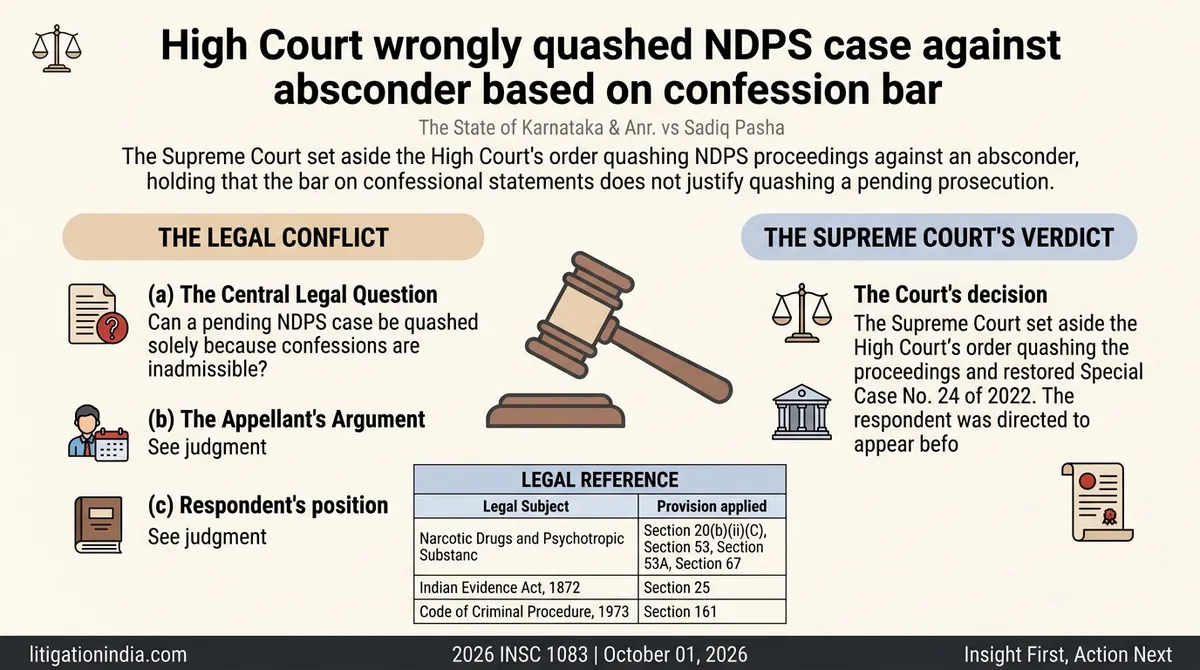
2026 INSC 1083 Non-Reportable IN THE SUPREME COURT OF INDIA CRIMINAL APPELLATE JURISDICTION CRIMINAL APPEAL NO. 4720 OF 2026 (Arising out of SLP (Crl.) No.6323 of 2026) The State of Karnataka & Anr. ...Appellant(s) Versus Sadiq Pasha ...Respondent(s) O R D E R Leave granted. 2. The State has filed the above appeal against the order of the High Court which quashed the proceedings in Special Case Crime No.24 of 2022, pending before the Principal District and Sessions Judge, Udupi, for the offence punishable under Section 20 (b)(ii) C of the Narcotic Drugs and Psychotropic Substances Act, 1985, (NDPS Act). The appellant was declared an absconder, and a split chargesheet was drawn against him. The impugned order quashed the criminal proceedings so pending, relying on the decisions of this Court in Tofan Singh v. State of Tamil Nadu1, State (by NCB) Bengaluru v. Pallulabid Ahmad 1 (2021) 4 SCC 1 Page 1 of 11 Digitally signed by VISHAL ANAND Date: 2026.10.05 16:47:39 IST Reason: Signature Not Verified
Arimutta and Another2, Balwinder Singh (Binda) v. Narcotics Control Bureau3 and Firdoskhan Khurshidkhan v. State of Gujarat and Another4. 3. We heard Sri Aman Panwar, learned AAG appearing on behalf of the State and none appeared for the respondent accused, who was served through the Commissioner of Police, who had deputed the Assistant Sub-Inspector, Lashkar Police Station, Mysuru, to serve the notice. The service of notice is spoken of in the communication addressed by the Assistant Sub-Inspector to the Commissioner of Police, Mysuru City, dated 16.04.2026, which is produced herein. 4. On facts, the respondent is an engineering graduate, who, after studies, was in the United States of America. The incident occurred when he was a student and he was arrayed as Accused No.3 in FIR No.30 of 2025, registered in the Lashkar Police Station, Mysuru City. The contents of the FIR indicate that on information received of transportation of Ganja in a car, a police party was dispatched, who found three persons standing in a parking area, near the specified car; one of whom ran away. The other two were apprehended 2 (2022) 12 SCC 633 3 (2024) 13 SCC 734 4 2024 SCC OnLine SC 680 Page 2 of 11
and on a search of the car, 32.615 kgs of Ganja was found in 42 bundles, hidden in the dashboard and trunk of the car. The investigation ensued and culminated in a chargesheet, wherein the respondent was shown as an absconder; hence the case was split up as against the absconder and the other accused. The respondent was the person who fled from the spot in which the seizure was effected. 5. The respondent approached the High Court seeking to quash the criminal case lodged against him and kept pending as Special Case No.24 of 2022 arising out of Special Case No.131 of 2019 in the records of the Principal District and Sessions Judge and Special Court, Udupi. The High Court quashed the proceedings on the sole ground of the respondent neither having been apprehended at the spot nor any contraband found in his possession, but arrayed only on the confessional statement of the other co-accused, who were apprehended on the spot. Reliance was also placed on the decisions as noticed hereinabove. We are afraid that the decisions have no application insofar as a case pending for trial before the Special Court. 6. Tofan Singh1 was considered by a three Judge Bench on a reference being made for an authoritative pronouncement on ‘Evidentiary value of a statement under Page 3 of 11
Section 67 of the NDPS Act’. The referring Court was of the opinion that the NDPS Act being a penal statute, is in contradistinction to the Customs Act, 1962 and the Central Excise Act, 1944, whose dominant object is to protect the revenue of the State. The judgments rendered in the context of those Acts; as to the evidentiary value of the statements recorded in a proceeding akin to search and seizure aimed at plugging revenue loss, opined the referring Court; may not be apposite when considering the NDPS Act; a penal statute, the object of the said enactments being disparate. The referring Court sought for reconsideration of the ratio of two earlier judgments of this Court, finding otherwise. 7. The challenge therein was on three counts; one, that the conviction was based solely on the purported confessional statement recorded under Section 67 of the NDPS Act; the statement having been given to an officer deemed to be a police officer and thus, hit by Section 25 of the Evidence Act, 1872. Then, it was argued that Section 67 of the NDPS Act does not enable recording of a confessional statement, and at best, the statement can only be regarded as a statement under Section 161 of the Code of Criminal Procedure, 19735. And lastly, the statement was subsequently 5 In short ‘CrPC’ Page 4 of 11
retracted and hence, it could not be the basis of conviction and could at best, corroborate other evidence. The three Judge Bench by a majority found that the Officers vested with the powers under Section 53 of the NDPS Act, are Police Officers within the meaning of Section 25 of the Evidence Act, 1872 and a confessional statement recorded by them would be hit by Section 25 of the said Act. A statement recorded under Section 67 of the NDPS Act cannot be used as a confessional statement in the trial of an offence under the NDPS Act. Answering the reference, the three Judge Bench sent back the individual cases for consideration to the Division Bench. Pertinently, it is to be noticed that therein, the appeal was against a conviction wherein a confessional statement was relied on for the purpose of finding guilt on the accused. 8. Pallulabid Ahmad Arimutta2 was concerned with the confessional statement which was urged by the State for the purpose of cancellation of bail. A batch of cases were considered, arising from two connected cases registered under the NDPS Act. The State and the Union of India were aggrieved with the bail granted to the accused. It was found on perusing the impugned orders that except for the voluntary statements of A1 and A2 in the first case and that Page 5 of 11
of the respondents themselves recorded under Section 67 of the NDPS Act, there was no substantial material available with the prosecution at the time of the arrest to connect the respondents with the allegations levelled against them of indulging in drug trafficking. Except for one, A2, none of the other respondents were found to be in possession of the narcotic drug. While the bail granted to the person found in possession was cancelled and he was directed to surrender before the Special Judge, the confessional statements were found to be not substantive material warranting cancelation of the bail already granted to the other accused. 9. In Balwinder Singh (Binda)3 also, the appeal was against a conviction, that too, a sentence of death awarded by the Trial Court, modified by the High Court with a sentence of rigorous imprisonment for 14 years. The death sentence was awarded by the Trial Court for reason of a prior conviction and thus, invoking the power under Section 31A of the NDPS Act. The incident was an interception carried out on information. A car was detained, from which, two persons fled and the third person got arrested. The contraband was recovered on search of the car and a seizure mahazar was also prepared. The seized items were also later handed over to the Superintendent-in-charge of the godown Page 6 of 11
and the samples taken were sent for chemical examination. The appellant Balwinder Singh was nowhere in the picture till then. Later, as claimed by the prosecution, a newspaper report of an arrest made in an another NDPS case, led the Investigating Officer to Balwinder Singh, who, on a statement recorded under Section 67 of the NDPS Act, confessed to his presence in the spot. The conviction of Balwinder Singh was only based on the confessional statement of the co-accused and the statement under Section 67 of the NDPS Act, of Balwinder Singh himself. In the context of no other independent incriminating evidence having come forth against Balwinder Singh, the conviction against him was set aside and he was acquitted of the charge. However, the conviction of the accused arrested on the spot was confirmed. 10. Firdoskhan Khurshidkhan4 was again a case in which, on information of transportation of Ganja, the Police in plain clothes carried out surveillance at a bus stand. The information obtained, contained the description of the physical features of suspects and the apparel they would be wearing. The surveillance party split into two groups and they found two suspects answering the description, one of whom handed over a bag to the other. The two separate Page 7 of 11
teams went in pursuit of the two, who went in opposite ways. The man with the bag was apprehended and contraband was seized from the bag. The other person fled and could not be apprehended. The Police party, for reason of security issues, moved to a nearby guesthouse to carry out the seizure and sampling. The appellant was arrested subsequently on the statement of the person apprehended at the spot and he was convicted on the basis of the statement recorded under Section 67 of the NDPS Act. Finding that no contraband was recovered from the appellant and that the conviction was merely based on the confessional statement, the appellant was acquitted. 11. Primarily, we must notice that the facts of the cases referred to in the impugned order, were either on conviction or one on a prayer for cancellation of bail, wherein the sole incriminating
circumstance,
the prosecuting/investigating agency was the confessional statement. The disclosure statement of the co-accused was also found to be of no evidentiary value to convict the accused or for cancellation of bail granted. Whether the same principle can be applied with respect to a pending prosecution, is the question arising herein, that too, to take the extreme step of quashing the charges. Page 8 of 11
12. The facts noticed from the instant case clearly indicate that one person fled from the spot, from which, two others were arrested and were found in conscious possession of the contraband. In the First Information Statement (FIS) itself, the name of the person who fled, was recorded, presumably on the others disclosing the same. There is neither a disclosure statement recorded from the co-accused nor a statement recorded under Section 67 of the NDPS Act from the respondent himself; he having evaded arrest. The quashing of charges merely on the ground that a confessional statement cannot be relied on in the trial, would not be a proper exercise of the inherent powers conferred on the High Court. The High Court has not looked into the evidence produced in the case, especially when the trial obviously would have been proceeded with against the co-accused. There is also no whisper as to the chargesheet filed in the case and the culpability found on the 3rd accused therein, who is the respondent herein; which in any event, would be premature at the stage of quashing. 13. We have no doubt that the confessional statement under Section 67 or a disclosure statement under Section 53A of the NDPS Act, can have no evidentiary value in a trial Page 9 of 11
and it cannot lead to a conviction. Section 53A of the NDPS Act does not enable the disclosure of the co-accused to be placed before Court, especially when he is not examined as a witness or made an approver. The disclosure made by the co-accused who were apprehended at the spot, about the identity and the name of the one who fled, is only a material which the Investigating Officer could use to gather further evidence, which alone could be the basis of a chargesheet or a conviction, in a properly instituted trial. 14. We find the manner in which the proceedings were quashed by the High Court to be improper. The impugned order deserves to be set aside; and we do so. We make it clear that we have not made any observation on the merits of the matter and the respondent could take up this very same contention of no other material having been unearthed in the investigation at the time when cognizance is taken by the Special Court or if it has already been taken, by filing an appropriate application for discharge. These contentions are left open to be agitated at the appropriate stage, as desired by the respondent . 15. However, finding the impugned order quashing the criminal proceedings to be improper, we restore Special Case No.24 of 2022 arising out of Special Case No.131 of Page 10 of 11
2019 in Crime No.94 of 2018 to the files of the Principal District and Sessions Judge and Special Court, Udupi. The respondent shall appear before the said Court within a period of two weeks from today, upon which the Court shall allow him to be released on bail on such terms and conditions it deems fit and otherwise, on failure to appear, the Trial Court shall issue steps for his apprehension for production before Court. 16. The appeal stands allowed with the above direction. 17. Pending application(s), if any, shall stand rejected. .......…….……………………. J.
(J. B. PARDIWALA) ....……….……………………. J. (K. VINOD CHANDRAN) NEW DELHI; OCTOBER 01, 2026. Page 11 of 11