
Can you lose a government job for hiding a pending criminal case?
Bappa Barai vs Union of India
Case: Bappa Barai vs Union of IndiaCitation: 2026 INSC 882Decided on: 18 August 2026
“The Supreme Court ruled that candidates who hide active criminal cases when applying for government jobs can be dismissed from service.”
Story Slides
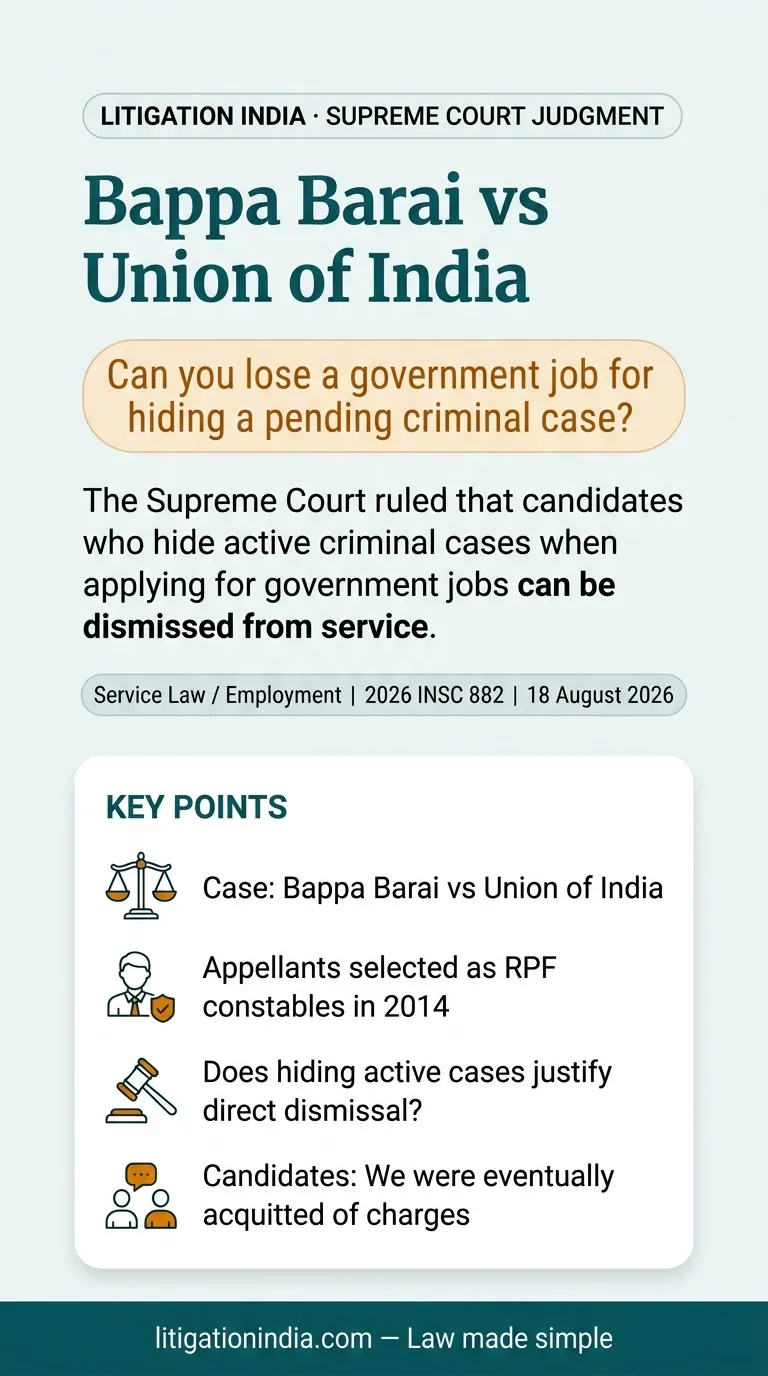
In short
This judgment clears up the rules for candidates applying for government jobs, especially in security forces like the Railway Protection Force (RPF). The appellants had applied for the post of Constables in 2011. They passed the written and physical exams and were sent for training. However, they hid the fact that they had active criminal cases pending against them. In their verification forms, they falsely marked 'NO' to questions about arrests and court cases. When the department discovered this during their training, it discharged them from service. The candidates argued that they were later acquitted in those cases and should be allowed to keep their jobs, pointing to other candidates who were reinstated. However, the Supreme Court rejected their plea. The Court explained that honesty and clean character are essential for security jobs. Since they deliberately lied while filling out the forms when the cases were still active, their termination was completely legal. The Court also clarified that they could not compare themselves with other reinstated workers, as those individuals were either cleared by court orders before filling out their forms or had very minor, trivial issues. Lying about active criminal cases at the start is a serious breach of trust that justifies dismissal.
Need clarity on a similar legal issue?
Request free pro bono guidance from a Supreme Court Advocate.
Background
The candidates applied for Constable posts in the Railway Protection Force in 2011 but did not disclose active criminal cases in their forms. Upon discovering this lie during their training, the authorities discharged them from service.
The Decision
The Supreme Court dismissed the candidates' appeals and upheld their dismissal. The Court ruled that deliberately hiding pending criminal cases during recruitment is a serious issue that makes a candidate unfit for service.
Why it matters for you
This judgment warns job seekers that honesty is crucial when filling out government application forms. Hiding criminal history, even if you are acquitted later, can lead to permanent loss of employment.
AI-assisted summary, reviewed and verified by our editorial team.
Need help with your case?
Facing a similar legal challenge in the Supreme Court or High Court? Connect with our pro bono volunteer advocates today.
Related Supreme Court services
Related Questions of Law
- Can the government force a high-performing officer to retire early shortly after promoting them?
- Can a qualified professor keep his job if his PhD is fake?
- Can local school committees hire government-funded staff without open competition and fair rules?
- Can employers delay processing medical retirement applications to deny compassionate jobs to dependents?
- Can the government cancel a worker's promotion using rules made years later?