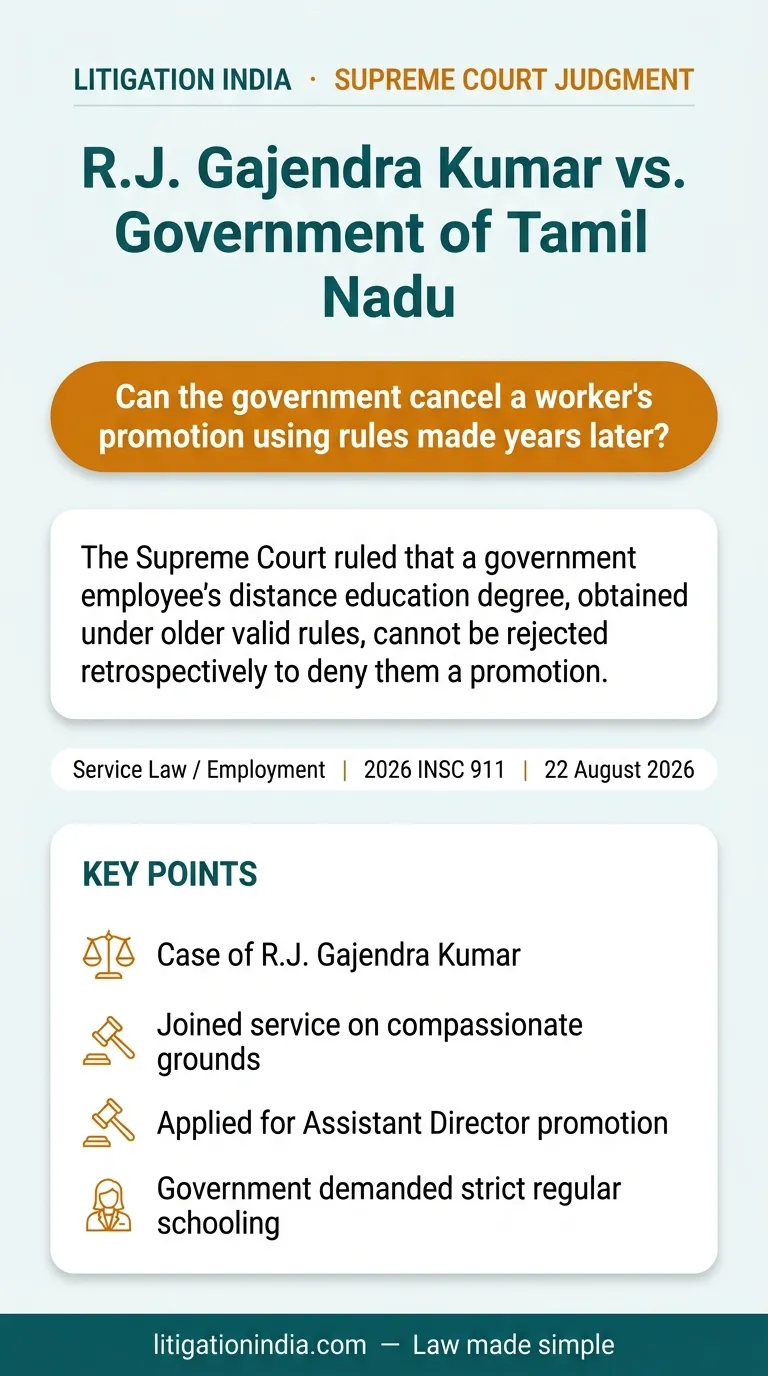
R.J. Gajendra Kumar vs. Government of Tamil Nadu
The big legal question
Can the government cancel a worker's promotion using rules made years later?
“The Supreme Court ruled that a government employee's distance education degree, obtained under older valid rules, cannot be rejected retrospectively to deny them a promotion.”
Story Slides
In short
This case is about R.J. Gajendra Kumar, who joined the Tamil Nadu Tourism Department on compassionate grounds in 1983. While working, he completed a foundation course and a B.Com degree through distance education from an Open University, with official department permission. In 2011, he was promoted to Tourist Officer, a post he held for 15 years. However, when he applied for promotion to Assistant Director, the government rejected his request. They argued his degree was invalid because he did not complete standard 12th schooling under the regular 10+2+3 pattern and had studied through distance mode instead. The Supreme Court ruled in favor of the employee. It held that the government cannot retrospectively apply new qualification rules to strip away benefits or eligibility. At the time he studied and was promoted to Tourist Officer, open university degrees were legally recognized. Furthermore, the court clarified that distance education degrees are completely valid for public services unless the rules explicitly ban them. The court criticized the High Court for questioning his 15-year-old appointment as a Tourist Officer when no one had challenged it. Finally, the Supreme Court ordered the government to consider him for promotion to Assistant Director, restoring the Single Judge's decision.
Background
The appellant joined government service in 1983 and completed his B.Com through distance learning with official permission. Years later, the government denied him a promotion to Assistant Director, claiming his distance degree did not meet the standard 10+2+3 school education format.
The Decision
The Supreme Court set aside the High Court's order and restored the Single Judge's ruling in favor of the employee. It declared the appellant eligible for promotion, holding that degrees earned under older, valid policies cannot be invalidated by new rules.
Why it matters for you
This judgment protects thousands of government employees who completed distance education or open university courses under older policies. It confirms that the government cannot suddenly change qualification rules to deny promotions to long-serving workers.
AI-assisted summary, reviewed and verified by our editorial team.
Need help with your case?
Facing a similar legal challenge in the Supreme Court or High Court? Connect with our pro bono volunteer advocates today.
Related Supreme Court services