Teacher keeps job over NET qualification but faces strict inquiry for fake PhD
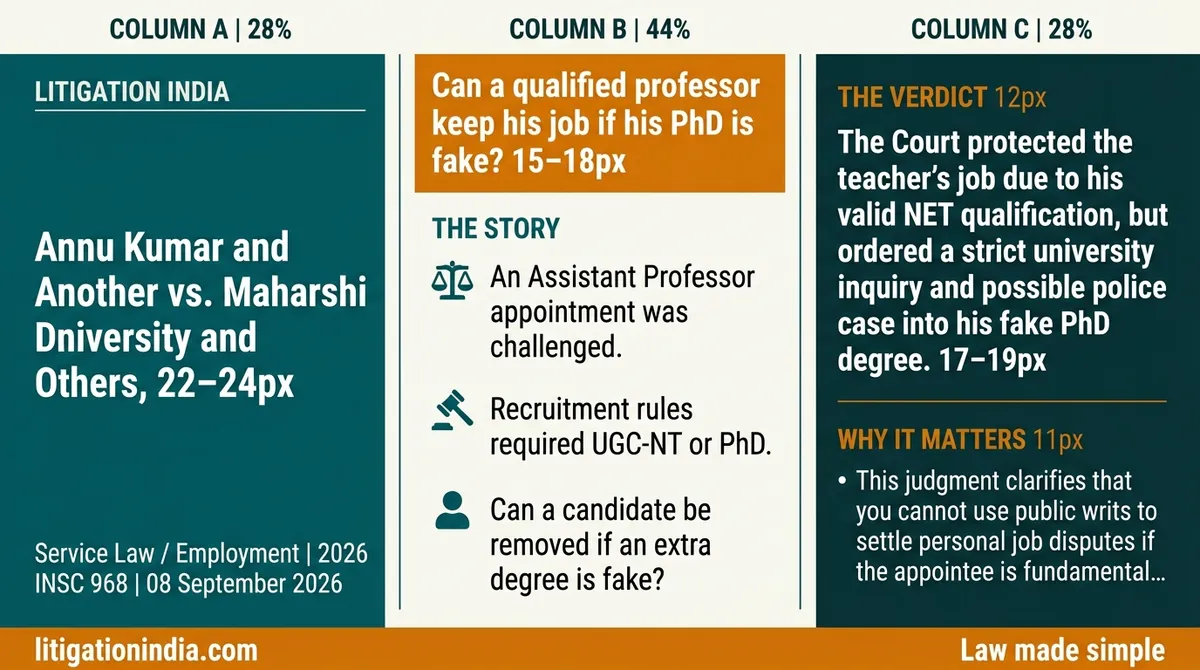
Annu Kumar and Another vs. Maharshi Dayanand University and Others
The big legal question
Can a qualified professor keep his job if his PhD is fake?
What this case means
This case was about whether an Assistant Professor's job can be cancelled using a public petition if his PhD degree is fake. The Court decided that because he had cleared the UGC-NET exam, he met the basic required qualification for the job, but it ordered a strict university inquiry into his suspicious PhD degree. This means that while basic qualifications might temporarily save a job, fraud and fake degrees will still face strict investigation and criminal action.
“The Court protected the teacher's job due to his valid NET qualification, but ordered a strict university inquiry and possible police case into his fake PhD degree.”
Story Slides
In short
This case arose when Annu Kumar and another candidate challenged the selection of an Assistant Professor of Physical Education at Sat Jinda Kalyana College, Haryana. The appellants argued that the selected candidate (the sixth respondent) had submitted a fake Ph.D. degree from Bundelkhand University to secure the job. They filed a writ of quo warranto in the High Court, asking for his removal. The High Court dismissed their plea, pointing out that even if the Ph.D. was doubtful, the candidate was still fully eligible because he had qualified the UGC-NET exam, which is the actual mandatory minimum qualification for the post. The High Court also noted that since the appellants did not rank in the top three of the merit list, they lacked the standing to challenge the appointment to settle personal grievances. Upon reaching the Supreme Court, the Court agreed with the High Court's legal reasoning. Under the relevant UGC Regulations, possessing a Ph.D. is not mandatory if a candidate has passed the NET exam. Therefore, the candidate did not lack the basic eligibility to hold the public office. However, the Supreme Court could not ignore the serious evidence presented by Bundelkhand University showing that the candidate's Ph.D. degree was indeed fabricated and fake. Using its special powers under Article 142, the Supreme Court ordered Maharshi Dayanand University to conduct a fresh, independent inquiry. The university must verify the degree in the presence of Bundelkhand University officials and the candidate. If the inquiry proves that the Ph.D. degree was forged, the university must take appropriate legal action, and criminal proceedings can be initiated against the candidate for fraud.
Background
An applicant was appointed as an Assistant Professor of Physical Education. Unsuccessful candidates challenged his selection, claiming he submitted a fake Ph.D. degree from Bundelkhand University to get selected.
The Decision
The Supreme Court dismissed the appeal and let the teacher keep his job because his NET qualification made him eligible. However, the Court ordered Maharshi Dayanand University to conduct a strict inquiry into his PhD, and allowed criminal prosecution if it is proven fake.
Why it matters for you
This judgment clarifies that you cannot use public writs to settle personal job disputes if the appointee is fundamentally qualified. However, it also establishes that even if you meet basic qualifications, using fake degrees to get extra marks is a serious crime that will face strict inquiry and criminal action.
Relevant Legal Provisions
Key Acts and sections cited or relied upon in this judgment
“Allows High Courts to issue orders or writs to protect people's rights and challenge unlawful public appointments.”
“Gives the Supreme Court special power to pass any order necessary to do complete justice in any case.”
“Sets the official minimum qualifications and eligibility rules required to become a teacher or professor in Indian colleges.”
AI-assisted summary, reviewed and verified by our editorial team.
In the Court's words
“...the post of Assistant Professor on which the sixth respondent aspired for appointment did not require, as an essential qualification, a Ph. D. degree; in fact, it was a desirable qualification.”
“To seek and succeed in a proceeding for a writ... of quo warranto, it is absolutely necessary for the writ petitioner... to establish that an appointee, not having the requisite qualification... was appointed...”
“If the sixth respondent has indeed secured an appointment by deceit... mere disposal of these appeals... will not be a protective shield for such appointment to be sustained.”
Need help with your case?
Facing a similar legal challenge in the Supreme Court or High Court? Connect with our pro bono volunteer advocates today.
Related Supreme Court services