
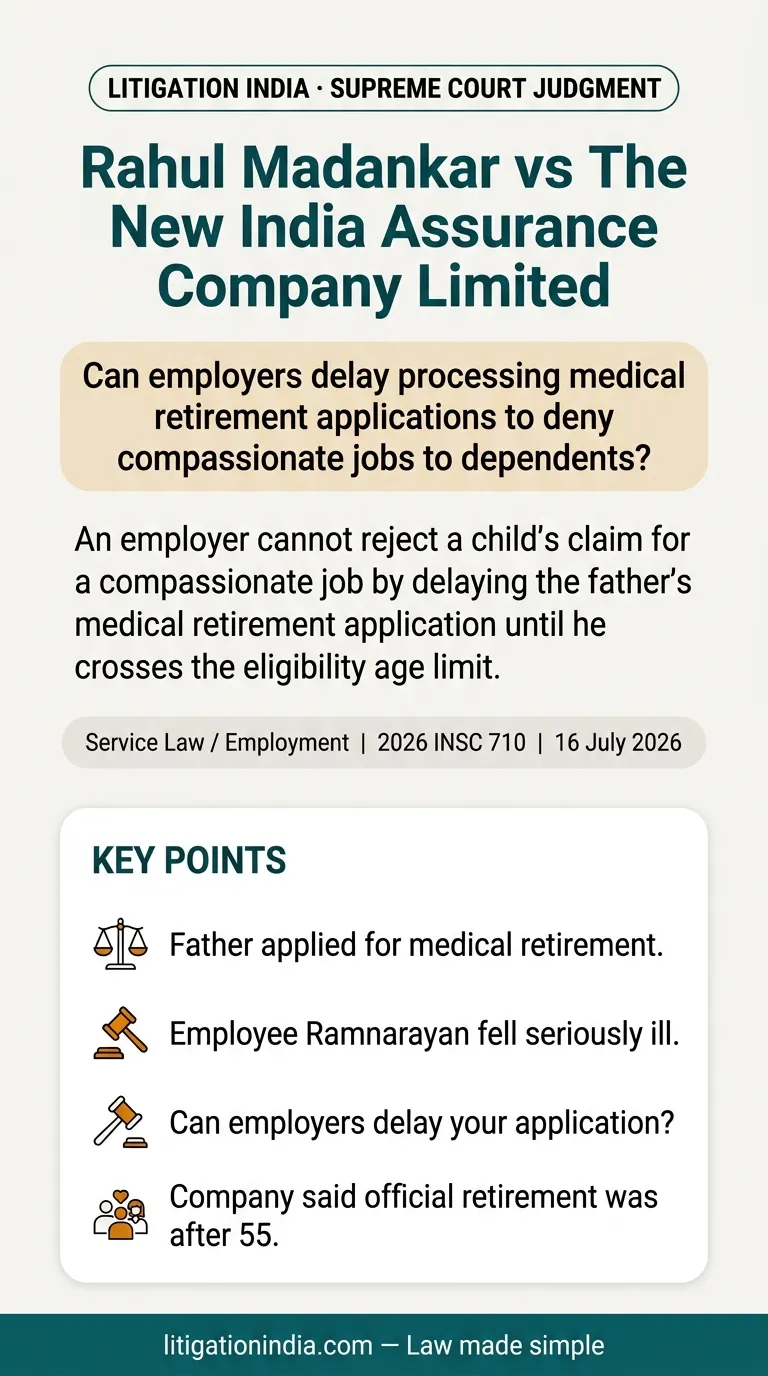
Can employers delay processing medical retirement applications to deny compassionate jobs to dependents?
Rahul Madankar vs The New India Assurance Company Limited
Case: Rahul Madankar vs The New India Assurance Company LimitedCitation: 2026 INSC 710Decided on: 16 July 2026
“An employer cannot reject a child's claim for a compassionate job by delaying the father's medical retirement application until he crosses the eligibility age limit.”
Story Slides
In short
This case involves Ramnarayan, a clerk with the New India Assurance Company, who suffered severe neurological issues. Before turning 55, he applied for voluntary retirement on medical grounds, attaching a certificate from a Civil Surgeon certifying his permanent incapacity. He sent two reminders before his 55th birthday, but the company remained silent. Only after he turned 55 did the company demand a Medical Board certificate, which he promptly submitted within a week. The company then accepted his retirement but rejected his son Rahul's application for a compassionate job. The rejection was based on the technicality that Ramnarayan was over 55 when he officially retired, which violated the company's scheme. The High Court agreed with the company. However, the Supreme Court reversed this decision. The Supreme Court ruled that an employer cannot take advantage of its own administrative delay. Since the employee applied and submitted his medical proof before turning 55, the company's failure to process it on time cannot be used to deny benefits to his family. The Court emphasized that beneficial welfare schemes must be administered fairly and promptly. Ultimately, the Court ordered the company to give Rahul a compassionate job within eight weeks, allowing age relaxation if necessary.
Need clarity on a similar legal issue?
Request free pro bono guidance from a Supreme Court Advocate.
Background
Ramnarayan, a clerk, became permanently incapacitated due to serious neurological illness. He applied for medical retirement at age 54, but the company delayed processing his application. The company waited until he crossed the eligibility threshold of 55 years and then rejected his son's claim for a compassionate job.
The Decision
The Supreme Court set aside the rejection and ordered the company to grant a compassionate job to the son within eight weeks. The Court directed that the son must be given age relaxation if he crossed the limit during the long pending court case.
Why it matters for you
This judgment stops government offices and companies from using self-created administrative delays to deny welfare benefits. It protects families of medically unfit workers, ensuring they are not punished for the slow-paced bureaucracy of employers.
AI-assisted summary, reviewed and verified by our editorial team.
Need help with your case?
Facing a similar legal challenge in the Supreme Court or High Court? Connect with our pro bono volunteer advocates today.
Related Supreme Court services
Related Questions of Law
- Can the government force a high-performing officer to retire early shortly after promoting them?
- Can a qualified professor keep his job if his PhD is fake?
- Can local school committees hire government-funded staff without open competition and fair rules?
- Can the government cancel a worker's promotion using rules made years later?
- Must a law graduate practice for three years before becoming a judge?