Government cannot compulsorily retire an outstanding officer shortly after promoting them
S.S. Das vs. Union of India
The big legal question
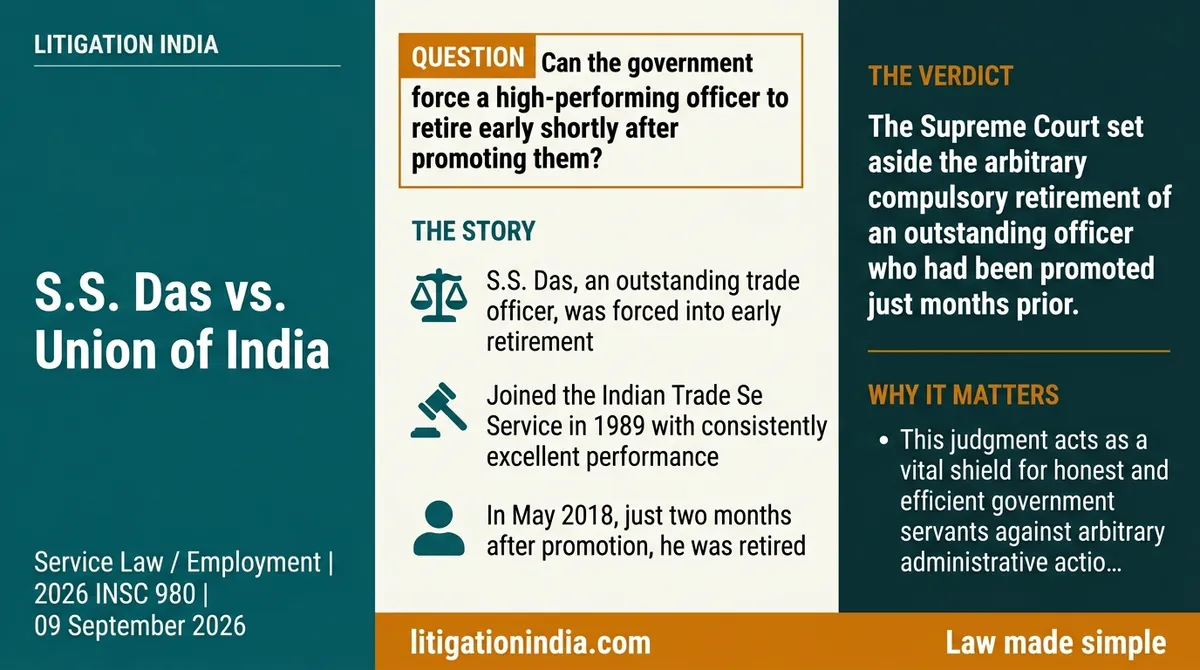
Can the government force a high-performing officer to retire early shortly after promoting them?
What this case means
This case was about an outstanding government officer who was suddenly forced to retire early under Rule 56(j). The Supreme Court cancelled the retirement because the officer had just been promoted and had an excellent track record. It shows that governments cannot use forced retirement arbitrarily to target honest, high-performing employees.
“The Supreme Court set aside the arbitrary compulsory retirement of an outstanding officer who had been promoted just months prior.”
Story Slides
In short
The appellant, S.S. Das, joined the Indian Trade Service (ITS) in 1989 and had an exceptional career spanning nearly three decades. He consistently received "Outstanding" and "Very Good" ratings in his annual performance reports, including scores of 9.8 and 9.6 in his later years. Recognizing his excellent service, the Union Public Service Commission (UPSC) and the Appointments Committee of the Cabinet (ACC) promoted him to the post of Joint Secretary on a regular basis in February 2018. However, on May 10, 2018, just over two months after his regular promotion, the government issued an order compulsorily retiring him from service under Fundamental Rule 56(j). This rule allows the government to prematurely retire underperforming or corrupt officials in the public interest. The government based its decision on a vague 2017 confidential note from a superior officer alleging "unprofessional" conduct and a single 2014-15 entry stating there was "room for improvement" in his integrity, despite his overall high score of 8.75 that year. The Central Administrative Tribunal (CAT) and the Delhi High Court both upheld his retirement, arguing that judicial review in such cases is extremely limited. The Supreme Court overturned these decisions, ruling that the government's actions were contradictory, highly arbitrary, and driven by legal malice. The Court clarified that while the government can evaluate an officer's entire service record under Rule 56(j), a recent merit-based promotion proves that the officer is fit for higher duties. Promoting an officer and then branding them as "dead wood" just months later is unacceptable. Since the appellant had already reached the age of retirement during the litigation, the Court ordered that he receive all back wages, a full honorable farewell ceremony, and Rs 15 lakh in costs and compensation.
Background
S.S. Das, a highly decorated Indian Trade Service officer, was promoted to the level of Joint Secretary on a regular basis in February 2018. Despite having an exemplary record of consistently "Outstanding" performance ratings, the government forced him to retire prematurely under Fundamental Rule 56(j) in May 2018, just two months after his promotion.
The Decision
The Supreme Court set aside the compulsory retirement order, declaring it arbitrary, perverse, and malicious. Since the officer had already reached the age of superannuation, the Court directed the government to pay him all back wages and service benefits, hold an honorable farewell ceremony, and pay Rs 15 lakh as litigation costs and compensation.
Why it matters for you
This judgment acts as a vital shield for honest and efficient government servants against arbitrary administrative action. It establishes that the government cannot abuse its power of compulsory retirement to target high-performing employees shortly after promoting them on merit.
Relevant Legal Provisions
Key Acts and sections cited or relied upon in this judgment
“Allows the government to retire a public servant prematurely in the public interest after they cross a certain age.”
“Protects government employees from being dismissed or removed arbitrarily without a proper inquiry.”
“Grants High Courts the power to issue directions and review government actions to protect citizens' rights.”
AI-assisted summary, reviewed and verified by our editorial team.
In the Court's words
“Having promoted the appellant, barely a couple of months later, the superior officers in the department could not have branded him, so to say, ‘dead wood’... The two actions are mutually destructive and cannot co-exist.”
“Discretion is not a charter for arbitrariness... When the statute, rule or regulation is silent, the power cannot be exercised whimsically or arbitrarily; it must be informed by reasonableness and fairness...”
“To brand an officer like the appellant... as dead wood and to weed him out from service by invoking the specious ground that it is necessary to do so in public interest smacks of a high degree of malice...”
Need help with your case?
Facing a similar legal challenge in the Supreme Court or High Court? Connect with our pro bono volunteer advocates today.
Related Supreme Court services