Long serving government cleaners cannot be fired or denied permanent status using unfair labels
Jaggo vs Union of India & Ors.
What this case means
Four low wage workers were fired after working for 15 to 25 years when they asked to be made permanent. The Supreme Court ordered the government to reinstate them and make their jobs permanent. This landmark decision protects temporary workers from being exploited by employers who use labels like part time to deny them basic rights.
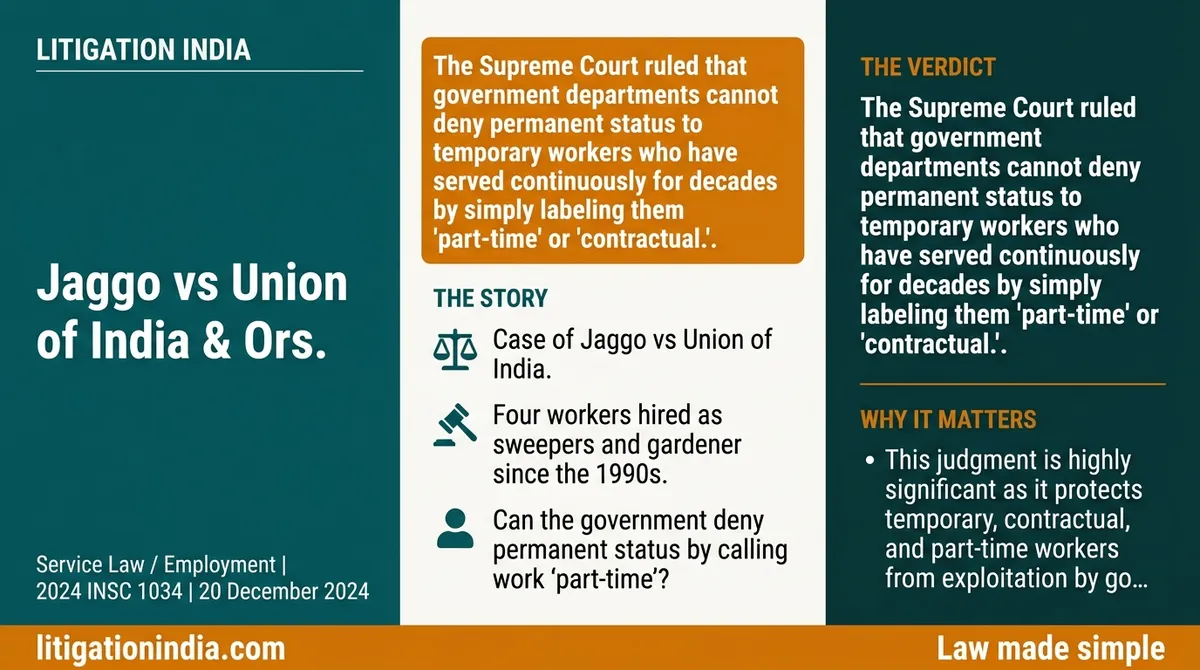
“The Supreme Court ruled that government departments cannot deny permanent status to temporary workers who have served continuously for decades by simply labeling them 'part-time' or 'contractual.'”
Story Slides
In short
This case involves four workers (three cleaning staff and one gardener) employed on a part-time, ad-hoc basis by the Central Water Commission (CWC). They worked continuously for 15 to 25 years without any complaints. When they requested to be regularized (made permanent employees), the Central Administrative Tribunal and the Delhi High Court rejected their plea, stating they lacked the required educational qualifications, did not work 'full-time' hours, and their jobs had been outsourced. Right after the tribunal's dismissal, their services were abruptly terminated without any notice. The Supreme Court reversed these decisions. It held that labeling long-term, essential workers as 'temporary' or 'contractual' is an unfair labor practice. The Court observed that the nature of their work—cleaning and gardening—was permanent and crucial for the office. Demanding formal educational degrees after decades of satisfactory service was unreasonable and unfair, especially since CWC had regularized other uneducated workers with fewer years of service. This selective treatment violated the constitutional right to equality. The Court clarified that previous landmark rulings (like the Uma Devi case) were meant to prevent illegal backdoor entries, not to punish honest, long-serving irregular workers. The Court ordered the immediate reinstatement and regularization of the workers, granting them service continuity benefits for their retirement.
Background
Four workers were hired by the Central Water Commission as cleaning staff and a gardener on a temporary basis between 1993 and 2004. After they served continuously for up to 25 years, their petition to become permanent was dismissed by the High Court, and they were abruptly fired. They appealed to the Supreme Court seeking reinstatement and permanent status.
The Decision
The Supreme Court allowed the appeals, quashed the termination orders, and ordered the government to reinstate and regularize the workers immediately. Although the Court did not grant back wages for the period they were out of work, it directed that their continuous past service must be counted towards their post-retirement benefits.
Why it matters for you
This judgment is highly significant as it protects temporary, contractual, and part-time workers from exploitation by government employers. It establishes that courts must look at the real nature and length of service rather than surface-level labels like 'temporary' to decide a worker's rights.
Relevant Legal Provisions
Key Acts and sections cited or relied upon in this judgment
“This article guarantees equality before the law and protects citizens against arbitrary actions by the government. In this case, the court applied it because the government had regularized other illiterate workers but discriminated against these four workers by demanding formal educational degrees for basic cleaning work.”
“This article guarantees equal opportunity in matters of public employment and prevents unfair treatment by state employers. The court ruled that keeping essential workers on a temporary status for up to 25 years to deny them the benefits of permanent jobs violates this constitutional guarantee.”
“This law bans unfair labor practices, including the practice of keeping workers temporary or contractual for years just to deprive them of permanent benefits. The court relied on this principle to hold that labeling these long-term cleaning staff as temporary or part-time was an illegal exploitation of labor.”
Photos

AI-assisted summary, reviewed and verified by our editorial team.
Need help with your case?
Facing a similar legal challenge in the Supreme Court or High Court? Connect with our pro bono volunteer advocates today.
Related Supreme Court services