Acquittal reversed for helpers who held down victim and urged shooter to kill
Santosh Singh v. The State of Madhya Pradesh and Ors.
The big legal question
Can helpers escape a murder conviction if they did not fire the fatal shot?
What this case means
A group ambushed a family and shot a man dead, with some members holding the victim and others encouraging the shooter. The High Court had freed these helpers, but the Supreme Court reversed this acquittal. This judgment establishes that active helpers in a violent crime share the same criminal intent and must be punished.
“The Supreme Court ruled that individuals who actively assist a killer by holding the victim or urging them to shoot share the common intention and must be convicted of murder.”
Story Slides
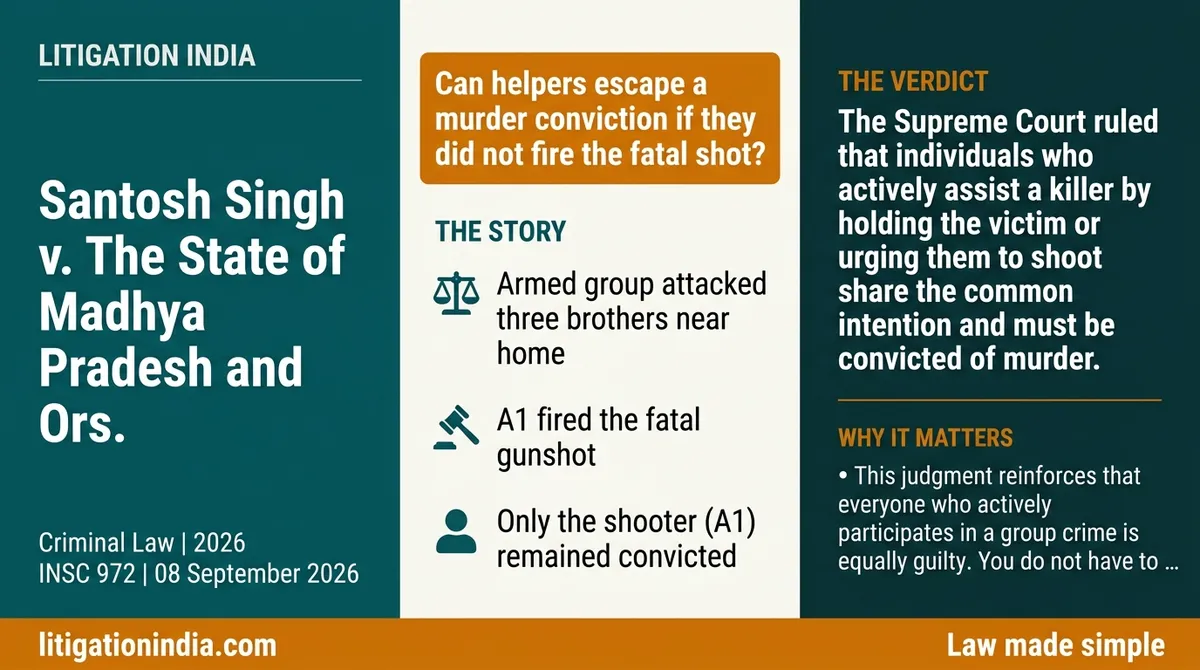
In short
This case arose from a deadly ambush where a group of armed men targeted a family, shooting one brother (Virender) dead and injuring another (Santosh) with a stick. Out of the fourteen accused who faced trial, the Trial Court convicted four: the shooter (A1), Nagendra (A6, who held the victim down), Dalpratap (A12, who exhorted the shooter to fire), and Rajeev (A13, who carried a gun). On appeal, the High Court acquitted A6, A12, and A13, only keeping the shooter (A1) convicted. The High Court reasoned that A6 could not have held the victim down because a close-range gunshot would have injured him too, and that A12 could not have been identified by voice in the dark. The injured brother, Santosh, appealed this acquittal to the Supreme Court. The Supreme Court reversed the acquittals of A6 and A12, restoring their life sentences. It rejected the High Court's speculative reasoning, pointing out that since the bullet remained embedded inside the victim's chest, there was no danger of injuring the person holding him. It also found consistent witness statements confirming that A12 shouted to encourage the shooting. However, the Court upheld the acquittal of A13 because his name was missing from the initial police report, and primary witnesses did not mention his presence early on. The Court emphasized that Indian courts must not discard an entire testimony just because it contains some exaggerations, but must carefully separate the truth from the falsehood.
Background
A group of armed men ambushed three brothers near their village home, shooting one brother dead and beating another with a stick. While the primary shooter was convicted, the High Court acquitted the accomplices who had held the victim and exhorted the killer.
The Decision
The Supreme Court reversed the acquittals of Nagendra (A6) and Dalpratap (A12), restoring their convictions and life sentences, and ordered them to surrender within two weeks. The acquittal of Rajeev (A13) was upheld due to lack of reliable early evidence.
Why it matters for you
This judgment reinforces that everyone who actively participates in a group crime is equally guilty. You do not have to pull the trigger to be punished for murder if you helped by restraining the victim or encouraging the killer.
Relevant Legal Provisions
Key Acts and sections cited or relied upon in this judgment
“Deals with joint liability, meaning when several people commit a crime with a common intention, each person is held fully responsible as if they did it alone.”
“States that every member of an unlawful group is guilty of any crime committed by the group in pursuit of their common goal.”
“Allows the court to summon and put on trial any additional person who appears to be involved in the crime, even if they were not initially charged.”
AI-assisted summary, reviewed and verified by our editorial team.
In the Court's words
“His presence at the scene of occurrence along with some others with a double barrel gun if established... he can be roped in on common intention and object”
“The reasoning of the High Court to absolve A6 on the premise that if he holds on to the victim then he would have sustained an injury cannot at all be countenanced.”
“The principle of 'falsus in uno, falsus in omnibus' is not applicable to India and... the Courts have a duty to separate the grain from the chaff in analyzing evidence.”
Need help with your case?
Facing a similar legal challenge in the Supreme Court or High Court? Connect with our pro bono volunteer advocates today.
Related Supreme Court services