Sahab Singh alias Sat Pal vs State of Haryana
The big legal question
Can a person be jailed for murder based only on weak, suspicious clues?
“The Supreme Court acquitted a man convicted of murder and sexual assault because the police's circumstantial evidence was full of lies, massive timeline contradictions, and lacked scientific proof.”
Story Slides
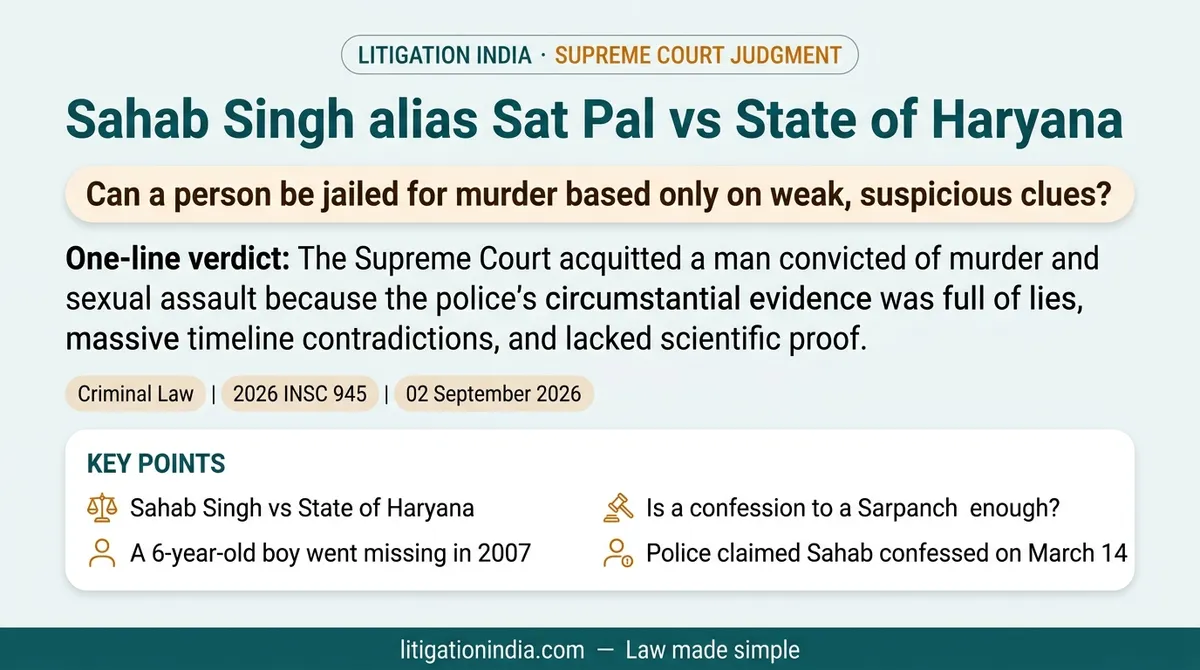
In short
In this case, the Supreme Court cleared a man named Sahab Singh, who had spent over 16 years in jail for the murder and sexual assault of a six-year-old boy. There were no eyewitnesses to the crime. The entire case of the police was based on circumstantial evidence—which means clues and circumstances instead of direct proof—and the theory of "last seen together" (meaning the suspect was last seen with the victim). The police claimed that Sahab Singh confessed his crime to the village Sarpanch (headman) two days after the body was found. The police also claimed the suspect showed them the well where the body was thrown. However, the Supreme Court found massive loopholes in the police's story. First, the child's body was taken out of the well on March 12, but the suspect's confession was recorded on March 14. The court pointed out that you cannot "discover" a body on information given by an accused when the police had already found and removed the body two days earlier. Under Section 27 of the Evidence Act, a confession to the police is only valid if it leads to finding a new, hidden fact. Second, a shopkeeper testified that the police brought the suspect to his shop on March 12, proving that the police already had him in custody before the alleged confession on March 14. Third, though semen was found, the police did not perform a DNA test to match it. The Supreme Court ruled that an extra-judicial confession is very weak evidence and cannot be used to convict someone when all other links in the chain of events are broken. Sahab Singh was given the benefit of doubt and ordered to be released immediately.
Background
In March 2007, a six-year-old child went missing from a village marriage and his body was found in a well the next day. The police arrested Sahab Singh, claiming he bought namkeen for the boy, sexually assaulted him, smothered him to death, and later confessed his crime to the village Sarpanch.
The Decision
The Supreme Court set aside the conviction and ordered Sahab Singh's immediate release. The court held that the police failed to prove their case beyond reasonable doubt, pointing out that key timeline claims were fake and no DNA tests were done to link the accused to the crime.
Why it matters for you
This judgment protects innocent citizens by ruling that the police cannot convict someone using cooked-up timelines, weak confessions, or incomplete science. It reinforces that courts must have solid, unbroken chains of evidence, not just assumptions, to take away a person's freedom.
AI-assisted summary, reviewed and verified by our editorial team.
In the Court's words
“Extra judicial confession is a weak piece of evidence and per se without any independent and cogent corroborative circumstance or evidence cannot be make the sole basis for conviction.”
“The Disclosure statement, (Ex. PT), was recorded on 14.03.2007, whereas the body of the deceased was discovered on 12.03.2007, i.e., two days prior to the disclosure statement.”
Need help with your case?
Facing a similar legal challenge in the Supreme Court or High Court? Connect with our pro bono volunteer advocates today.
Related Supreme Court services