Kondapaka Sridhar vs The State of Telangana
The big legal question
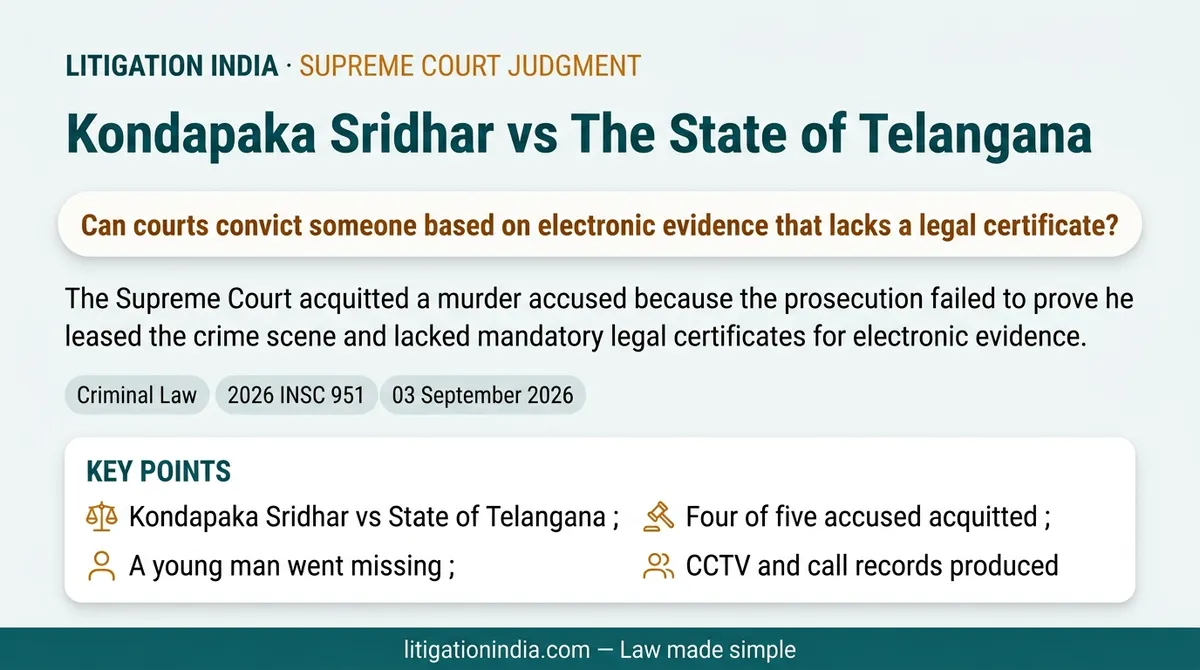
Can courts convict someone based on electronic evidence that lacks a legal certificate?
“The Supreme Court acquitted a murder accused because the prosecution failed to prove he leased the crime scene and lacked mandatory legal certificates for electronic evidence.”
Story Slides
In short
This case involves a tragic kidnapping and murder where a victim's dead body was recovered from a refrigerator inside an apartment. The prosecution alleged that the appellant (referred to as A1) and others kidnapped the victim for a ransom of two lakh rupees, subsequently murdered him, and hid the body. While the Trial Court convicted five of the accused persons, the High Court of Telangana acquitted four of them but sustained the conviction of the appellant. The High Court based this conviction primarily on the 'last seen' theory of a watchman (PW3) and the appellant's failure to explain the presence of the body in the apartment under Section 106 of the Indian Evidence Act, 1862. However, the Supreme Court reversed this decision and highlighted serious lapses in the police investigation. First, the Court noted that confessions made to police officers are legally inadmissible and cannot be used to prove guilt. Second, crucial electronic evidence, such as mobile phone call details (CDR) and ATM CCTV footage of money withdrawals, was completely rejected. This was because the prosecution failed to produce the mandatory electronic evidence certificate under Section 65B of the Evidence Act and did not examine the telecom Nodal Officer or bank officials. Third, the prosecution failed to prove that the appellant had actually leased the flat; there was no lease deed, no visitor register, and no proof of ownership of the flat. The Test Identification Parade (TIP) was also compromised because the witness was shown photographs of the suspect beforehand. Thus, the Supreme Court ruled that the entire chain of circumstantial evidence was broken and ordered the immediate release of the appellant.
Background
A missing person's body was discovered inside a refrigerator in an apartment, and the police accused six people of kidnapping for ransom and murder. The Trial Court convicted them, but the High Court acquitted everyone except the appellant, relying on a watchman's claim of seeing him with the deceased.
The Decision
The Supreme Court allowed the appeal, set aside the appellant's conviction, and ordered his immediate release. The Court ruled that key electronic evidence was legally useless without certificates, and there was no proof that the appellant ever rented the flat where the body was found.
Why it matters for you
This judgment highlights that the police cannot secure a conviction based solely on confessions or uncertified call records and CCTV footage. It ensures that the courts strictly protect the accused's rights against slipshod investigations that fail to follow mandatory electronic evidence laws.
AI-assisted summary, reviewed and verified by our editorial team.
In the Court's words
“We have to immediately notice that there was nothing to substantiate the above story but for the confessions, which definitely cannot be relied on to inculpate any of the accused.”
“A6 having been acquitted, his statement leading to the discovery, if at all proved, cannot incriminate A1.”
“The I.O definitely was led by the confessions and failed to collect any substantive evidence connecting the accused to the crime.”
Need help with your case?
Facing a similar legal challenge in the Supreme Court or High Court? Connect with our pro bono volunteer advocates today.
Related Supreme Court services