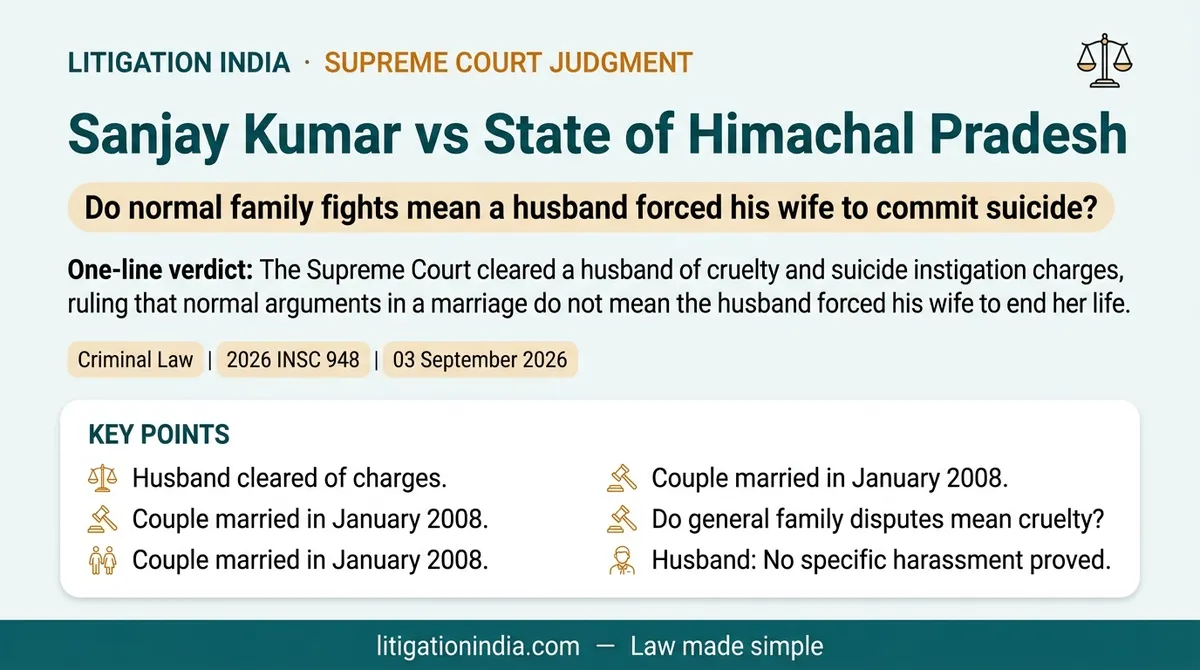
Sanjay Kumar vs State of Himachal Pradesh
The big legal question
Do normal family fights mean a husband forced his wife to commit suicide?
“The Supreme Court cleared a husband of cruelty and suicide instigation charges, ruling that normal arguments in a marriage do not mean the husband forced his wife to end her life.”
Story Slides
In short
In this case, the Supreme Court of India dealt with an appeal filed by a husband, Sanjay Kumar, who was convicted by the High Court of Himachal Pradesh under Section 306 (abetment of suicide) and Section 498-A (cruelty to a woman by husband or relatives) of the Indian Penal Code, 1860. Originally, the trial court (Sessions Court) had acquitted Sanjay and his family members, noting that the allegations of dowry demand and harassment were vague, general, and lacked specific incidents. The trial court also observed that when the wife ingested poison, the husband immediately took her to a pharmacist and then to a hospital in an attempt to save her life. However, on appeal, the High Court reversed Sanjay's acquittal, convicting him based on general statements of harassment. The Supreme Court reversed the High Court's decision and restored the husband's acquittal. The Court explained the strict legal standard for reversing an acquittal: an appellate court must find that the trial court's decision was 'perverse' or completely 'impossible' based on the evidence. It cannot simply swap the trial court's reasonable view with its own. Furthermore, the Supreme Court clarified that under Section 306 read with Section 107 of the IPC, the prosecution must prove a clear, intentional act of instigation (abetment) that drove the deceased to commit suicide. Normal matrimonial disputes or everyday family discord, while unfortunate, do not automatically amount to instigation or cruelty under the law. Because there was no evidence of physical torture or direct instigation, and the husband actively tried to save his wife's life, the Supreme Court set aside the conviction and completely cleared Sanjay of all charges.
Background
Sanjay Kumar and Lata married in January 2008. In November 2009, Lata died after consuming poison. Her family filed a police complaint accusing Sanjay and his relatives of dowry harassment and driving her to suicide.
The Decision
The Supreme Court set aside the High Court's order and restored Sanjay's acquittal. The Court ruled that there was no evidence showing Sanjay intentionally instigated or forced his wife to commit suicide.
Why it matters for you
This judgment protects individuals from wrongful conviction based on general, vague accusations after a family tragedy. It clarifies that everyday marriage arguments and discord cannot be treated as a criminal offense of instigating suicide without clear proof of intentional harassment.
AI-assisted summary, reviewed and verified by our editorial team.
In the Court's words
“In order to bring out an offence under Section 306, IPC specific abetment as contemplated by Section 107, IPC on the part of the accused with an intention to bring out the suicide... is required.”
“It is likely that there may have been some disputes or discord in the matrimonial life of the appellant and the victim. That, however, would not be sufficient in itself to attract the provisions of Section 306...”
Need help with your case?
Facing a similar legal challenge in the Supreme Court or High Court? Connect with our pro bono volunteer advocates today.
Related Supreme Court services