Sudesh Pal vs State of Uttar Pradesh
The big legal question
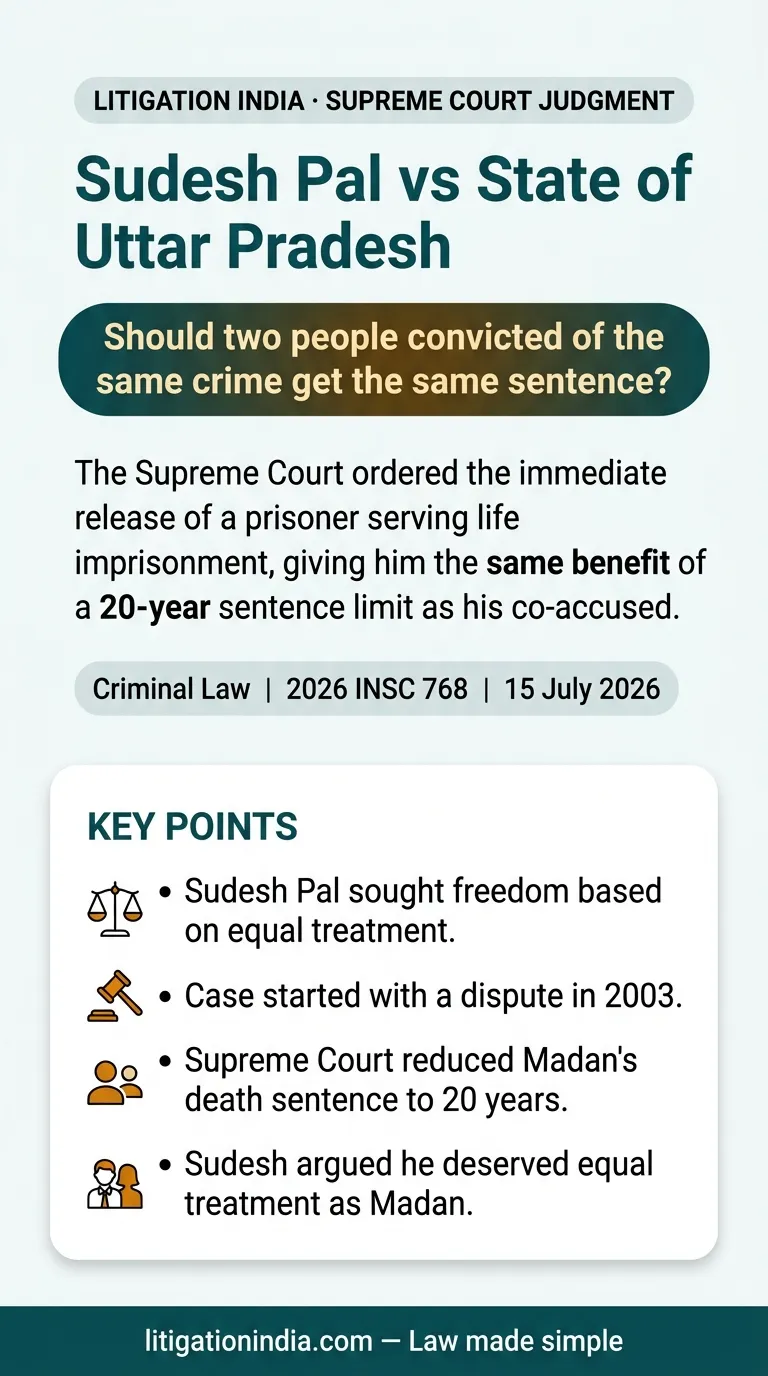
Should two people convicted of the same crime get the same sentence?
“The Supreme Court ordered the immediate release of a prisoner serving life imprisonment, giving him the same benefit of a 20-year sentence limit as his co-accused.”
Story Slides
In short
This case is about fairness in punishment, known as the principle of parity. In 2015, Sudesh Pal and his co-accused, Madan, were sentenced to death for murder. Later, the High Court reduced Sudesh Pal's punishment to life imprisonment but kept Madan's death sentence. When they appealed to the Supreme Court, the Court reduced Madan's death sentence to a fixed 20-year prison term, and since Madan had already served 20 years, he was set free. However, Sudesh Pal was still left facing life imprisonment. Sudesh Pal then filed an application in the Supreme Court. He argued that since he had already spent over 24 years in jail (including time off for good behavior), he should be treated equally to Madan and released. The State government opposed this, claiming Madan was released only because of his poor health. The Supreme Court rejected the State's argument. It ruled that fairness requires equal treatment for equal cases. Since both played similar roles, Sudesh Pal's sentence should also be limited to 20 years. Because he had already served more than 20 years, the Court ordered his immediate release.
Background
Sudesh Pal and Madan were sentenced to death by a trial court for murder. The High Court later changed Sudesh Pal's sentence to life imprisonment, while the Supreme Court eventually reduced Madan's death sentence to a fixed 20 years of jail.
The Decision
The Supreme Court applied the rule of equal treatment and limited Sudesh Pal's sentence to 20 years. Since he had already spent over 24 years in jail (including remissions), the Court ordered his immediate release.
Why it matters for you
This judgment highlights that the law must treat co-accused individuals fairly and equally. If one person gets a reduced sentence, others with similar roles cannot be kept in jail forever for the same crime.
AI-assisted summary, reviewed and verified by our editorial team.
Need help with your case?
Facing a similar legal challenge in the Supreme Court or High Court? Connect with our pro bono volunteer advocates today.
Request Free Callback