State of Andhra Pradesh vs. Ponthati Siva Rami Reddy
The big legal question
Can a murder conviction stand if the victim's final statement is highly doubtful?
“The Supreme Court refused to restore a murder conviction because the prosecution's evidence was highly inconsistent, and the accused had already served their six-year reduced sentence.”
Story Slides
In short
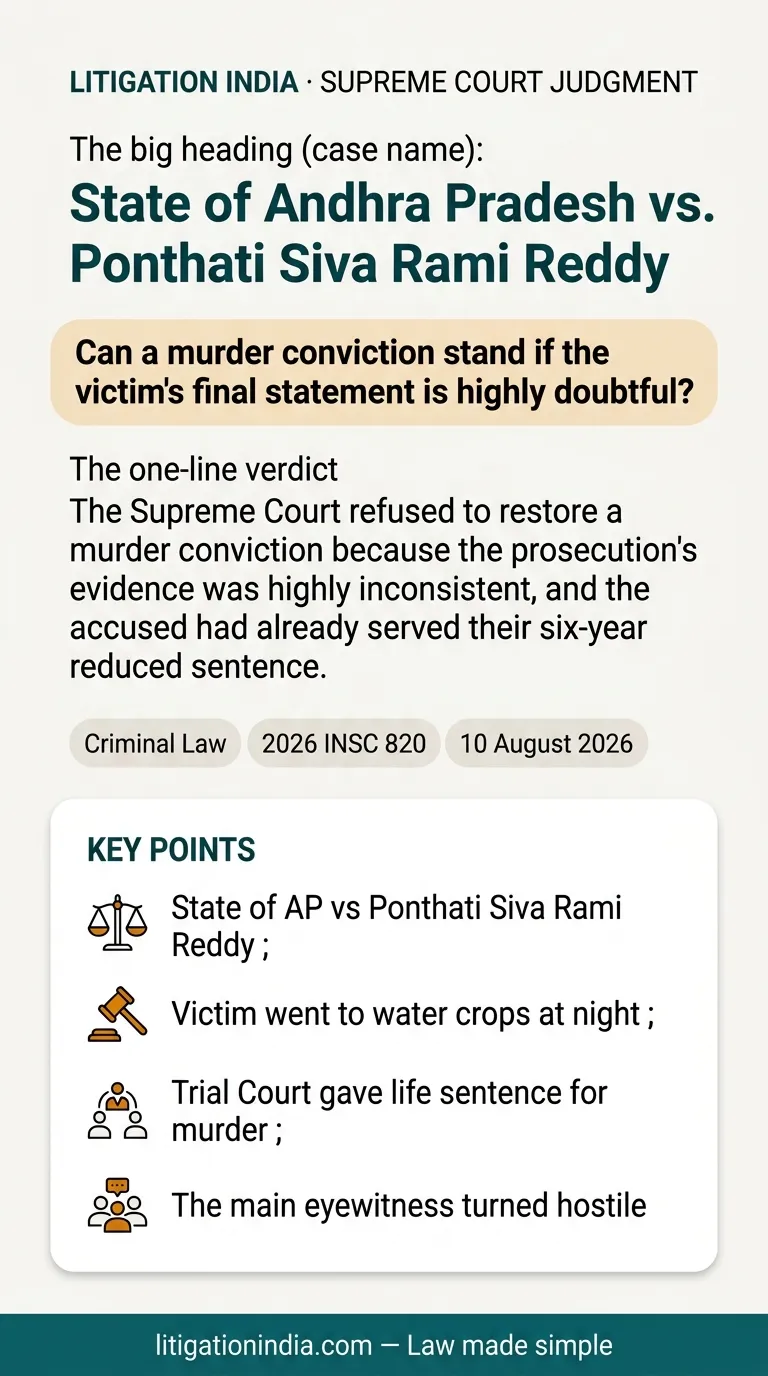
This case arose from a dispute in Andhra Pradesh where the victim was brutally attacked with sickles and iron pipes, sustaining twenty-two injuries, and later died. The Sessions Court convicted four accused individuals of murder and sentenced them to life imprisonment. On appeal, the High Court modified this conviction to culpable homicide not amounting to murder (Section 304 Part II) and reduced their sentence to six years of rigorous imprisonment, largely using guesses about how the attack happened. The State appealed to the Supreme Court, asking to restore the murder conviction. The Supreme Court dismissed the appeal and refused to restore the murder charge. It pointed out critical flaws in the prosecution's story: the main eyewitness turned hostile, witnesses gave conflicting statements about where the attack happened and how the victim was taken to the hospital, and there were no bloodstains on the clothes of the people who carried him. Crucially, the court found the victim's detailed, page-and-a-half-long final statement (dying declaration) highly doubtful because a person with twenty-two severe injuries and on painkillers is unlikely to give such a detailed account. While the Supreme Court criticized the High Court for making wild guesses, it agreed that the evidence was not strong enough for a murder conviction. Since the accused had already served their six-year sentence, the court decided to close the case.
Background
Due to a long-standing family dispute, a man was attacked at night with sickles and pipes and later died in the hospital. The local trial court sentenced four accused individuals to life imprisonment for murder.
The Decision
The Supreme Court dismissed the State's appeal, refusing to restore the murder conviction due to major contradictions in the evidence. It allowed the reduced six-year sentence to stand since the accused had already served it.
Why it matters for you
This judgment highlights that courts cannot convict someone of murder based on doubtful dying declarations or inconsistent witness statements. It also establishes that judges must decide cases strictly on actual evidence, not on personal guesses or theories.
AI-assisted summary, reviewed and verified by our editorial team.
Need help with your case?
Facing a similar legal challenge in the Supreme Court or High Court? Connect with our pro bono volunteer advocates today.
Related Supreme Court services