
A failed business deal cannot be turned into a criminal cheating case
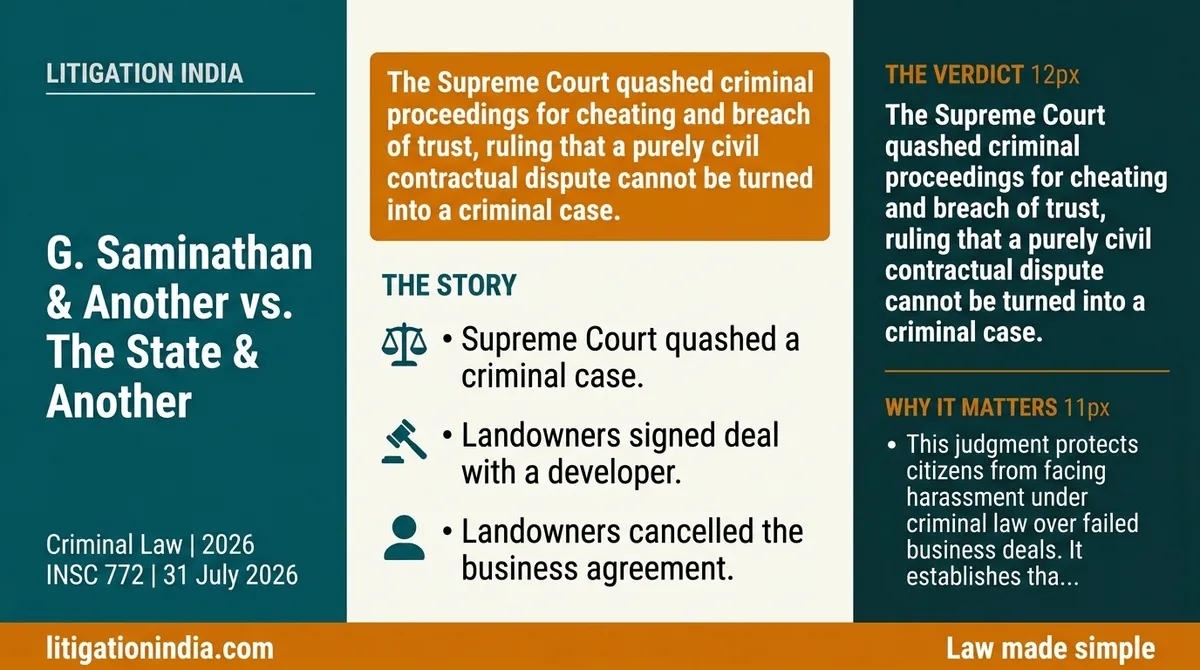
The Supreme Court quashed criminal proceedings for cheating and breach of trust, ruling that a purely civil contractual dispute cannot be turned into a criminal case.
Case: G. Saminathan & Another vs. The State & AnotherCitation: 2026 INSC 772Decided on: 31 July 2026
What this case means
A landowner cancelled a business deal after the government rejected their construction plan, but the developer filed a criminal cheating case instead of taking a refund. The Supreme Court cancelled the police case, ruling that a broken business contract is a civil matter, not a crime. This decision protects ordinary citizens from being harassed by the police over failed business agreements.
“The Supreme Court quashed criminal proceedings for cheating and breach of trust, ruling that a purely civil contractual dispute cannot be turned into a criminal case.”
Story Slides
In short
In this case, landowners (the appellants) entered into a Joint Development Agreement with a construction company to build residential flats and received a refundable security deposit of Rs. 3 crore. However, the government authority rejected the building plan because the land layout was unapproved. Consequently, the landowners cancelled the agreement, offered to refund the deposit, and sold the land to a third party. Instead of accepting the refund and pursuing civil remedies, the developer filed a criminal case accusing the landowners of cheating and criminal breach of trust. The Supreme Court observed that the dispute was entirely civil and contractual in nature. It held that for a charge of cheating, there must be a dishonest intention right from the beginning of the agreement, which was absent here as both parties had initially tried to make the project work. The Court also clarified that a refundable security deposit in a business deal does not qualify as 'entrusted property' for a criminal breach of trust. Additionally, the Court ruled that the charges of cheating and criminal breach of trust cannot logically apply together to the exact same set of facts. The Court criticized the growing trend of using criminal complaints to pressure parties in civil disputes and quashed the criminal proceedings.
Need clarity on a similar legal issue?
Request free pro bono guidance from a Supreme Court Advocate.
Background
Landowners signed a business agreement with a developer and took a Rs. 3 crore deposit, but the government rejected the construction plan. After the project failed, the landowners cancelled the agreement, offered a full refund, and sold the land, prompting the developer to file a cheating case.
The Decision
The Supreme Court set aside the High Court's order and completely quashed the criminal case, ruling that the parties must resolve their monetary disputes through civil courts or arbitration.
Why it matters for you
This judgment protects citizens from facing harassment under criminal law over failed business deals. It establishes that a mere breach of a contract is a civil matter and cannot be used by police to force financial settlements.
Relevant Legal Provisions
Key Acts and sections cited or relied upon in this judgment
“This section punishes cheating where someone is dishonestly induced to deliver property to another person. It strictly requires that the person had a dishonest and cheating intention right from the very beginning of the deal. In this case, the Court found no such initial bad intention because both parties had genuinely tried to make the construction project work.”
“This section provides punishment for criminal breach of trust, which happens when someone is trusted with property but dishonestly keeps or misuses it. The Court clarified that cheating and criminal breach of trust are different and cannot be charged together for the same facts. Since this was a simple case of returning a security deposit, it was a civil contract issue rather than a criminal breach of trust.”
“This provision gives the High Court inherent powers to cancel or throw out unfair criminal cases to prevent the abuse of law and ensure justice. The Supreme Court used these principles to set aside the High Court order and quashed the FIR, holding that civil disputes must be resolved through civil courts or arbitration instead of criminal prosecution.”
AI-assisted summary, reviewed and verified by our editorial team.
Need help with your case?
Facing a similar legal challenge in the Supreme Court or High Court? Connect with our pro bono volunteer advocates today.
Related Supreme Court services
Related Questions of Law
- Can a murder conviction stand on unreliable eyewitnesses and incomplete circumstantial evidence?
- Can a person be convicted of murder if the police investigation is highly careless
- Can helpers escape a murder conviction if they did not fire the fatal shot?
- Do normal family fights mean a husband forced his wife to commit suicide?
- Can courts convict someone based on electronic evidence that lacks a legal certificate?