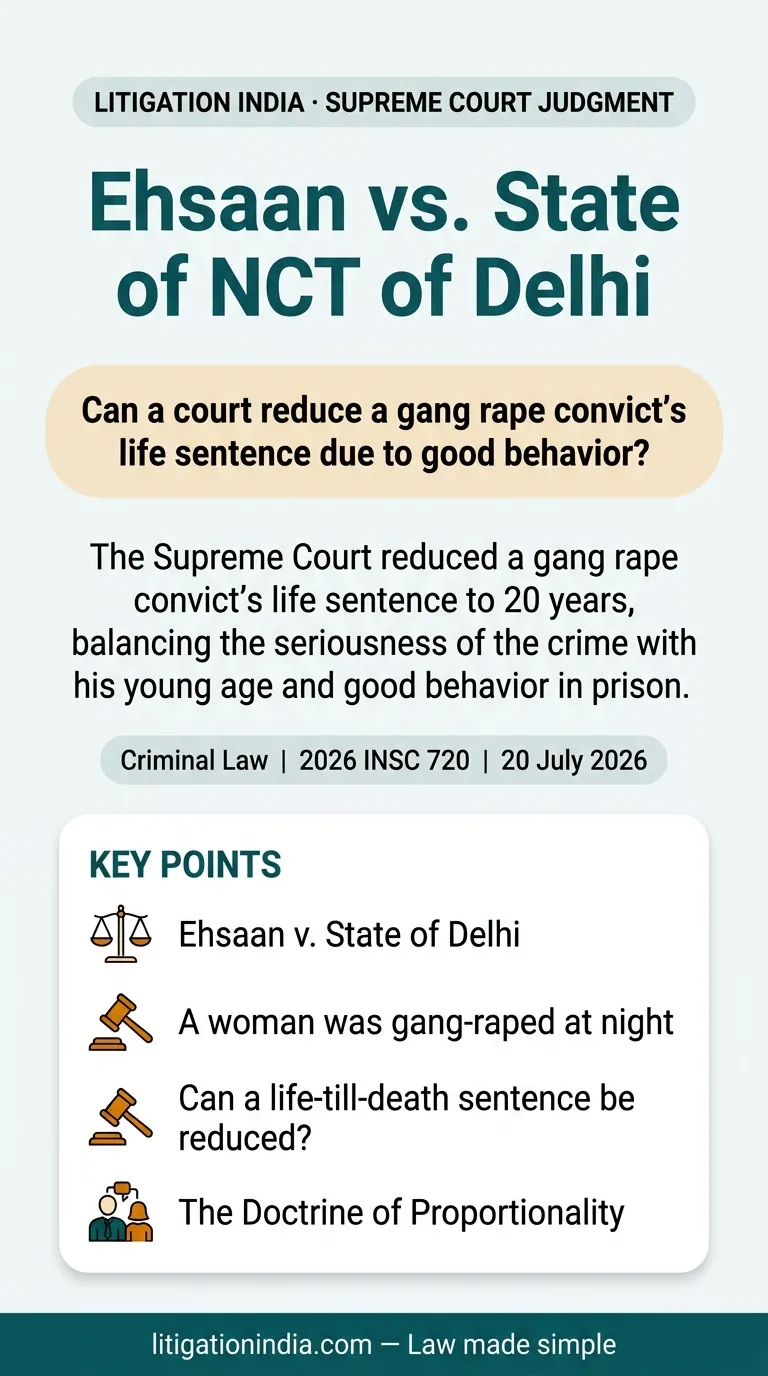
Ehsaan vs. State of NCT of Delhi
The big legal question
Can a court reduce a gang rape convict's life sentence due to good behavior?
“The Supreme Court reduced a gang rape convict's life sentence to 20 years, balancing the seriousness of the crime with his young age and good behavior in prison.”
Story Slides
In short
In this case, the appellant, Ehsaan, was convicted of gang rape under Section 376-D of the Indian Penal Code (IPC) for a heinous crime committed in Delhi in 2016. The Trial Court and the Delhi High Court had sentenced him to rigorous imprisonment for the remainder of his natural life. When the matter reached the Supreme Court, the Court chose not to disturb his conviction but agreed to review the severity of his punishment. Under the 2013 law (introduced after the Nirbhaya case), the minimum punishment for gang rape is 20 years, while the maximum is life imprisonment for the remainder of natural life. The Supreme Court applied the 'doctrine of proportionality'—the rule that a punishment must fit the crime and balance the interests of the victim, society, and the offender. The Court observed that Ehsaan was only 25 years old at the time of the incident, had no previous criminal record, and had maintained excellent behavior during his ten years in prison. Believing there was still a chance for him to reform, the Supreme Court reduced his sentence from the remainder of his natural life to a fixed term of 20 years, allowing him the possibility of early release (remission) if permitted by the government.
Background
In September 2016, a woman took a rickshaw at night from Delhi Railway Station. Instead of dropping her home, the driver took her to a lonely place, where he and another person committed gang rape. The trial court convicted the accused and sentenced them to spend the rest of their natural lives in jail, which was approved by the High Court.
The Decision
The Supreme Court kept the conviction intact but reduced the sentence to 20 years of rigorous imprisonment. It ruled that while the crime was terrible, the convict's young age, lack of past crimes, and ten years of good conduct in jail showed he could be reformed.
Why it matters for you
This judgment highlights that while dealing with heinous crimes, courts must balance strict punishment with the possibility of reform. It clarifies that even in serious offences, mitigating factors like age and prison conduct can be used to reduce a sentence to the legal minimum.
AI-assisted summary, reviewed and verified by our editorial team.
Need help with your case?
Facing a similar legal challenge in the Supreme Court or High Court? Connect with our pro bono volunteer advocates today.
Request Free Callback