Dhrub Singh Etc. vs The State of Bihar
The big legal question
Can a court convict someone of murder if scientific medical evidence contradicts eyewitnesses?
“The Supreme Court acquitted the accused because the police investigation was highly suspicious, medical reports contradicted the eyewitnesses, and guilt was not proven beyond reasonable doubt.”
Story Slides
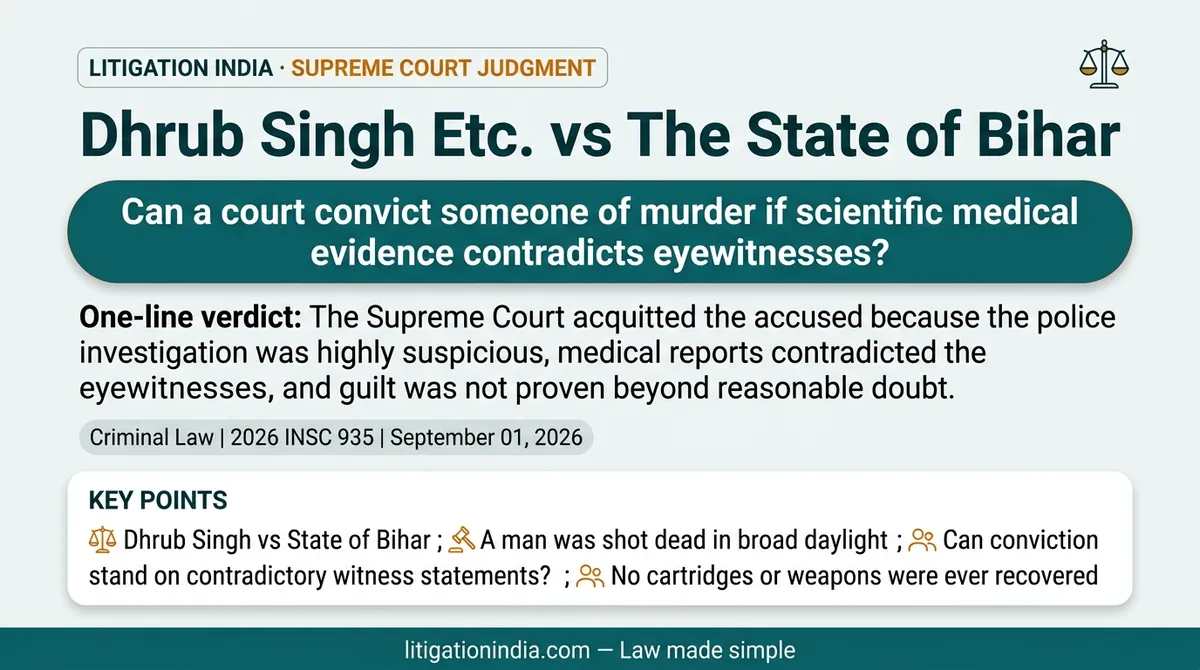
In short
This important criminal appeal highlights the Supreme Court's firm stance on establishing criminal guilt beyond reasonable doubt. It shows how courts cannot rely on eyewitness testimonies when physical and medical evidence tells a completely different story. In this case, five accused challenged their conviction for murder under Sections 302 and 307 of the Indian Penal Code. The prosecution claimed that the accused ambushed the victim and shot him in the back while he was walking to his fields. However, the Supreme Court discovered major loopholes. First, the medical expert testified that the bullet trajectory and skin blackening proved the victim was shot from a very close distance of just three to four feet while sitting down. This completely disproved the eyewitnesses' claim of a running shootout from behind. Second, the police investigation was highly suspicious. No weapons or cartridges were recovered from the scene, and blood-stained soil was never sent for chemical testing. Most shockingly, the police completed the inquest of the dead body before registering the First Information Statement (FIS), suggesting that the story was manufactured later to frame the accused due to old village rivalries. The Supreme Court explained that while a faulty investigation alone does not always free an accused, courts cannot presume guilt when there is absolutely no reliable corroborating evidence. Because the prosecution failed to prove the case beyond a reasonable doubt, the Supreme Court set aside the high court's order and acquitted all the appellants.
Background
The case involved a broad-daylight murder in Bihar. The trial court and High Court convicted the accused based on the statements of the victim's close relatives and employee, who claimed they were ambushed and shot from behind while walking.
The Decision
The Supreme Court set aside the convictions and acquitted all the appellants, holding that the contradictory medical report, lack of recovered weapons or cartridges, and registering the FIR after the body's inquest created an overwhelming doubt about the police case.
Why it matters for you
It protects innocent citizens from false cases by ruling that when scientific medical evidence contradicts biased eyewitness testimonies, and basic police procedures are bypassed, courts must give the benefit of doubt to the accused.
AI-assisted summary, reviewed and verified by our editorial team.
In the Court's words
“The case is not of a faulty investigation but of no investigation having been carried out.”
“There is complete lack of evidence in the present case and the testimonies, as we observed, do not inspire confidence.”
Need help with your case?
Facing a similar legal challenge in the Supreme Court or High Court? Connect with our pro bono volunteer advocates today.
Related Supreme Court services