Deo Prasad vs State of Uttar Pradesh
The big legal question
Can a murder conviction stand if the police delay sending the FIR to court?
“The Supreme Court acquitted three men accused of a 1977 murder because the police delayed sending the FIR to the court and left the body unprotected all night, raising serious doubts.”
Story Slides
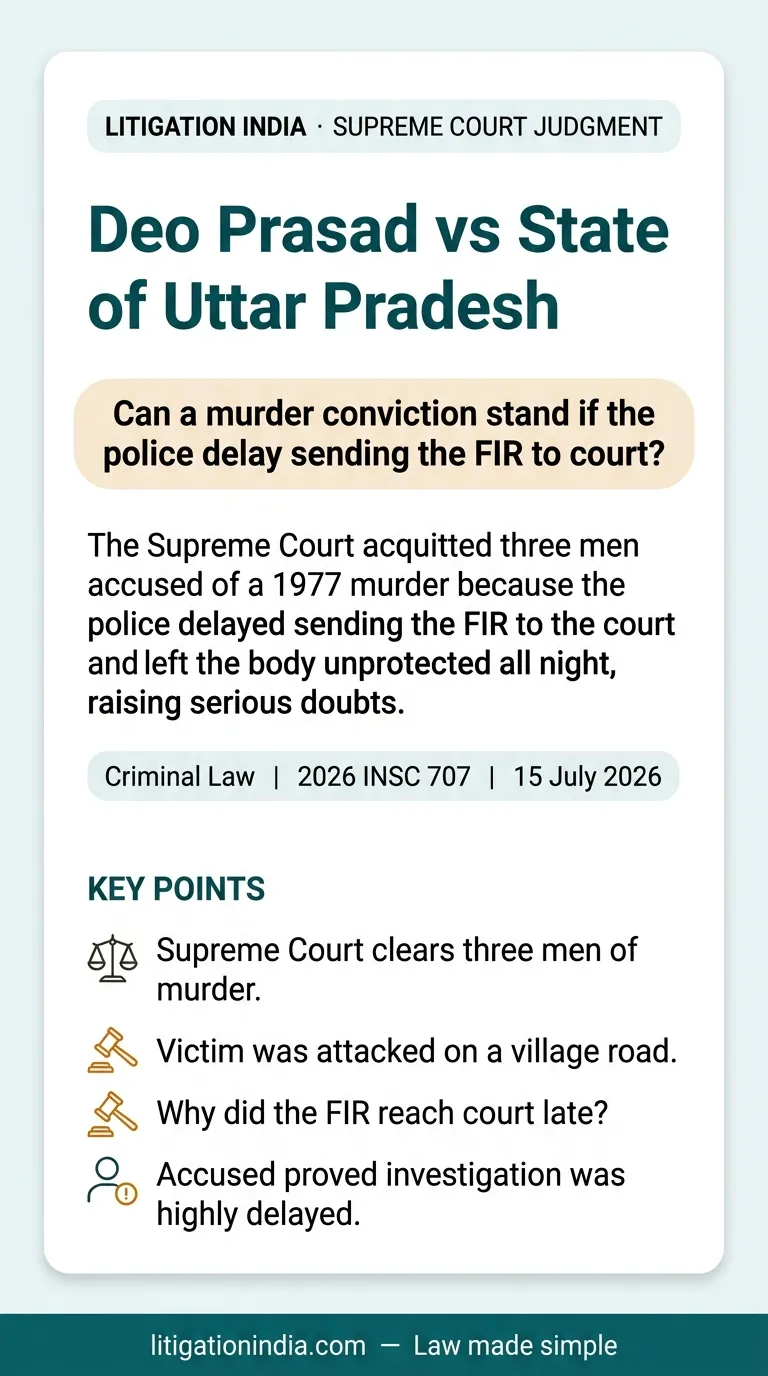
In short
The Supreme Court of India cleared three men of murder charges in a case dating back to 1977. The prosecution alleged that the accused ambushed and killed a man in broad daylight in Gonda, Uttar Pradesh, over political rivalry. Both the trial court and the High Court had convicted the men. However, the Supreme Court found several major flaws in how the police handled the case. First, even though the police station was very close and the police visited the crime scene on the night of the incident, they left the victim's dead body lying unprotected on the road through the entire night. The victim's family also did nothing to protect the body, which is highly unusual. Second, the police took nearly 48 hours to conduct the post-mortem examination. Third, and most importantly, the First Information Report (FIR) was registered on June 28, but it reached the local Magistrate only on June 30. The Supreme Court explained that prompt sharing of the FIR with the court is a crucial safeguard against police creating a fake, delayed story to trap innocent people. Because of these serious loopholes and contradictions, the Court decided that the prosecution's story was not reliable and acquitted all surviving accused by giving them the benefit of doubt.
Background
In June 1977, a man named Harihar Saran was brutally killed on a road in Gonda, Uttar Pradesh. The police claimed it was a pre-planned attack by six men due to political and village rivalry. The trial court and High Court sentenced the accused to life imprisonment based on local eyewitnesses.
The Decision
The Supreme Court set aside the convictions and acquitted all surviving accused. It held that the delayed FIR, along with leaving the body unattended all night and postponing the post-mortem, showed that the police fabricated the case later to fit their narrative.
Why it matters for you
This judgment shows that police cannot write FIRs at their convenience after completing investigations to falsely trap people. It protects citizens by holding police accountable for not sending documents to the court immediately as required by law.
AI-assisted summary, reviewed and verified by our editorial team.
Need help with your case?
Facing a similar legal challenge in the Supreme Court or High Court? Connect with our pro bono volunteer advocates today.
Related Supreme Court services