Arjun Jani @ Tuntun vs State of Orissa
The big legal question
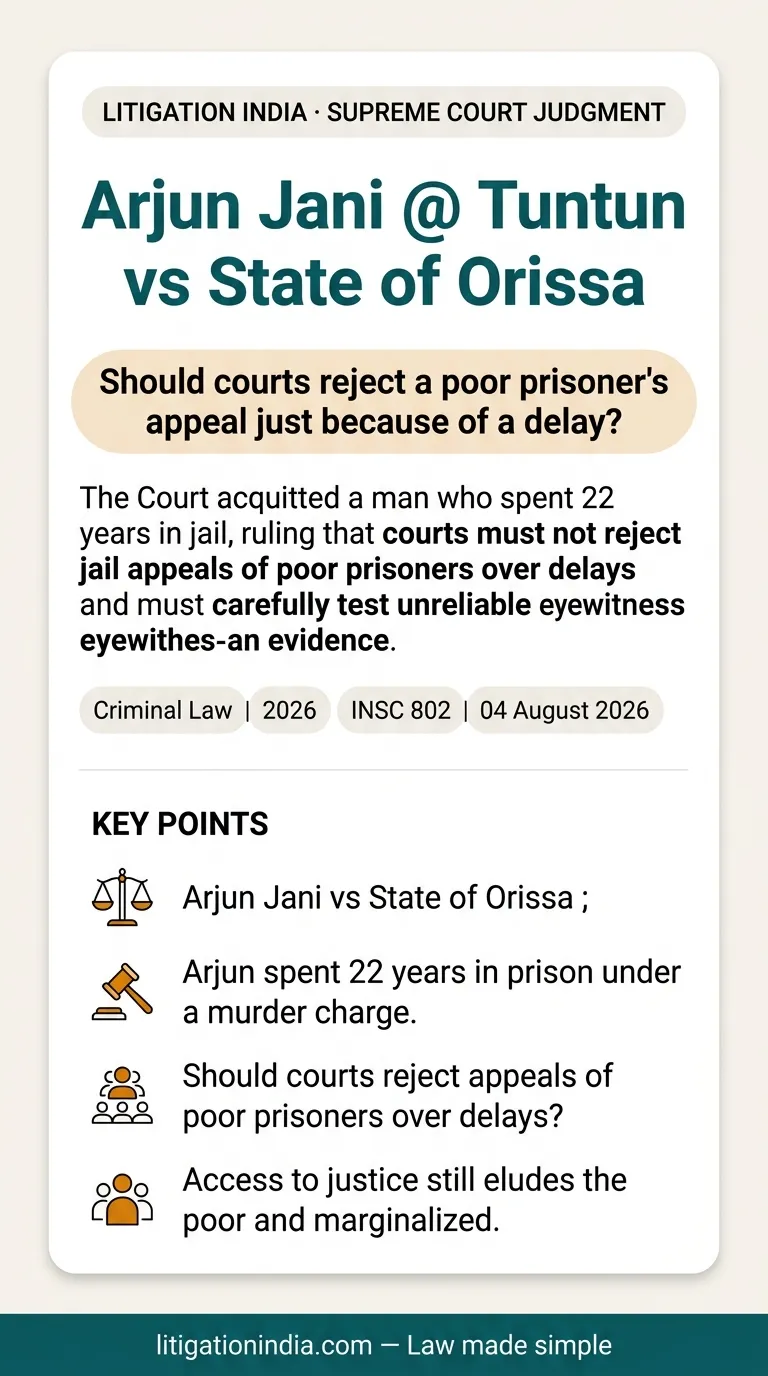
Should courts reject a poor prisoner's appeal just because of a delay?
“The Court acquitted a man who spent 22 years in jail, ruling that courts must not reject jail appeals of poor prisoners over delays and must carefully test unreliable eyewitness evidence.”
Story Slides
In short
The Supreme Court of India set aside the murder conviction of Arjun Jani, who had languished in prison for 22 years. The High Court had earlier dismissed his appeal simply because it was filed late by 3,157 days, without even hearing his case on merits. The Supreme Court expressed deep disappointment, emphasizing that poor and marginalized prisoners struggle to access justice. Constitutional courts must take a proactive and extremely liberal approach to forgive delays in jail appeals, as a person's fundamental right to liberty is at stake. Upon reviewing the actual case files, the Supreme Court found the prosecution's evidence highly unbelievable. The conviction rested solely on a shaky eyewitness whose statements were filled with major contradictions. For instance, she claimed she did not see two other dead bodies on her path while fleeing, yet next morning she claimed to know about all three deaths. Additionally, the police used physical force to get a confession, which is illegal, and failed to produce any scientific evidence like bloodstains on the stones allegedly used as weapons. Realizing that 22 years of an innocent man's life were erased due to poor judicial oversight, the Supreme Court acquitted him immediately. The Court also ordered the local administration in Koraput, Odisha, to help resettle and rehabilitate him.
Background
Arjun Jani was arrested for the murder of three women in Odisha and sentenced to life imprisonment. He spent 12 years in jail before filing an appeal through prison, which the High Court rejected solely because of a long delay.
The Decision
The Supreme Court set aside the conviction, stating that the eyewitness was unreliable and the investigation was deeply flawed. The Court ordered his immediate release and directed the local administration to help rehabilitate him after 22 years of wrongful imprisonment.
Why it matters for you
This judgment ensures that poor prisoners do not lose their right to appeal due to technical delays. It reminds courts to prioritize justice and liberty over procedural timelines, protecting innocent citizens from wrongful life imprisonment.
AI-assisted summary, reviewed and verified by our editorial team.
Need help with your case?
Facing a similar legal challenge in the Supreme Court or High Court? Connect with our pro bono volunteer advocates today.
Related Supreme Court services