Landmark Supreme Court of India rulings, explained in clear, plain language.
Filter by Act / Section
Showing 7 of 7 judgments
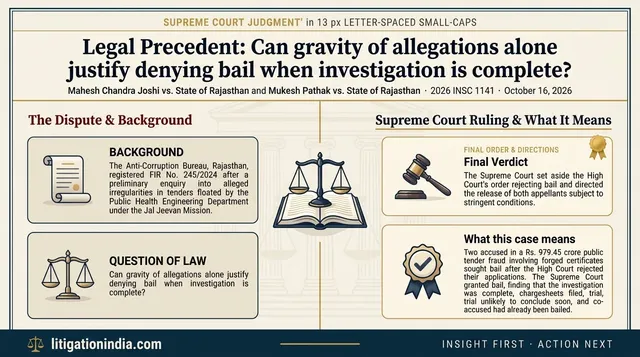
Can gravity of allegations alone justify denying bail when investigation is complete?
Mahesh Chandra Joshi vs. State of Rajasthan and Mukesh Pathak vs. State of Rajasthan
The Supreme Court granted bail to two accused in the Jal Jeevan Mission tender fraud, holding that completed investigation, voluminous record, and prolonged custody warranted their release subject to conditions.
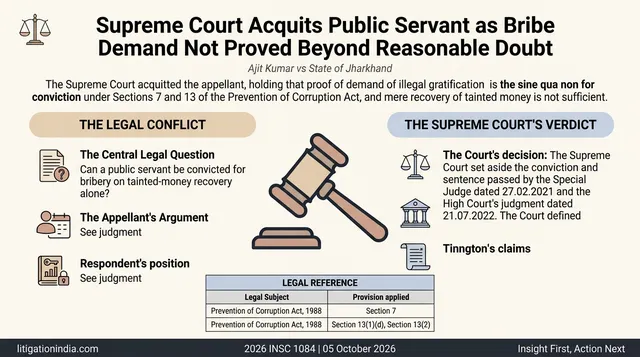
Can a public servant be convicted for bribery on tainted-money recovery alone?
Ajit Kumar vs State of Jharkhand
The Supreme Court acquitted the appellant, holding that proof of demand of illegal gratification is the sine qua non for conviction under Sections 7 and 13 of the Prevention of Corruption Act, and mere recovery of tainted money is not sufficient.
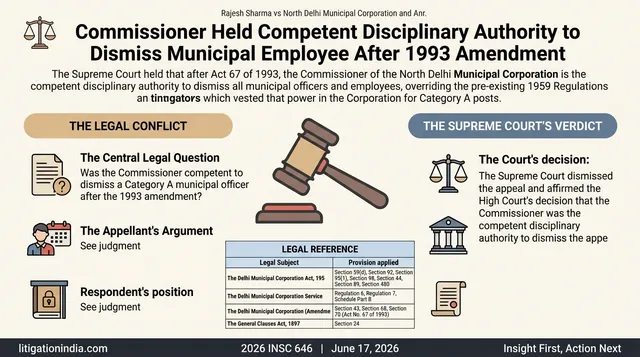
Was the Commissioner competent to dismiss a Category A municipal officer after the 1993 amendment?
Rajesh Sharma vs North Delhi Municipal Corporation and Anr.
The Supreme Court held that after Act 67 of 1993, the Commissioner of the North Delhi Municipal Corporation is the competent disciplinary authority to dismiss all municipal officers and employees, overriding the pre-existing 1959 Regulations which vested that power in the Corporation for Category A posts.
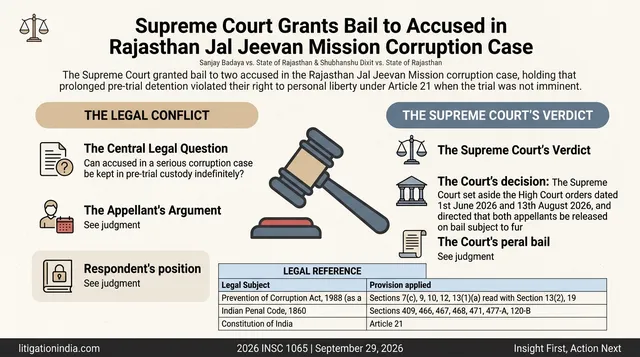
Can accused in a serious corruption case be kept in pre-trial custody indefinitely?
Sanjay Badaya vs. State of Rajasthan & Shubhanshu Dixit vs. State of Rajasthan
The Supreme Court granted bail to two accused in the Rajasthan Jal Jeevan Mission corruption case, holding that prolonged pre-trial detention violated their right to personal liberty under Article 21 when the trial was not imminent.
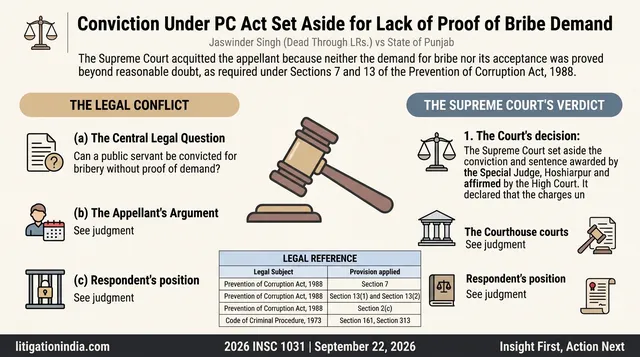
Can a public servant be convicted for bribery without proof of demand?
Jaswinder Singh (Dead Through LRs.) vs State of Punjab
The Supreme Court acquitted the appellant because neither the demand for bribe nor its acceptance was proved beyond reasonable doubt, as required under Sections 7 and 13 of the Prevention of Corruption Act, 1988.
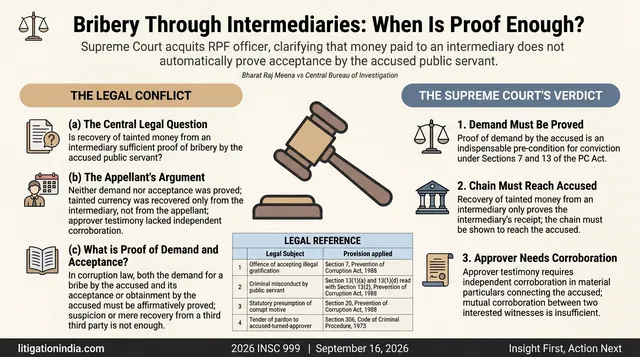
Can a public servant be convicted for bribery when money was paid only to intermediaries?
Bharat Raj Meena vs Central Bureau of Investigation
The Supreme Court acquitted the appellant in both corruption cases, holding that the prosecution failed to prove beyond reasonable doubt that illegal gratification was demanded by or ultimately reached the appellant through the intermediaries.
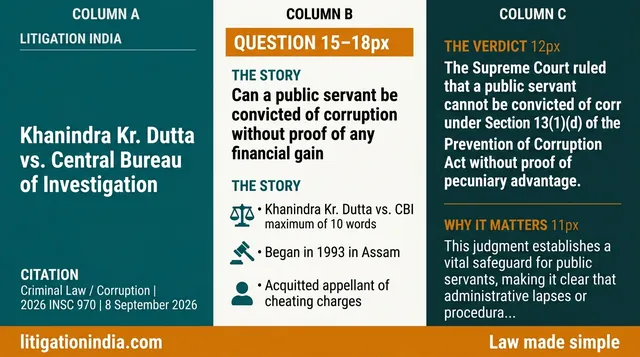
Can a public servant be convicted of corruption without proof of any financial gain
Khanindra Kr. Dutta vs. Central Bureau of Investigation
The Supreme Court ruled that a public servant cannot be convicted of corruption under Section 13(1)(d) of the Prevention of Corruption Act without proof of pecuniary advantage.
You have reached the end — all 7 judgments loaded.