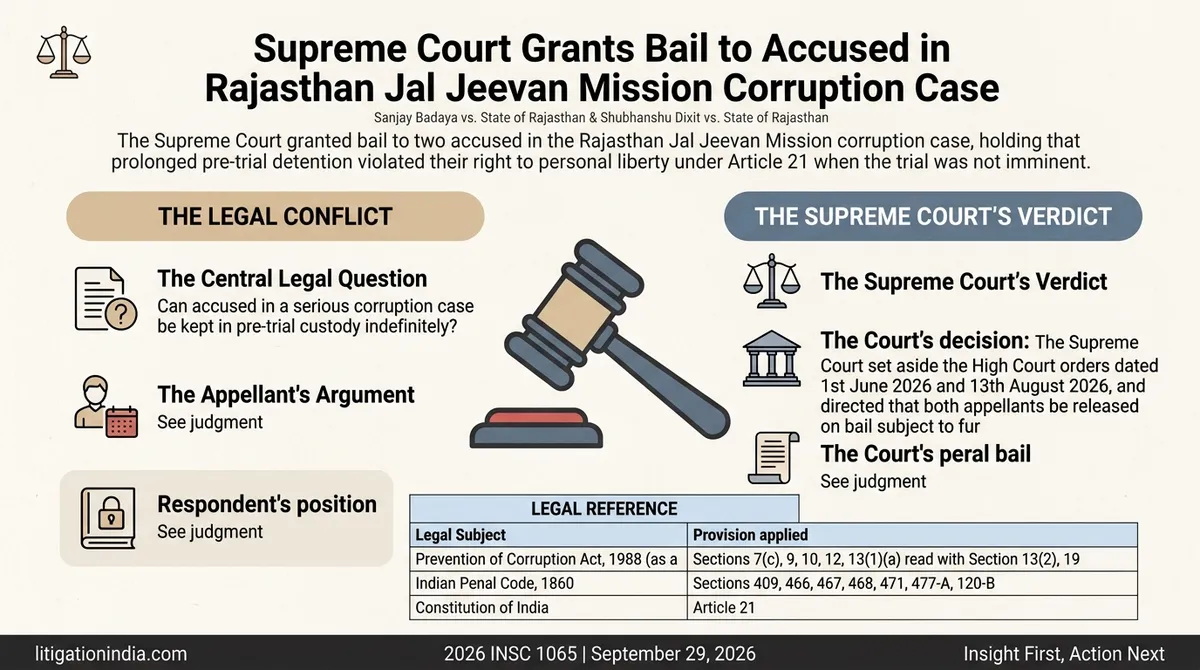
Full text of the judgment
Text extracted from Sanjay Badaya vs. State of Rajasthan & Shubhanshu Dixit vs. State of Rajasthan. For the authoritative version refer to the Supreme Court of India's official website.
2026 INSC 1065 Page 1 of 8
NON-REPORTABLE IN THE SUPREME COURT OF INDIA CRIMINAL APPELLATE JURISDICTION CRIMINAL APPEAL NO. OF 2026 [ARISING OUT OF SLP (CRL.) NO. 15347 OF 2026]
SANJAY BADAYA
… APPELLANT
STATE OF RAJASTHAN
… RESPONDENT WITH CRIMINAL APPEAL NO. OF 2026 [ARISING OUT OF SLP (CRL.) NO. 13461 OF 2026]
SHUBHANSHU DIXIT
… APPELLANT
STATE OF RAJASTHAN
… RESPONDENT O R D E R DIPANKAR DATTA, J. 1. Leave granted. 2. Appellants have impugned the dismissal of their respective applications seeking regular bail by the High Court of Judicature for Rajasthan, Bench at Jaipur1, vide separate impugned orders dated 1st June, 2026, and 13th August, 2026.
1 High Court Digitally signed by JATINDER KAUR Date: 2026.09.29 16:19:26 IST Reason: Signature Not Verified
Page 2 of 8
3. For clarity, the details of the respective appeals and corresponding bail applications filed by both the appellants before the High Court are set out in the table below: Name of the appellant Appeal No. Bail application before the High Court Date of impugned order Shubhanshu Dixit SLP (Crl.) No. 13461 of 2026 S.B. Criminal Misc. Bail Application No. 3183/2026 01.06.2026 Sanjay Badaya SLP (Crl.) No. 15347 of 2026 S.B. Criminal Misc. Bail Application No. 11425/2026 13.08.2026 4. The genesis of the prosecution’s case against both the appellants is anchored in a common Preliminary Enquiry No. 06/2024 dated 18th January, 2024, which subsequently culminated in the registration of an FIR bearing No. 245/2024 dated 30th October, 2024, at Police Station, Anti-Corruption Bureau, Jaipur, Rajasthan2. The said FIR was registered for offences punishable under Sections 7(c), 9, 10, 13(1)(a) read with Section 13(2), and Section 12 of the Prevention of Corruption Act, 1988 (as amended in 2018)3, alongside Sections 409, 466, 467, 468, 471, 477-A, and 120-B of the Indian Penal Code, 1860. 5. The factual matrix of the prosecution’s case seeks to expose a wellorchestrated conspiracy and massive financial irregularities within the Public Health Engineering Department, Rajasthan4. These anomalies
2 ACB 3 PoC Act 4 PHED
Page 3 of 8
pertain to the execution of the “Jal Jeevan Mission”, an ambitious joint initiative of the Central and State Governments intended to provide functional household tap connections for safe and adequate drinking water. The prosecution projects that two private contracting firms, namely M/s Shri Ganpati Tubewell Company (proprietorship of Mr. Mahesh Mittal) and M/s Shri Shyam Tubewell Company (proprietorship of Mr. Padam Chand Jain), acting in connivance with senior public servants and private intermediaries, procured forged and fabricated work-experience and completion certificates purportedly issued by IRCON International Limited. Relying on these forged documents, the aforementioned firms deceitfully secured eligibility and were awarded work orders for approximately 104 tenders, amounting to a staggering sum of Rs. 979.45 crore, thereby causing immense wrongful loss to the State exchequer. 6. Upon completion of the investigation, the ACB filed Chargesheet No. 80/2026 dated 12th April, 2026, followed by Supplementary Chargesheet No. 80-B/2026 dated 29th June, 2026. Therein, the present appellants have been arrayed as accused alongside other coaccused public servants and private individuals. The prosecution proposes to examine 124 witnesses, while seeking to rely on voluminous documentary evidence running into thousands of pages. 7. Given the distinct roles attributed to the present appellants, it is apposite to briefly outline the specific edifice of the prosecution’s case against each:
Page 4 of 8
a. SHUBHANSHU DIXIT The said appellant, a public servant, served as the Secretary of the Rajasthan Water Supply and Sewerage Management Board (RWSSMB), Jal Bhawan, Jaipur, during the relevant period (30th December 2022 to 13th February 2024). By virtue of this office, he concurrently functioned as the de facto Secretary of the PHED Finance Committee. The prosecution alleges that despite receipt of specific complaints from whistleblowers, including one Mr. Padam Singh (dated 14th and 16th February, 2023) and legal notices from Mr. Mahesh Kalwania (dated 16th and 20th March, 2023), explicitly highlighting the use of forged IRCON certificates by the accused firms, the said appellant failed to take any effective action. It is alleged that, acting in criminal conspiracy with the then Additional Chief Secretary (Mr. Subodh Agarwal) and the accused contractors, the said appellant deliberately suppressed these complaints. Furthermore, he participated in multiple Finance Committee meetings where the financial bids of the tainted firms were approved. The prosecution asserts that by issuing the minutes of these meetings, he allegedly facilitated the award of tenders to ineligible firms. He was arrested on 17th February, 2026. b. SANJAY BADAYA The said appellant, a private individual, is portrayed by the prosecution as a central intermediary and broker acting on behalf of the then Cabinet Minister of the PHED, Mr. Mahesh Chandra Joshi. The
Page 5 of 8
prosecution alleges that despite holding no official position within the department, he exercised undue influence over departmental operations, including the movement of tender files, vigilance inquiries, and the transfers, postings, and “Awaiting Posting Orders” of departmental engineers. It is alleged that he collected substantial cash bribes from the accused contractors in exchange for securing favourable treatment, suppressing pending inquiries, and ensuring the smooth clearance of inflated bills. The evidentiary trail, predominantly comprising intercepted telephonic conversations, allegedly demonstrates that he facilitated the routing of bribe amounts into the bank accounts of his relatives/acquaintances, which were subsequently transferred to M/s Sumangalam Landmark LLP, a firm owned by the son of the then PHED Minister. He was arrested on 11th May, 2026. 8. We have accorded our thoughtful consideration to the rival submissions advanced by learned senior counsel(s) appearing for the respective appellants and learned counsel representing the respondent-State, and have perused the materials on record. 9. Since this order is confined to consideration of the prayers for grant of bail, we need not delve into the correctness of the allegations or the materials. 10. While we have no hesitation to agree with learned counsel for the State that economic offences having deep-rooted conspiracies must be viewed seriously, and the State is justified in opposing the prayer for
Page 6 of 8
grant of bail to the present appellants, however, sight of the other features of the present case cannot be lost. The investigation qua the present appellants is complete, and chargesheets have since been filed. The prosecution’s case predominantly rests on documentary records and electronic trails. Since these materials are already seized and in the safe custody of the investigating agency, the apprehension of tampering with evidence is substantially obliterated. 11. The materials to be placed before the Trial Court are voluminous. Presently, the proceedings are at a nascent stage. Admittedly, the charges are yet to be framed and the trial is yet to commence for, inter alia, the following reasons: the investigation against some of the accused persons is still pending; two of the accused persons are absconding; and sanction under Section 19 of the PoC Act was granted on 6th September, 2026 for the prosecution of six (6) other co-accused persons who are public servants. Bearing in mind the sheer volume of evidence that must be led to prove the charges, the trial is bound to be a protracted exercise. 12. It is a well-settled postulate of criminal jurisprudence that pre-trial incarceration cannot masquerade as punitive detention, particularly when the commencement and conclusion of the trial are not imminent. This Court must intervene to safeguard the right to personal liberty under Article 21 of the Constitution of India when a trial cannot be reasonably concluded in the near future.
Page 7 of 8
13. We are also persuaded by the fact that some co-accused in this overarching conspiracy, whose alleged roles will ultimately be considered at trial, have already been granted bail or protection. One such co-accused, Mr. Arun Srivastava, was enlarged on bail by the High Court vide order dated 1st June, 20265. Notably, the principal political executive, the then PHED Minister, Mr. Mahesh Chandra Joshi, has been granted bail in the corresponding PMLA offence6 arising out of the present FIR, by this Court vide order dated 3rd December, 20257. 14. In the conspectus of these aspects, we are of the view that it would serve no fruitful purpose to keep the appellants under further pre-trial custody. Resultantly, the present appeals succeed. The impugned orders dated 1st June, 2026, and 13th August, 2026, passed by the High Court are hereby set aside. 15. Appellants – Sanjay Badaya and Shubhanshu Dixit – shall be released on bail in connection with the present case, unless required in any other case, subject to furnishing of bail bonds to the satisfaction of the Trial Court and subject to such other terms and conditions as the Trial Court may deem fit and proper to impose. 16. Also, since the investigation is yet to conclude against some accused persons, we direct that if the investigating officer calls upon the appellants to join the investigation to facilitate the filing of appropriate report(s), they shall do so by attending at the police station.
5 S.B. Criminal Misc. Bail Application No. 4864/2026 6 ECIR No. JPZO/29/2023 dated 21st August, 2023 7 2025 SCC OnLine SC 2633
Page 8 of 8
17. It is also made clear that the appellants shall diligently participate in the trial and shall appear before the Trial Court on the dates fixed, unless exempted. Should there be any default in their appearance without justifiable cause, or any infraction of the bail conditions, the Trial Court shall be at liberty to cancel the bail of the defaulting appellant(s) and pass appropriate orders in accordance with the law. 18. At this juncture, we make it abundantly clear that we are not expressing any opinion on the merits of the allegations, the specific roles attributed to the appellants, or the evidentiary value of the records. These are matters best left for the Trial Court to adjudicate independently. The observations made hereinabove are confined exclusively to the adjudication of the present appeals seeking bail and shall have no bearing whatsoever on the merits of the case during the trial. 19. Pending application(s), if any, shall also stand disposed of.
…………………………….J. (DIPANKAR DATTA)
…………………………….J. (SHEEL NAGU) NEW DELHI; SEPTEMBER 29, 2026.