No corruption conviction under Section 13 1 d without proof of monetary gain
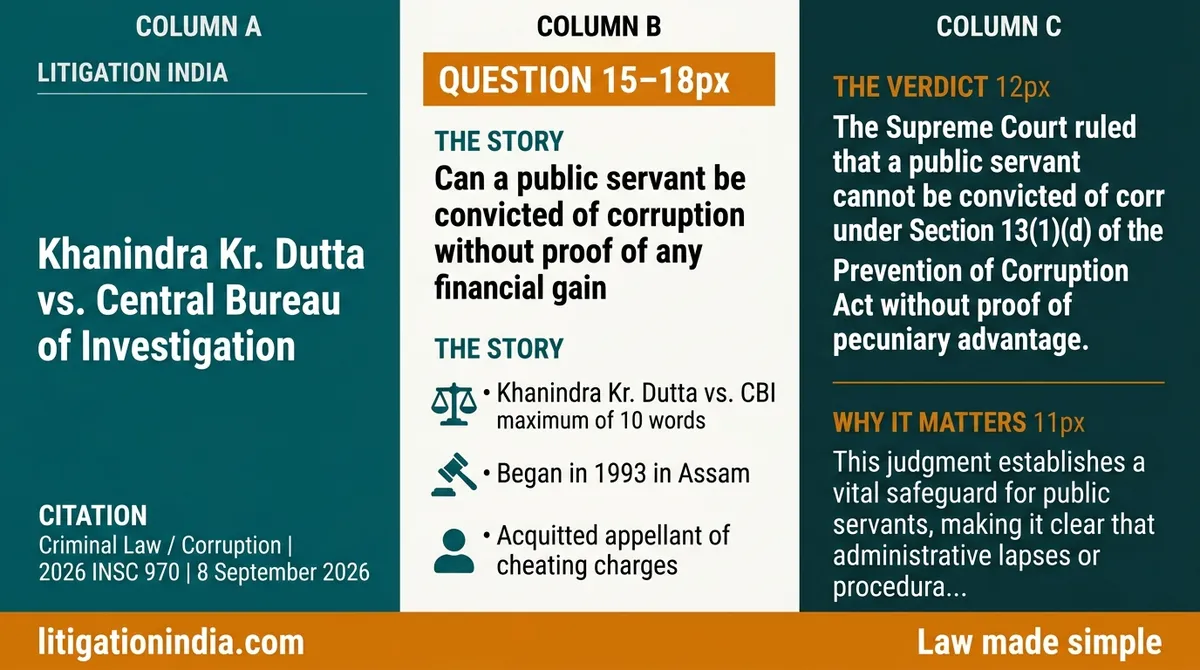
Khanindra Kr. Dutta vs. Central Bureau of Investigation
The big legal question
Can a public servant be convicted of corruption without proof of any financial gain
What this case means
An Assam government employee was convicted of corruption for certifying fake medicine bills, despite no proof of financial gain. The Supreme Court ruled that without proof of monetary benefit, a conviction under Section 13(1)(d) of the Prevention of Corruption Act cannot stand. This protects government workers from illegal corruption convictions.
“The Supreme Court ruled that a public servant cannot be convicted of corruption under Section 13(1)(d) of the Prevention of Corruption Act without proof of pecuniary advantage.”
Story Slides
In short
The appellant, Khanindra Kr. Dutta, worked as a store-in-charge in the Veterinary Department of Assam. In 1993, an investigation was launched into a scam involving a loss of Rs. 5,97,200 to the government. The allegation was that false bills were submitted for medicines that were never actually supplied, and payments were made to a fictitious firm. The storekeeper had made false entries in the store register, which were certified by the appellant. Seven individuals were charge-sheeted. The trial court convicted four, including the appellant. On appeal, the High Court acquitted the accountant but upheld the conviction of the storekeeper and the appellant under Section 13(1)(d) of the Prevention of Corruption Act, 1988, along with Section 120B of the Indian Penal Code. Crucially, the High Court acquitted them of IPC charges like cheating (Section 420) and falsifying accounts (Section 477A), categorically finding that there was absolutely no evidence showing that the appellant or the storekeeper had received any monetary gain, money, or 'pecuniary advantage' from the crime. The Supreme Court overturned the conviction. It explained that under Section 13(1)(d) of the Prevention of Corruption Act, the prosecution must prove that the accused public servant obtained a 'valuable thing or pecuniary advantage' (a financial benefit) either for themselves or for someone else. Since the High Court itself found that there was no financial gain proved, it committed a clear legal error by still convicting them under this section. The Supreme Court also pointed out that the CBI failed to appeal the High Court's decision to acquit the appellant of the IPC cheating charges. Finally, the Court criticized the CBI's poor investigation, noting they failed to track the money trail and wasted time examining 62 witnesses, most of whom were irrelevant, causing unnecessary delays in court.
Background
In 1993, a scam was reported in the Assam Veterinary Department where Rs. 5,97,200 was paid to a fake firm for medicines that were never delivered. The appellant, as the store-in-charge, was accused of certifying false store register entries made by the storekeeper to show the medicines had arrived.
The Decision
The Supreme Court set aside the appellant's conviction and acquitted him. It ruled that a person cannot be convicted under Section 13(1)(d) of the Prevention of Corruption Act if there is no evidence of them receiving any financial benefit or monetary advantage.
Why it matters for you
This judgment establishes a vital safeguard for public servants, making it clear that administrative lapses or procedural errors cannot be labeled as corruption unless there is solid proof of illegal monetary gain. It also urges investigative agencies to focus on tracing the money trail rather than overwhelming courts with irrelevant witnesses.
Relevant Legal Provisions
Key Acts and sections cited or relied upon in this judgment
“This provision punishes a public servant who uses illegal means or abuses their position to obtain any money or financial benefit for themselves or others.”
“These provisions deal with criminal conspiracy, cheating, and falsification of official accounts by employees.”
AI-assisted summary, reviewed and verified by our editorial team.
In the Court's words
“Without a pecuniary advantage, there could be no conviction under Section 13(1)(d)...”
“We do not see any investigation having been taken to find out the money trail when the amounts were so disbursed...”
“Prosecution in corruption cases have a history of long pendency; especially because of the voluminous evidence led, which often is unnecessary...”
Need help with your case?
Facing a similar legal challenge in the Supreme Court or High Court? Connect with our pro bono volunteer advocates today.
Request Free Callback