
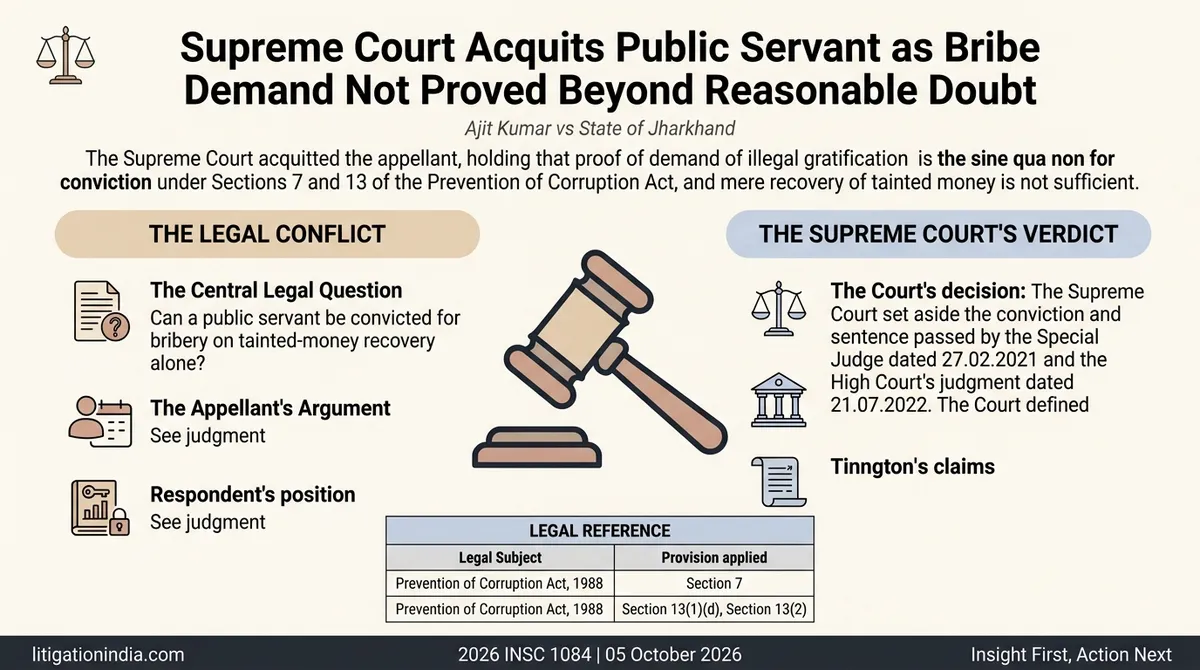
Full text of the judgment
Text extracted from Ajit Kumar vs State of Jharkhand. For the authoritative version refer to the Supreme Court of India's official website.
2026 INSC 1084 REPORTABLE
IN THE SUPREME COURT OF INDIA CRIMINAL APPELLATE JURISDICTION
CRIMINAL APPEAL NO. 4573 OF 2026
AJIT KUMAR …APPELLANT(S)
STATE OF JHARKHAND
....RESPONDENT(S)
J U D G M E N T
UJJAL BHUYAN, J.
This appeal takes exception to the judgment and order dated 21.07.2022 passed by the High Court of Jharkhand at Ranchi (briefly ‘the High Court’ hereinafter) in Criminal Appeal (S.J.) No. 135 of 2021 (Ajit Kumar Vs. State of Jharkhand) affirming the conviction and sentence imposed on the appellant by the Court of Special Judge, Anti- Corruption Bureau, West Singhbhum at Chaibasa (briefly ‘the Digitally signed by IRAMNAZ Date: 2026.10.05 16:56:54 IST Reason: Signature Not Verified
Special Judge’ hereinafter) in Vigilance Case No. 17 of 2010 vide the judgment and order dated 27.02.2021. 2.
Be it stated that by the aforesaid judgment and order dated 27.02.2021, learned Special Judge had convicted the appellant under Sections 7 and 13(2) of the Prevention of Corruption Act, 1988 (for short ‘the PC Act’ hereinafter) and sentenced him to undergo rigorous imprisonment (RI) for four years and to pay fine of Rs. 10,000.00 with a default stipulation for each of the two offences, both the sentences to run concurrently. 3.
On 24.07.2026, when this Court had issued notice, learned counsel for the appellant had submitted that though the appellant had undergone the sentence of imprisonment and paid the fine, yet he would like to pursue the related special leave petition to get his name cleared. On 23.09.2026, leave was granted and the appeal was heard whereafter the judgment was reserved. 4.
At the outset, it would be appropriate to narrate the prosecution case.
4.1. Prosecution case is that PW-1 Durgapad Singh Munda was appointed to the post of orderly in the Government High School at Sirum on 01.02.2010 but his salary was not paid. Appellant was an Assistant in the District Education Office at Saraikella. Durgapad Singh Munda approached the appellant for release of his salary. Appellant demanded Rs. 5,000.00 as bribe for getting the salary released. 4.2. However, Durgapad Singh Munda did not like to pay the bribe. Therefore, on 19.04.2010, he submitted an application to the Superintendent of Police, Vigilance Bureau, Ranchi (briefly ‘the SP’ hereinafter). The SP deputed PW-2, Police Inspector Shyamlal Champiya, to verify the complaint and to submit report. Inspector Shyamlal Champiya submitted report on 19.05.2010 stating that the allegations made in the complaint were true. Thereafter, Vigilance PS Case No. 17/2010 was registered under Sections 7 and 13(2) of the PC Act.
4.3. PW-11 DSP Ramashish Raut was assigned the task of investigation. He completed the investigation and submitted the chargesheet on 10.07.2010 alongwith the sanction order before the Court of the learned Special Judge. Vide the order dated 12.07.2010, learned Special Judge took cognizance under Sections 7/13(2) read with Section 13(1)(d) of the PC Act. 4.4. Charges under the aforesaid provisions were framed by the learned Special Judge on 14.12.2010. However, the appellant pleaded not guilty and claimed to the tried. 4.5. Prosecution examined 12 witnesses including the complainant Durgapad Singh Munda as PW-1, Police Inspector Shyamlal Champiya as PW-2, and DSP Ramashish Raut, the investigating officer, as PW-11. Prosecution also exhibited a number of documents. 4.6. On conclusion of the trial, learned Special Judge convicted and sentenced the appellant as above. 4.7. Aggrieved thereby, appellant preferred appeal before the High Court and vide the judgment and order dated
21.07.2022, the High Court dismissed the appeal and confirmed the conviction and sentence. 5.
Mr. Shambo Nandy, learned counsel for the appellant submits that the trial court erred in convicting the appellant under Sections 7 and 13 of the PC Act. The High Court also fell in error in affirming such conviction and sentence. 5.1. He submits that prosecution has failed to establish the alleged demand of illegal gratification by the appellant beyond reasonable doubt. Proof of demand of illegal gratification is the sine qua non for an offence under the aforesaid provisions. Prosecution relied entirely on the uncorroborated testimony of the complainant. 5.2. It is evident that the demand of illegal gratification and acceptance of the same by the appellant remained wholly unproved. The prosecution itself admitted that the transaction took place inside the residence of the appellant in the complete absence of the trap team and without the presence of any shadow or independent witness.
5.3. The trial court erred in inferring acceptance of such illegal gratification by subsequent recovery of currency notes from the residence of the appellant which were covered with the chemical even though the solution turned pink when the fingers of the appellant were dipped in the same. In this connection, he submits that mere recovery of the alleged tainted money from the residence of the appellant would not prove demand and acceptance of illegal gratification. 5.4. Learned counsel submits that the trial proceedings were vitiated by serious and uncurable infirmities which strike at the root of the prosecution case. The phenolphthalein test was conducted belatedly which cannot be said to have proved the prosecution case. 6. On the other hand, learned counsel for the respondent-State of Jharkhand Mr. Mukherjee submits that the trial court based its conviction on a correct appreciation of the evidence on record. It does not suffer from any error or infirmity. The High Court rightly appreciated the evidence as well as the judgment of conviction and affirmed the same.
6.1. Learned state counsel submits that on a wholesome reading of the evidence on record, it is crystal clear that the demand for illegal gratification and acceptance of the same by the appellant stood proved. Mere discrepancies here and there would not be sufficient to dislodge the conviction. The High Court was fully justified in affirming such conviction. 6.2. In the circumstances, learned state counsel submits that no case has been made out for interference with the impugned conviction and sentence as affirmed by the High Court. In any view of the matter, appellant has served out his sentence. Therefore, the appeal has become an academic exercise. In the circumstances, he seeks dismissal of the appeal. 7.
Submissions made by learned counsel for the parties have received the due consideration of the Court. 8.
PW-1 is the complainant Durgapad Singh Munda himself. In his examination-in-chief, he stated that he joined service as Peon in the Government High School at Sirum on
01.02.2010. However, he was not paid his salary. For this purpose, he went to the office of the District Education Officer at Saraikella and submitted an application. Accused Ajit Kumar, who was an Assistant in the said office, met him and asked for Rs. 5,000.00 as bribe for release of his salary. 8.1. As PW-1 was averse to the idea of giving bribe, he lodged a complaint on 19.04.2010 in the office of the Vigilance Bureau at Ranchi. He stated that Vigilance Inspector Shyamlal Champiya (PW-2) accompanied him to the office of the District Education Officer where the accused asked for the bribe amount. To this, PW-1 stated that he would have to arrange for the money. 8.2. On 20.05.2010, PW-1 went to the Vigilance Office and handed over Rs. 5,000.00 there. Chemical was applied on the currency notes and after instructions of what was to be done, the currency notes were returned back to PW-1 for him to hand over the same to the accused. 8.3. PW-1 alongwith the vigilance team reached Saraikella and gave Rs. 5,000.00 to the accused in his
residence. The said amount was received by the accused whereafter he kept it under his bed. Thereafter, PW-1 alongwith the accused returned to the office of the accused where he gave indication to the vigilance team. At that stage, the vigilance team entered into the office of the accused and apprehended him. Accused was brought to his residence from where he handed over the bribe money (Rs. 5,000.00) to the vigilance team. When the trap team brought the accused to his office and dipped his hands, the colour of the water (solution) turned to pink. PW-1 identified the accused in the dock. 8.4. In his cross-examination, PW-1 stated that in the office of the District Education Officer, he did not meet any other official except the accused. He did not lodge any complaint before the District Education Officer regarding demand of bribe by the accused. He denied the defence suggestion that he had taken debt from the accused to tide over his financial difficulties because he did not receive
salary; when he was asked to return the debt money, PW-1 implicated the accused in the case falsely. 9.
PW-2 Shyamlal Champiya is the Police Inspector who was deputed by the SP, Vigilance Bureau to verify the complaint and to submit report. In his examination-in-chief, he stated that on verification of the complaint, he found the allegations to be true and, therefore, submitted the verification report to the SP. He stated that on 20.05.2010, in the morning hours, members of the trap team and the complainant had reached the Vigilance Office at Ranchi where a physical demonstration was presented before the members of the trap team. On completion of the pre-trap formalities, the trap team went to the office of the District Education Officer at Saraikella. PW-1 was sent to meet the accused. Accused alongwith PW-1 went to his residence and returned back to office after 10-15 minutes. It was then that the complainant PW-1 disclosed that the accused had kept the bribe money at his residence. Upon this, the police personnel from the Vigilance Bureau arrested the accused and brought
him to his residence. During the course of the search, Rs. 5,000.00 was recovered from under his bed. The numbers of the currency notes tallied with the notes memorandum prepared by the vigilance team. Thereafter, accused was brought to his office and when both his hands were dipped into the solution, it turned pink. 9.1. He stated in his cross-examination that on 22.04.2010, around noon, he had accompanied the complainant to the office of the District Education Officer. Only the complainant PW-1 talked with the accused. He had heard the conversation between PW-1 and the accused on the basis of which he submitted his verification report. Interestingly, PW-2 stated that he had submitted the verification report late because the complainant had no money. 10. Police Inspector Shashi Bhushan was a member of the trap team. He is PW-3. In his evidence-in-chief, he stated that on 19.05.2010, he was posted as Police Inspector at the Vigilance Bureau, Ranchi. On that day, DSP Ramashish Raut
(PW-11) constituted a trap team on the orders of the SP. PW- 3 was also made a member of the trap team. On the next day i.e. on 20.05.2010 at 05:00 am, members of the trap team assembled in the office of the Vigilance Bureau. There, complainant PW-1 was also present. One currency note of Rs. 1000.00 denomination and eight currency notes of Rs. 500.00 denomination were collected for the trap operation. Chemical reaction of sodium carbonate and phenolphthalein on the currency notes was demonstrated. The currency notes were thereafter handed over to PW-1 with the instruction that he would pay the said amount on demand to the accused. The trap team thereafter proceeded and reached the office of District Education Officer at Saraikella at about 11:30 am. From the office, complainant PW-1 alongwith accused Ajit Kumar went outside on motorcycle. After they returned back, PW-1 disclosed that he had given the bribe amount to the accused at his residence. Trap team then arrested the accused Ajit Kumar and took him to his residence. In the residence, Ajit Kumar took out the currency notes from below his pillow. Those tallied with the memorandum of currency
notes prepared previously. He stated that the hands of the accused were ‘washed’ in the solution kept separately in two glass containers. Thereafter, accused Ajit Kumar was brought to his office where he handed over the documents relating to salary of the complainant PW-1. 10.1. In his cross-examination, PW-3 stated that accused was staying in a rented accommodation. Distance between the office and the residence of the accused was about ¼ kilometer. Bed, bed-sheet and pillow were not seized from the residence of the accused. Hands of the accused were ‘washed’ in his residence. Accused was thereafter brought to the office from his residence where he was arrested. 11. Similar is the statement of PW-4 Constable Dinesh Kumar Singh, who was also a member of the trap team. In his evidence-in-chief, he stated that PW-1 informed the trap team that the accused had kept the bribe amount in his house. They (trap team) alongwith the independent witnesses went to the rented house of the accused. On the lock of the house being opened by the accused, it was searched in the presence
of two independent witnesses. Accused took out Rs. 5,000.00 from under his pillow. Thereafter they brought the accused to his office whereafter both of his hands were dipped into the prepared solution which turned pink. 11.1. He stated in his cross-examination that PW-1 had disclosed to him that transaction of money took place in the office of the accused. Accused went to his house by a motorcycle to keep the money there. Though he was present at the time of seizure and arrest, the seizure memo did not contain his signature. 12. PW-5 is Constable Sudhir Kumar Thakur who was a member of the trap team. As per his deposition, the accused was arrested in his office after PW-1 gave indication that the bribe money was paid to him. After the accused was arrested, complainant PW-1 told them that the accused had gone to his residence to keep the bribe money there. 12.1. He admitted in his cross-examination that complainant PW-1 did not hand over the bribe money to the accused before him. Though accused was caught in his office
but no money was recovered from him. He could not remember as to who searched the accused. The seizure list did not have his signatures. 13. Assistant Sub-Inspector Devendra Nath Upadhayay, PW- 6, was a member of the trap team. According to him, complainant Durgapad Singh Munda came out alongwith the accused from the office of the accused and both of them went from there on a motorcycle. Members of the trap team followed them in a vehicle but the motorcycle went ahead whereafter they (complainant and the accused) returned back to the office. After some time, complainant disclosed to PW-2 that he had given bribe to the accused. After they got hold of the accused, they took him to his residence where the accused brought out the bribe money from his bed kept under the pillow. Fingers of both hands of the accused were dipped into the solution which turned pink. 14. PW-8 Chandeshwar Mahato was posted as the Head Clerk in the office of the District Education Officer at Saraikella. Though he accompanied the vigilance team to the
residence of the accused, he remained outside the house when the vigilance team went inside. 14.1. In his cross-examination, he stated that nothing was shown to him. He had no knowledge as to which thing was brought from where. He had just put his signature on some documents on the direction of the vigilance officials. Vigilance officials told him that money was recovered from the house of the accused 15. Similar is the evidence of PW-9 Chandan Kumar Patnayak, who was a Clerk in the office of the District Education Officer, Saraikella. In his cross-examination, he stated that vigilance officials told him to put his signature on certain papers whereafter he put his signature. He was not aware of the contents of such papers. He came out of his office due to the chaos when vigilance officials caught hold of the accused. He could not say as to what happened in the house of the accused. He did not see any money. It was on the direction of the police that he deposed that currency notes were recovered from the residence of the accused.
16. According to PW-10, Ajit Baxrai, who was the Assistant Director of Employment and was part of the trap team, after PW-1 and the accused came back to the office from the residence of the accused on motorcycle, PW-1 disclosed that he had given bribe of Rs. 5,000.00 to the accused whereafter accused was arrested. Accused admitted that he had accepted bribe from PW-1. It was then that members of the trap team took the accused to his residence. 16.1. He admitted in his cross-examination that transaction of money was not witnessed by him. Money was not recovered from the possession of the accused in the office. The house of the accused was situated at a distance of about one and a half kilometer from the office. 17. PW-11 Ramashish Raut is the Investigating Officer. In his cross-examination, he stated that PW-1 and PW-2 informed the trap party at about 12:00 noon that the bribe money was given to the accused on his demand who kept the same in his house and thereafter returned back to the office. It was then that members of the trap team entered the office
of the District Education Officer and confronted the accused. Members of the trap team alongwith the accused, PW-1 and two employees of the office proceeded to the rented house of the accused. It was situated on the first floor. Inside his room, upon interrogation, accused took out Rs. 5,000.00 from his bed which matched and tallied with the notes memorandum prepared for the trap. Fingers of both the hands of the accused were dipped into the solution in the presence of independent witnesses which turned to pink colour. 17.1. PW-11 in his cross-examination admitted that no one had seen the accused taking money. Transaction of money had taken place in the office of the accused at around 11:35 am to 12:00 noon. At that time, he was outside the office. 18. From an analysis of the evidence as extracted above, what transpires is that PW-1 had approached the vigilance office on 19.04.2010 and lodged the complaint regarding demand of bribe by the accused. PW-2 was assigned the task of verifying the complaint and to submit report. It
appears that he had accompanied PW-1 on 22.04.2010 to the office of the accused where he is stated to have overheard the demand of bribe made by the accused to PW-1. However, there was considerable delay in the submission of his report, which was submitted on 19.05.2010. He explained the delay by saying that PW-1 could not immediately arrange the bribe money. But that had nothing to do with the truthfulness or otherwise of the complaint. Be that as it may, the trap operation was carried out on 20.05.2010 but there are inconsistencies galore in the narration of facts. Without getting bogged down on the inconsistencies, what is startling to note is that on 20.05.2010 when PW-1 offered to pay the bribe money to the accused in his office, both of them left for the residence of the accused where it is alleged that the bribe money was given to the accused. According to the version of some witnesses, the accused was apprehended in his residence; on the other hand, as per the version of some other witnesses, after PW-1 and accused came back to the office from the residence and on PW-1 signaling to the vigilance team that he had paid the bribe money, the vigilance team
barged into the office of the accused and apprehended him. As per this version, accused was then taken to his residence from where the bribe money was allegedly recovered from under his pillow. But what is uniformly common is that none of the witnesses have seen the accused demanding bribe or PW-1 handing over the bribe money to the accused. There is no evidence in this regard. It is only the uncorroborated testimony of PW-1. A couple of witnesses have even gone to the extent of saying that they had signed the seizure list on being directed to do so by the vigilance officials. 19. In P. Satyanarayana Murthy Vs. State of A.P.1, this Court held that proof of demand of illegal gratification is the sine qua non for constituting an offence under Sections 7 and 13 of the PC Act. In the absence thereof, the charge would fail. Failure of the prosecution to prove the demand for illegal gratification would be fatal and mere recovery of alleged bribe money from the accused would not be sufficient for a
1 (2015) 10 SCC 152
conviction under Sections 7 or 13 of the PC Act. This Court held thus: 23. The proof of demand of illegal gratification, thus, is the gravamen of the offence under Sections 7 and 13(1)(d)(i) and (ii) of the Act and in absence thereof, unmistakably the charge therefor, would fail. Mere acceptance of any amount allegedly by way of illegal gratification or recovery thereof, dehors the proof of demand, ipso facto, would thus not be sufficient to bring home the charge under these two sections of the Act. As a corollary, failure of the prosecution to prove the demand for illegal gratification would be fatal and mere recovery of the amount from the person accused of the offence under Section 7 or 13 of the Act would not entail his conviction thereunder.
20. This aspect was also gone into by a Constitution Bench of this Court in Neeraj Dutta Vs. State (Government of NCT of Delhi)2. The Constitution Bench declared that proof of demand and acceptance of illegal gratification by a public servant as a fact in issue has to be proved by the prosecution. It is essential to establish the guilt of the accused public
(2023) 4 SCC 731
servant under Sections 7 and 13(1)(d)(i) and (ii) of the PC Act. This Court declared amongst others, as follows: 88.1. (a) Proof of demand and acceptance of illegal gratification by a public servant as a fact in issue by the prosecution is a sine qua non in order to establish the guilt of the accused public servant under Sections 7 and 13(1)(d)(i) and (ii) of the Act. 88.2. (b) In order to bring home the guilt of the accused, the prosecution has to first prove the demand of illegal gratification and the subsequent acceptance as a matter of fact. This fact in issue can be proved either by direct evidence which can be in the nature of oral evidence or documentary evidence.
21. A two-Judge Bench of this Court in Aman Bhatia Vs. State3, surveyed the law on this aspect and came to the conclusion that mere recovery of tainted money, by itself, is insufficient to establish the charge(s) against an accused under the PC Act. The Bench held that to sustain a conviction under Sections 7 and 13 of the PC Act, the prosecution must prove beyond reasonable doubt that the public servant voluntarily accepted the money, knowing it to be a bribe.
3 2025 SCC OnLine SC 1013
Thus, the demand for bribe is the sine qua non for establishing an offence under Sections 7 and 13 of the PC Act. The Bench held as under: 52. It is well-settled that mere recovery of tainted money, by itself, is insufficient to establish the charges against an accused under the PC Act. To sustain a conviction under Sections 7 and 13(1)(d) of the Act respectively, it must be proved beyond reasonable doubt that the public servant voluntarily accepted the money, knowing it to be a bribe. The courts have consistently reiterated that the demand for a bribe is sine qua non for establishing an offence under Section 7 of the PC Act.
21.1. Finally, the Bench concluded as follows: 55. From the above exposition of law, it may be safely concluded that mere possession and recovery of tainted currency notes from a public servant, in the absence of proof of demand, is not sufficient to establish an offence under Sections 7 and 13(1)(d) of the PC Act respectively. Consequently, without evidence of demand for illegal gratification, it cannot be said that the public servant used corrupt or illegal means, or abused his position, to obtain any valuable thing or pecuniary advantage in terms of Section 13(1)(d) of the PC Act.
22. In a recent decision of this Court in Jaswinder Singh Vs. State of Punjab4, authored by one of us (Ujjal Bhuyan, J.), all the above decisions have been analysed and reiterated. In the facts of that case, it has been held as under: 21. Under such circumstances, it is evident that neither the demand nor acceptance of the bribe can be said to have been proved. As a matter of fact, no one saw the appellant making the demand for bribe and no one saw PW-1 handing over the bribe money to the appellant nor acceptance of the same by the appellant. The fact situation of this case, thus, is squarely covered by the judgments of this Court in Satyanarayana Murthy, Neeraj Dutta and in Aman Bhatia.
23. In so far the present case is concerned, proof of demand and acceptance of illegal gratification by the accused as a fact in issue could not be proved by the prosecution. 24. That being the position, it cannot be said that the charge against the appellant under Sections 7 and 13 of the PC Act was proved, not to speak of beyond all reasonable doubt. Consequently, we set aside the judgment and order
4 2026 SCC OnLine SC 1952
dated 27.02.2021 passed by learned Special Judge in Vigilance Case No. 17 of 2010 as well as the judgment and order dated 21.07.2022 passed by the High Court of Jharkhand in Criminal Appeal (S.J.) No. 135 of 2021. It is declared that the charge framed against the appellant Ajit Kumar under Sections 7 and 13 of the PC Act could not be proved. Ajit Kumar is thus cleared of the said charges. 25. Resultantly, the appeal is allowed.
…...…………………………J.
[UJJAL BHUYAN]
…..….………………………J. [ATUL S. CHANDURKAR]
NEW DELHI; OCTOBER 05, 2026.