Landmark Supreme Court of India rulings, explained in clear, plain language.
Filter by Act / Section
Showing 5 of 5 judgments
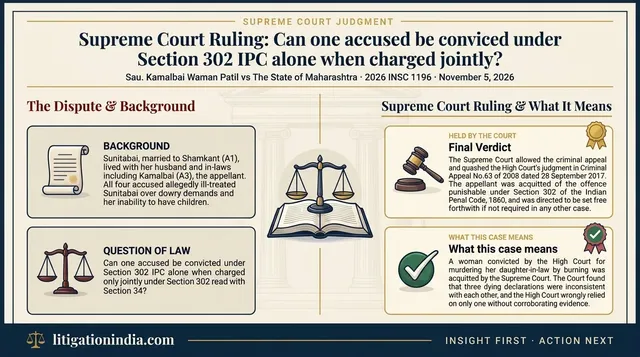
Can one accused be convicted under Section 302 IPC alone when charged only jointly under Section 302 read with Section 34?
Sau. Kamalbai Waman Patil vs The State of Maharashtra
The Supreme Court acquitted the appellant by holding that the High Court wrongly reversed her acquittal by relying on a single inconsistent dying declaration without corroboration and by convicting her under Section 302 IPC alone when the charge was only under Section 302 read with Section 34 IPC.
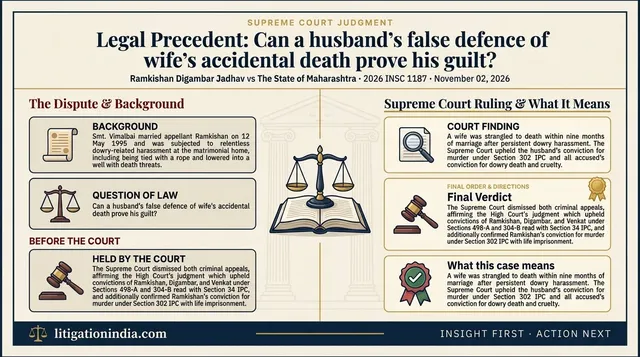
Can a husband's false defence of wife's accidental death prove his guilt?
Ramkishan Digambar Jadhav vs The State of Maharashtra
The Supreme Court dismissed the appeals and upheld conviction of the husband for murder and all three appellants for dowry death and cruelty.
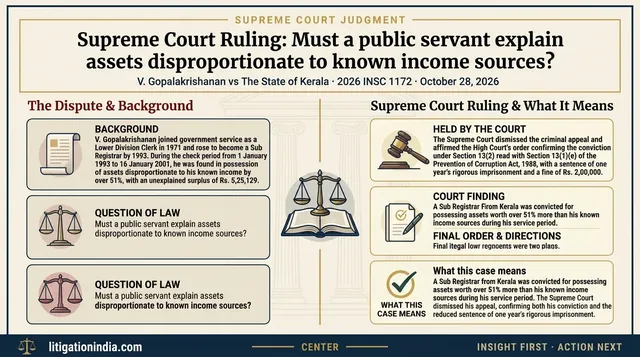
Must a public servant explain assets disproportionate to known income sources?
V. Gopalakrishanan vs The State of Kerala
The Supreme Court dismissed the appeal of a Sub Registrar convicted under the Prevention of Corruption Act for possessing assets disproportionate to his known income by over 51%, holding that he failed to satisfactorily account for the excess.
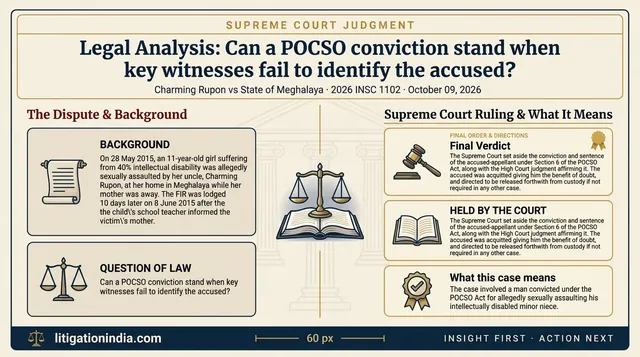
Can a POCSO conviction stand when key witnesses fail to identify the accused?
Charming Rupon vs State of Meghalaya
The Supreme Court acquitted the accused under POCSO Act, finding the prosecution evidence riddled with identification failures, witness tutoring, and unexplained omissions.
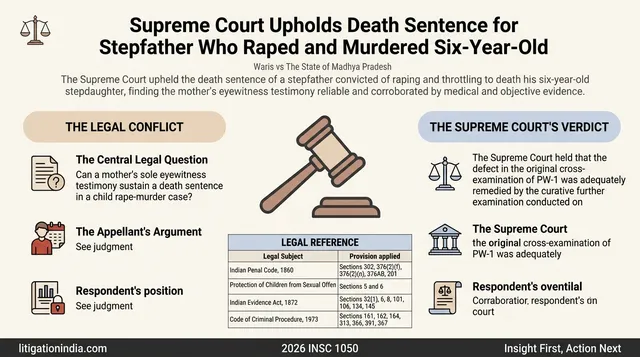
Can a mother's sole eyewitness testimony sustain a death sentence in a child rape-murder case?
Waris vs The State of Madhya Pradesh
The Supreme Court upheld the death sentence of a stepfather convicted of raping and throttling to death his six-year-old stepdaughter, finding the mother's eyewitness testimony reliable and corroborated by medical and objective evidence.
You have reached the end — all 5 judgments loaded.