
Full text of the judgment
Text extracted from V. Gopalakrishanan vs The State of Kerala. For the authoritative version refer to the Supreme Court of India's official website.
2026 INSC 1172 REPORTABLE IN THE SUPREME COURT OF INDIA CRIMINAL APPELLATE JURISDICTION C R I M I N A L A P P E A L N O . 5 3 9 9 O F 2 0 2 5 V. GOPALAKRISHANAN .…. APPELLANT (S) VERSUS THE STATE OF KERALA
..…RESPONDENT(S) J U D G M E N T SANJEEV SACHDEVA,
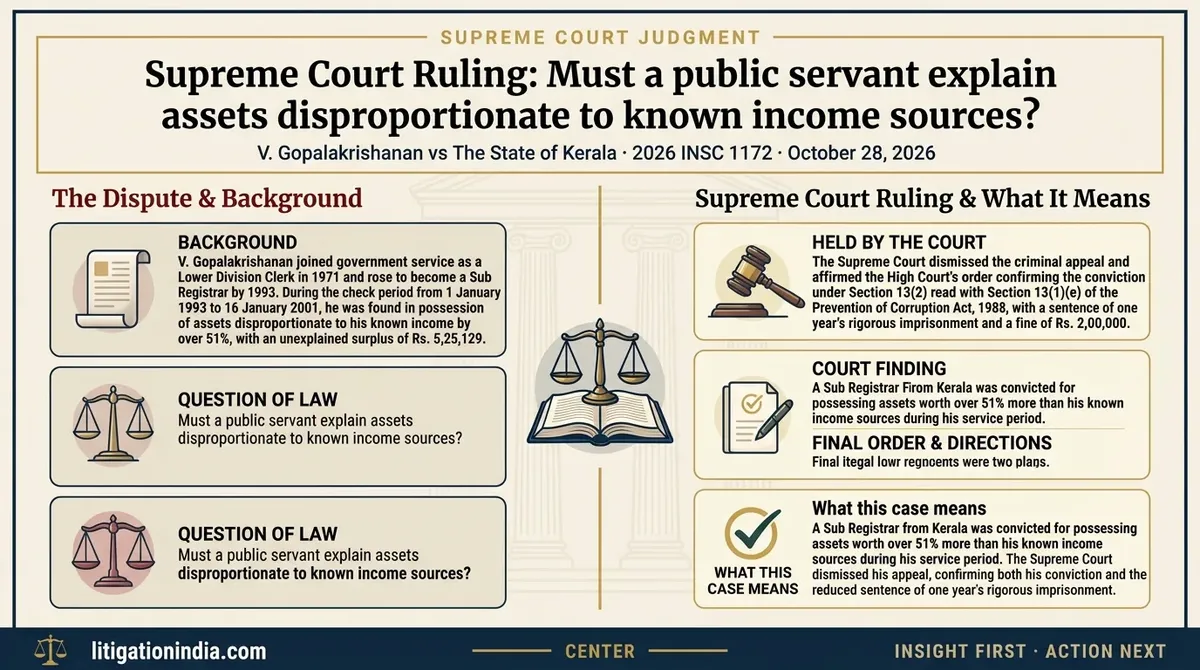
J. 1. Appellant impugns order dated 29.01.2025 passed in Criminal Appeal No. 1937 of 2009, whereby his appeal against Judgment dated 27.08.2009, in Complaint Case No. 40 of 2005, was partly allowed by reduction of sentence only. By Judgment dated 27.08.2009, Appellant was held guilty of the offence under Section 13(2) read with Section 13(1)(e) of the Prevention of Corruption Act, 19881 and sentenced to rigorous imprisonment for a period of two years and a fine of Rs. 5,50,000/- with a default clause of rigorous imprisonment for one year. By Judgment dated 29.01.2025, the High Court while confirming the conviction, keeping in view the delay 1 PC Act for short. 1 Digitally signed by Deepak Guglani Date: 2026.10.28 18:51:03 IST Reason: Signature Not Verified
occurred in concluding the proceedings and the age of the appellant and the trauma undergone, took a lenient view and reduced the sentence to undergo rigorous imprisonment for a period of one year and to pay a fine of Rs. 2,00,000/- and in default of payment of fine, to undergo rigorous imprisonment for a period of three months. 2. Appellant entered the Government Service as a Lower Division Clerk on 13.05.1971. By eventual promotions, he became a Sub Registrar on 22.09.1993. As per the Respondents, while working as a public servant, he acquired assets by illegal means during the period from 01.01.1993 to 16.01.2001 disproportionate to his known source of income. It was alleged that as on 01.01.1993, the assets he and members of his family possessed were worth Rs. 1,93,898/-. As on 16.01.2001, the value of the total assets they possessed was Rs. 12,37,720/-. During the check period, they earned Rs. 10,12,117.20/-. and they incurred expenditure of Rs. 4,93,424/-. The sources of an amount of Rs. 5,18,693/- could not be explained by the appellant. 3. On 15.01.2001, a First Information report2 was registered against the Appellant under section 13(1) (e) read with Section 13(2) of the PC Act. The 2 FIR for short 2
Deputy Superintendent of Police, Vigilance and Anti-Corruption Bureau (VACB Special Cell), Thiruvananthapuram, submitted a final report, based on which, subject Complaint Case (C.C. No. 40 of 2005) was initiated. Prosecution examined 45 witnesses as PWs 1 to 45 and marked 130 exhibits as Exhibit P1 to P 130. Appellant examined himself as DWl. 4. Prosecution produced Basic statements A, B, C, D and E. Basic Statement A contained the list of assets at the beginning of the Check Period i.e. 01.01.1993. As per Basic Statement A, Appellant possessed Assets valued at Rs. 1,93,898.26. Basic Statement B contained list of assets at the end of the check period i.e. 16.01.2001 which were valued at Rs. 12,37,720.00. Basic Statement C listed the income of the Appellant and his family members during the check period (i.e. in between 01.01.1993 to 16.01.2001) which was assessed as Rs. 10,12,117.20. Basic Statement D listed the expenditure of the Appellant and his family members during the check period i.e. in between 01.01.1993 to 16.01.2001 which was assessed as Rs. 4,93,424.00. Basis Statement D is in two parts. The First Part lists out the ‘Verifiable Expenses’ and the second part the ‘Non-Verifiable Expenses’. The Basic Statement E is the likely savings during the check period and is 3
the computation of Basic Statement C (Income) minus Basic Statement D (Expenditure) and is shown as Rs. 5,18,693/-. 5. Basic Statement F is the computation for Disproportionate Assets which is arrived at by computing the value of Assets acquired during the check period which is calculated by subtracting assets at the beginning of the check period with that at the end (i.e. Basic Statement A (–) Basic Statement B). Then from the value of assets acquired during the check period the value of likely savings is subtracted to arrive at the Disproportionate Assets. 6. In the case of the Appellant, as per the computations produced, the Value of Assets acquired during the check period was assessed as Rs. 10,43,822.00. Likely savings during the check period were assessed at Rs. 5,18,693.00. Thus, the Disproportionate Assets computed were Rs. 5,25,129.00. i.e. 51.88% of the income of the Appellant and his family members during the check period, which is much beyond the 10% threshold laid down by this Court in Krishnanand Agnihotri versus State of Madhya Pradesh3. Though, in Krishnanand Agnihotri it has been held that in a case of possessing disproportionate assets, an excess of less than ten percent would not justify application of the presumption, but it does not lay down a 3 (1977) 1 SCC 816 4
hard and fast rule that in all cases where the excess is less than ten percent, there can be no prosecution. It would depend on facts and circumstances of each case. However, in the present case, the disproportionate assets assessed are in excess by over 50% of the income. 7. This Court in B.C. Chaturvedi versus Union of India4, while referring to Krishnanand Agnihotri (supra), wherein this Court had held that if the excess was comparatively small (it was less than 10% of the total income in that case), it would be right to hold that the assets found in the possession of the accused were not disproportionate to his known sources of income raising the presumption under sub-section (3) of Section 5, went on to hold that said principle was evolved by this Court to give benefit of doubt, due to inflationary trend in the appreciation of the value of the assets and the benefit thereof (10%) was the maximum and if the percentage began to rise in each case, it would extended till it reached the level of incredulity to give the benefit of doubt. It thus declined to extend the principle of deduction beyond 10% in calculating disproportionate assets of a delinquent officer. 8. In the present case, as per the record, at the relevant time the only earning members of the family of the appellant were the appellant and his 4 (1995) 6 SCC 749 5
wife. In respect of the expenditure enlisted in Basic Statement D, prosecution witnesses proved the receipts, vouchers, etc., concerning each verifiable item of such expenditure. In respect of the non-verifiable items of expenses, i.e., cost of the new clothes purchased, maintenance of the motorcycle, personal expenses of the appellant while he was at his workplace and conveyance expenses, no supporting document were produced. The major head of the non-verifiable expenses is the household expense during the check period amounting to Rs. 1,78,620/- out of the total of Rs. 4,93,424/-. Prosecution examined PW33, who was the Additional Director of Economics and Statistics Directorate, Thiruvananthapuram. She proved expense of a family consisting of four members based on the prevailing consumer price index (Exhibits P83 and 83A). In Judgment dated 27.08.2009, the Special Judge has in detail discussed about the witnesses who proved the valuation of each of the assets. 9. It is contended by the Appellant that the entire prosecution case is based on estimation and not actual evidence. Appellant has disputed the estimated monthly expenditure of the family. It is contended that the criteria taken is of an agricultural family whereas the Appellant was a government servant. It is further contended that in respect of the non-verifiable expenses 6
towards purchase of clothes, maintenance of motorcycle, expenses incurred when he was away and conveyance expenses, they were not supported by any vouchers. 10. Appellant has also disputed the value assessed by the prosecution of the construction raised by the Appellant of the commercial cum residential building during the check period. PW45, an Assistant Engineer, PWD, had valued the building based on the schedule rates prevailing in 1997 at Rs. 8,82,330/-. Prosecution applied the 1996 rates and estimated the value of the cost of construction of the building at Rs. 8,59,153/-. On the other hand, Appellant has assessed the value at Rs. 6,69,000/-. It is thus contended that the Prosecution has taken an excess of Rs. 1,90,153/- towards the cost of acquisition of the Asset. 11. It is further the case of the appellant that the prosecution had taken the household expenditure for the check period as Rs. 1,78,620/- by taking the monthly expenditure at Rs. 1968.96. It is contended by the Appellant that in his testimony he had deposed that the maximum daily expense of his family was Rs. 35/- to Rs. 40/- i.e. a maximum of Rs. 1,200/- per month. The High Court has held that if the difference of Rs. 700/- per month was considered it would total up to about Rs. 67,200/- for the entire check period. This the 7
High Court held would not justify the acquisition of assets worth Rs. 5,18,693/- during the check period. 12. In the impugned Judgment dated 29.01.2025, the High Court recorded (in para 9) that as far as other assets are concerned no serious dispute was raised. Dispute was raised essentially qua the valuation of the commercial cum residential building constructed by the Appellant during the check period. The High Court recorded that as far as the other assets of the Appellant are concerned, there was no serious dispute raised nor was there scope for the same as such values are borne by documents. 13. As per the Appellant his actual cost of construction was only Rs. 6,69,000/-. He relied upon Exhibit P58. The High Court noticed that Exhibit P58 was only a notebook containing sporadic entries of costs and not a statement of accounts kept in the ordinary course of business. The High Court held, and rightly so, that although this notebook was seized during a search, for it to be relied upon it has to be shown as one kept in ordinary course of business. Further, the High Court noticed that Appellant could not substantiate the entries in the notebook while in the witness box. 8
14. Even if the submission of the Appellant in respect of the said building were to be taken on a demurrer, as per the Appellant, a sum of Rs. 1,90,153/has been taken in excess. Appellant has failed to produce any cogent material to contradict the valuation taken by the prosecution which was based on the PWD rates prevailing during the check period. Appellant has not produced any material to substantiate his claim of value of construction. Further, even if the entire amount of Rs. 190,153/- were to be reduced from the computation of disproportionate assets of 5,25,129/- it would come to Rs. 3,34,976/-. Which is still more than 33% above the income of the Appellant and his family. 15. With regard to the Household Expenses, the High Court rejected Appellant’s contention as the prosecution’s calculation was based on the prevailing price index and Appellant’s version was based on estimation and not on any actuals. Appellant claimed that it was in excess by Rs. 67,200/-. Even if from the computation of disproportionate assets, the differential of the expenditure of Rs. 67,200/- were to be reduced, the disproportionate assets would come to Rs. 2,67,776/-. Which, is still more than 26% above the income of the Appellant and his family. 9
16. In terms of Section 13 (1) (e) of the Act5, if the public servant has, at any time during the period of his office, been in possession of pecuniary resources or property disproportionate to his known sources of income, for which he cannot satisfactorily account, he is said to have committed the offence of criminal misconduct. 17. Appellant has also raised an issue with regard to amount remitted towards Chit Fund. However the differential is minor. A sum of Rs. 38,786/has been taken as remitted towards a Chitty with ARP Chitty fund. As per the Appellant the amount should have been Rs. 36,320/- (a negligible difference). In respect of rental income, in absence of any documentary proof, the same has already been assessed at Rs. 9,600/-. The Trial Court has 5 13. Criminal misconduct by a public servant. — (1) A public servant is said to commit the offence of criminal misconduct, — ***** ***** ***** (e) if he or any person on his behalf, is in possession or has, at any time during the period of his office, been in possession for which the public servant cannot satisfactorily account, of pecuniary resources or property disproportionate to his known sources of income. Explanation. —For the purposes of this section, “known sources of income” means income received from any lawful source and such receipt has been intimated in accordance with the provisions of any law, rules or orders for the time being applicable to a public servant. (2) ***** 10
held that the amount is shown as Rs. 9,600/-, which was found to be true based on Exhibit P41 (release deed in the name of the wife of Appellant) and P44 (rent deed in the name of the Appellant). Apart from his oral testimony, Appellant failed to produce any documentary evidence with regard to the rental received. He even failed to produce the annual income tax returns allegedly submitted by his wife. 18. Appellant has also taken a ground that the total salary drawn and the GPF loan taken by him and his wife has not been taken into account. The Trial court had noticed that the salary particulars of the Appellant were produced before the Court, exhibited and the documentary proof shown to the Appellant, the authors of records examined in Court. However, even before this court, though Appellant has raised a ground but he has failed to produce any material to contradict the amount taken in the Basic Statements showing his income and expenditure. 19. This Court in P. Nallamal & Anr. versus. State6, held that “the two postulates must combine together for crystallization into the offence, namely, possession of property or resources disproportionate to the known sources of income of public servant and the inability of the public servant to 6 (1999) 6 SCC 559 11
account for it. Burden of proof regarding the first limb is on the prosecution whereas the onus is on the public servant to prove the second limb………”[Emphasis supplied] 20. This Court in State of Tamil Nadu. Versus R. Soundirarasu7, held as under: “41. While the expression “known sources of income” refers to the sources known to the prosecution, the expression “for which the public servant cannot satisfactorily account” refers to the onus or burden on the accused to satisfactorily explain and account for the assets found to be possessed by the public servant. This burden is on the accused as the said facts are within his special knowledge. Section 106 of the Evidence Act applies. The Explanation to Section 13(1)(e) is a procedural section which seeks to define the expression “known sources of income” as sources known to the prosecution and not to the accused. The Explanation applies and relates to the mode and manner of investigation to be conducted by the prosecution, it does away with the requirement and necessity of the prosecution to have an open, wide and roving investigation and enquire into the alleged sources of income which the accused may have. It curtails the need and necessity of the prosecution to go into the alleged sources of income which a public servant may or possibly have but are not legal or have not been declared. The undeclared alleged sources are by their very nature are expected to be known to the accused only and are within his special 7 (2023) 6 SCC 768 12
knowledge. (emphasis supplied) The effect of the Explanation is to clarify and reinforce the existing position and understanding of the expression “known sources of income” i.e. the expression refers to sources known to the prosecution and not sources known to the accused. The second part of the Explanation does away with the need and requirement for the prosecution to conduct an open ended or roving enquiry or investigation to find out all alleged/claimed known sources of income of an accused who is investigated under the PC Act, 1988. The prosecution can rely upon the information furnished by the accused to the authorities under law, rules and orders for the time being applicable to a public servant. No further investigation is required by the prosecution to find out the known sources of income of the accused public servant. As noticed above, the first part of the Explanation refers to income received from legal/lawful sources. This first part of the expression states the obvious as is clear from the judgment of this Court in N. Ramakrishnaiah [N. Ramakrishnaiah v. State of A.P., (2008) 17 SCC 83 : (2010) 4 SCC (Cri) 454] .” (Emphasis supplied) 21. Reference may also be had to the judgment in State of Madhya Pradesh versus Awadh Kishore Gupta8, wherein this court held that the legislature has advisedly used the expression “satisfactorily account”. The emphasis must be on the word “satisfactorily” and the legislature has, thus, 8 (2004) 1 SCC 691 13
deliberately cast a burden on the accused not only to offer a plausible explanation as to how he came by his large wealth, but also to satisfy the court that his explanation was worthy of acceptance. 22. In a prosecution for possession of disproportionate assets, the prosecution is required, in the first instance, to establish the foundational facts, namely, the known sources of income of the public servant during the check period and the assets, pecuniary resources, and expenditures attributable to him during the same period. The expression “known sources of income” does not refer to sources known merely to the accused, but to sources known to the prosecution upon a thorough and lawful investigation. Once the prosecution discharges this initial burden and demonstrates that the assets possessed by the public servant are disproportionate to his known sources of income, a prima facie case stands established. 23. Law does not cast an impossible burden upon the prosecution to negate every hypothetical source from which the accused may claim to have derived income. Such an interpretation would render the statutory provision unworkable and defeat its very object. The prosecution is only required to establish, on the basis of material collected during investigation, the income legitimately attributable to the public servant and the extent of the assets 14
found in his possession. Where a disproportion emerges from such exercise, the evidentiary burden shifts to the accused to account for the same. 24. The rationale underlying this principle is that the source, nature, and mode of acquisition of any undisclosed income, asset, or pecuniary resource are matters peculiarly and exclusively within the knowledge of the public servant. Such facts are not ordinarily accessible to the prosecution and are incapable of being established except through disclosure by the person concerned. Consequently, any income or asset not reflected in the disclosed or known sources of income falls within the realm of the accused’s special knowledge. The statutory scheme, read in conjunction with the principles underlying Section 109 of the Bharatiya Sakshya Adiniyam9 (Section 106 Evidence Act, 1872), places the obligation upon the public servant to furnish a satisfactory and credible explanation regarding the existence and acquisition of such assets. 9 S. 109. Burden of proving fact especially within knowledge. When any fact is especially within the knowledge of any person, the burden of proving that fact is upon him. Illustrations: (a) When a person does an act with some intention other than that which the character and circumstances of the act suggest, the burden of proving that intention is upon him. (b) A is charged with travelling on a railway without a ticket. The burden of proving that he had a ticket is on him. 15
25. Once the prosecution establishes the disproportion between the assets possessed and the known sources of income, the burden squarely rests upon the accused to demonstrate, through cogent and reliable material, that the assets in question were acquired from lawful and legitimate sources. In the absence of such explanation, the prosecution cannot be faulted for its inability to establish facts which lie exclusively within the knowledge of the accused himself. 26. This Court in R. Soundirarasu (supra), elaborately considered the scope and effect of the Explanation to Section 13(1)(e) of the PC Act. It held that the Explanation defines the parameters of the investigation required to be undertaken by the prosecution and clarifies the meaning of the expression “known sources of income.” The legislative intent underlying the provision is to require the prosecution to investigate and establish such lawful sources of income as are reasonably ascertainable and known upon investigation, and not every conceivable source which the accused may subsequently choose to assert. The statutory framework does not contemplate an openended, limitless, or roving enquiry obliging the investigating agency to explore every possible avenue of income that may be imagined or claimed by the accused. Such a construction would impose an impracticable burden 16
upon the prosecution and would permit an accused public servant to defeat the objective of the provision merely by advancing speculative or belated claims regarding undisclosed sources of income. Law does not require the investigating agency to embark upon inquiries into sources which were never disclosed, never reflected in any record, and never brought to the notice of the authorities during the relevant period. 27. Where an accused seeks to rely upon income from sources not disclosed in statutory returns, official records, financial documents, or other contemporaneous material, the burden necessarily rests upon him to establish the existence, legitimacy, and availability of such sources. Undisclosed sources of income are, by their very nature, matters falling within the exclusive and special knowledge of the accused. The prosecution cannot reasonably be expected to investigate sources about which it has no prior knowledge and which are known only to the person asserting them. 28. Explanation to Section 13(1)(e) of the PC Act, therefore, embodies a legislative recognition of this practical reality. It relieves the prosecution of the obligation to undertake an endless search for every possible source of income and places the corresponding responsibility upon the public servant to disclose and substantiate any source relied upon to explain the assets 17
found in his possession. Once disproportionate assets are shown with reference to the known sources of income established during investigation, it becomes incumbent upon the accused to furnish a satisfactory, credible, and verifiable explanation for the excess assets. Failure to do so necessarily entitles the Court to draw an adverse inference against the accused and to hold that the disproportion remains unexplained. 29. As noticed hereinabove, Prosecution has established that the Appellant accumulated assets disproportionate to his known source of income by over 51%. Even if the explanation given by the Appellant were to be taken on a demurrer, the disproportionate assets exceed 26% of his known sources of income. Looked at from any angle, Appellant has failed to render a satisfactory explanation to the disproportionate assets accumulated during the check period. 30. We find no infirmity in the view taken by the Trial Court in holding the Appellant guilty of the offence under Section 13(2) read with Section 13(1)(e) of the PC Act and the High Court in affirming the same. There is no merit in the appeal. The same is accordingly dismissed. Consequently, the interim bail granted to the Appellant by order dated 28.03.2025 is vacated. 18
He is granted two weeks’ time to surrender before the concerned Trial Court to undergo the remaining sentence. ………………………….J. [SANJAY KUMAR] …………………………….J. [SANJEEV SACHDEVA] New Delhi; October 28, 2026 19