
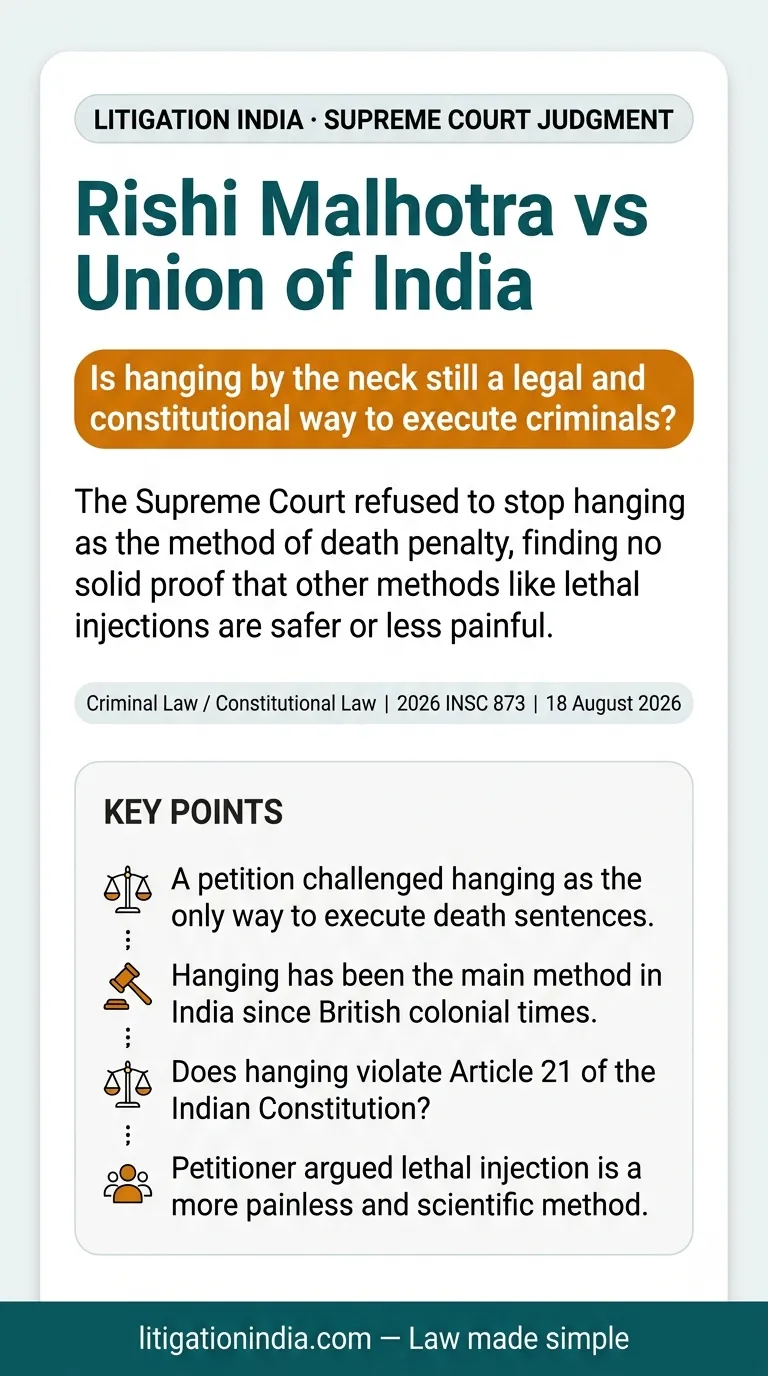
Is hanging by the neck still a legal and constitutional way to execute criminals?
Rishi Malhotra vs Union of India
Case: Rishi Malhotra vs Union of IndiaCitation: 2026 INSC 873Decided on: 18 August 2026
“The Supreme Court refused to stop hanging as the method of death penalty, finding no solid proof that other methods like lethal injections are safer or less painful.”
Story Slides
In short
In this case, the Supreme Court of India was asked to decide whether executing death-row prisoners by hanging them by the neck is cruel and unconstitutional. The petitioner, advocate Rishi Malhotra, argued that hanging is barbaric and causes intense physical and mental pain. He suggested that India should switch to more modern and humane methods, such as lethal injections or shooting. He argued that every person has a fundamental right to die with dignity under Article 21 of the Constitution. The Supreme Court rejected the petition and refused to change the law. The Court pointed out that a larger bench of three judges had already declared hanging valid in 1983 in the Deena case. Under court rules, a smaller bench of two judges cannot easily overturn a decision made by a larger bench. Furthermore, the Court noted that there is no scientific proof that alternative methods like lethal injections are pain-free. In fact, evidence from countries like the United States shows that lethal injections often fail, causing prolonged suffering to the prisoner. However, the Court clarified that the government can set up an expert committee to study other scientific methods if it wants to in the future.
Need clarity on a similar legal issue?
Request free pro bono guidance from a Supreme Court Advocate.
Background
A lawyer challenged the rules that say hanging by the neck is the only way to carry out a death sentence in India. He argued that hanging is too painful and violates a person's right to die with dignity.
The Decision
The Supreme Court dismissed the petition, stating that past judgments have already approved hanging as legal. It noted that alternative methods, like lethal injections, have failed frequently in other countries and are not proven to be more humane.
Why it matters for you
This judgment clarifies that court decisions cannot be changed without strong scientific proof. It also shows that the law values human dignity, but will not force the government to adopt untried, risky methods of execution.
AI-assisted summary, reviewed and verified by our editorial team.
Need help with your case?
Facing a similar legal challenge in the Supreme Court or High Court? Connect with our pro bono volunteer advocates today.
Related Supreme Court services
Related Questions of Law
- Can a statutory remission policy override an earlier constitutional one?
- Can the government banish a person from their district without a prior hearing?
- Can police escape criminal investigation and fair compensation for a death in custody?
- Can a person be sentenced to death without being given a lawyer?