Vijay Kumar Rajpoot vs State of Chhattisgarh
The big legal question
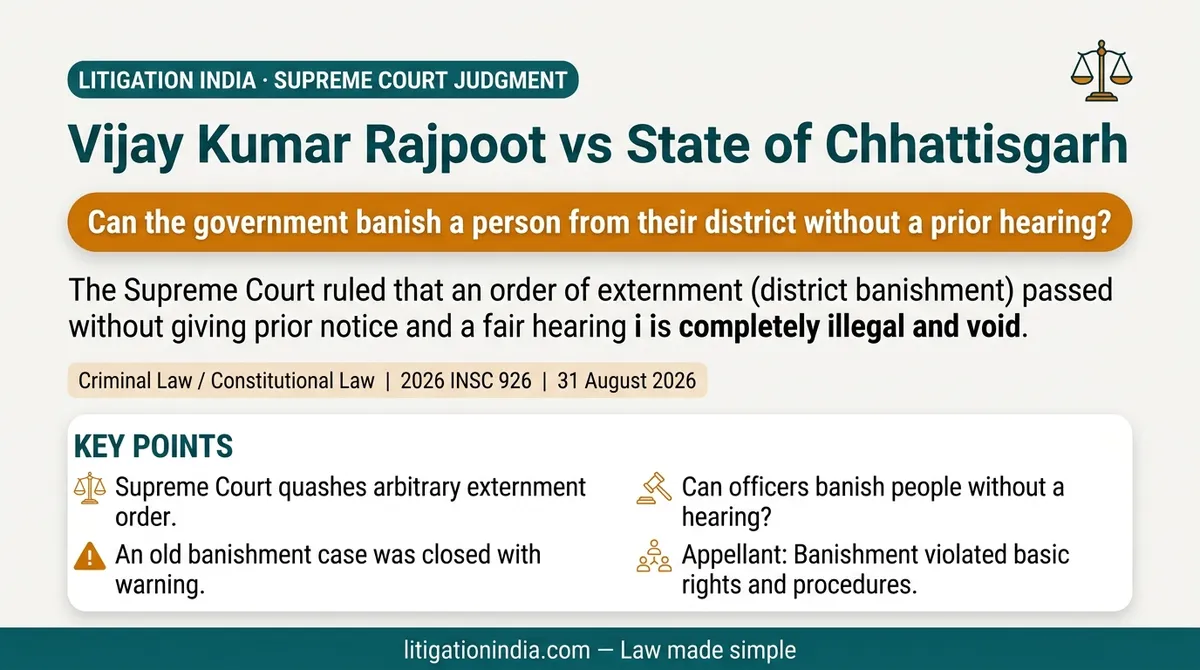
Can the government banish a person from their district without a prior hearing?
“The Supreme Court ruled that an order of externment (district banishment) passed without giving prior notice and a fair hearing is completely illegal and void.”
Story Slides
In short
In this case, the Supreme Court of India set aside an order of externment (district banishment) passed against the appellant, Vijay Kumar Rajpoot. The District Magistrate of Raigarh, Chhattisgarh, had initially closed an externment case against the appellant with a warning. However, after a new criminal complaint was filed, the Magistrate revived the closed case and ordered his banishment from Raigarh and nearby districts for one year. Crucially, this banishment order was passed while the appellant was in jail, without giving him any notice or an opportunity to defend himself. The High Court refused to help, telling him to file a regular appeal instead. The Supreme Court ruled that the High Court made a big mistake by refusing to step in. A High Court can and should hear a writ petition under Article 226 of the Constitution if there is a severe violation of natural justice (such as not giving a hearing) or if the officer had no power to pass the order. The Supreme Court explained that externment is an extreme measure that takes away a citizen's fundamental right to move freely (Article 19). Therefore, the law requires the DM to strictly follow Section 8 of the Chhattisgarh Rajya Suraksha Adhiniyam, which mandates giving a clear written notice and a fair hearing first. Additionally, the Court held that the DM had no power to review or reopen his own closed order because the law does not give him any such review power. Finally, the Court noted that the alleged offenses did not involve violence or qualify for banishment under Section 5 of the Act. The Court allowed the appeal and canceled the banishment order.
Background
The police recommended banishing the appellant based on ten old criminal cases, but the District Magistrate closed the matter with a warning because the appellant had been acquitted. Later, after a new complaint was registered, the Magistrate revived the closed case and ordered the appellant's banishment for one year. This order was passed without giving any notice or hearing to the appellant, who was in jail at the time.
The Decision
The Supreme Court allowed the appeal and completely quashed both the High Court's order and the externment (banishment) order. The Court declared that the appellant is free to enter the districts from which he was banished.
Why it matters for you
This judgment protects citizens from arbitrary and unfair banishment (externment) by local administrations. It confirms that the police and magistrates cannot bypass the basic rule of giving a person a fair hearing, even if they have criminal charges against them. It also clarifies that High Courts must protect citizens' fundamental rights when natural justice is violated, rather than turning them away on technicalities.
AI-assisted summary, reviewed and verified by our editorial team.
In the Court's words
“The duty to hear manacles his jurisdictional exercise and any act is, in its inception, void except when performed in accordance with the conditions laid down in regard to hearing.”
“There cannot be any manner of doubt that an order of externment is an extraordinary measure. The effect of the order of externment is of depriving a citizen of his fundamental right...”
“It is settled law that an administrative authority enjoys no power to review his earlier order, unless the statute empowers him to do so.”
Need help with your case?
Facing a similar legal challenge in the Supreme Court or High Court? Connect with our pro bono volunteer advocates today.
Related Supreme Court services