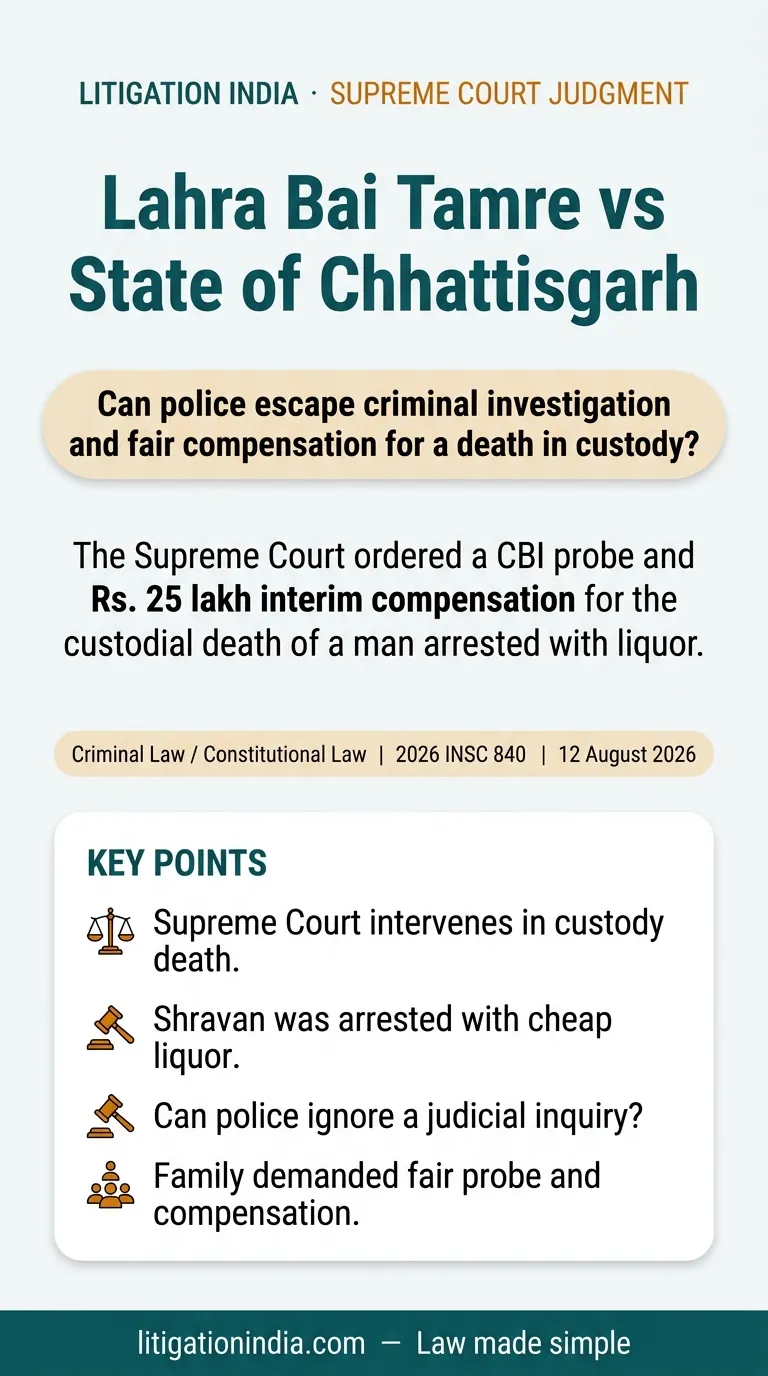
Lahra Bai Tamre vs State of Chhattisgarh
The big legal question
Can police escape criminal investigation and fair compensation for a death in custody?
“The Supreme Court ordered a CBI probe and Rs. 25 lakh interim compensation for the custodial death of a man arrested with liquor.”
Story Slides
In short
Shravan Suryavanshi was arrested by the Chhattisgarh police in January 2024 for possessing six litres of local liquor worth just Rs. 1,200. While in custody, he suffered severe injuries and died. A post-mortem report and a judicial inquiry confirmed he died from head injuries caused by a hard, blunt object. However, the Chhattisgarh High Court only awarded a tiny compensation of Rs. 1 lakh and did not order any criminal investigation against the responsible officers. The deceased's wife and daughters appealed to the Supreme Court. The Supreme Court strongly criticized senior state officials for trying to cover up the custodial death and using weak excuses. The court noted that jail records falsely tried to blame the death on alcohol withdrawal instead of head injuries. To ensure justice, the Supreme Court handed over the investigation to the Central Bureau of Investigation (CBI) to register a regular criminal case against the responsible officers. It also ordered the Chhattisgarh government to pay an interim compensation of Rs. 25 lakhs to the deceased's wife within four weeks, rejecting the High Court's inadequate award. The final compensation will be decided later.
Background
Shravan Suryavanshi was arrested by the Chhattisgarh police for carrying six bottles of local liquor worth Rs. 1,200. Within four days, he died in custody from severe injuries, including a head injury caused by a blunt object. His family approached the court when the police failed to register a case against the officers.
The Decision
The Supreme Court ordered the CBI to immediately register a criminal case and investigate the custodial death. The court also ordered the State of Chhattisgarh to pay Rs. 25 lakhs as interim compensation to the deceased's wife within four weeks.
Why it matters for you
This judgment shows that the police cannot abuse their power and cover up deaths in custody. It assures common citizens that even senior police officers will be held accountable, and families of victims will receive substantial financial support.
AI-assisted summary, reviewed and verified by our editorial team.
Need help with your case?
Facing a similar legal challenge in the Supreme Court or High Court? Connect with our pro bono volunteer advocates today.
Related Supreme Court services