Dr. Abdul Hameed vs State of Rajasthan
The big legal question
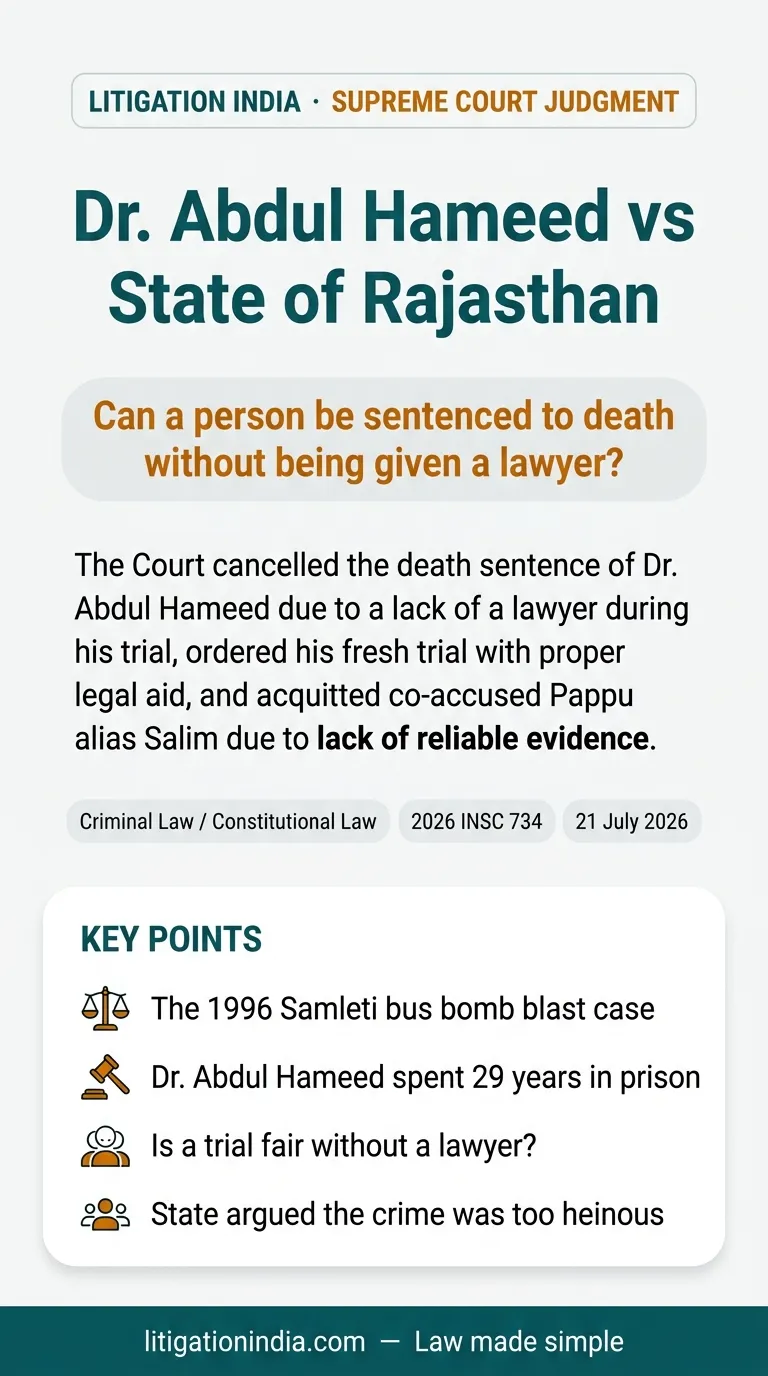
Can a person be sentenced to death without being given a lawyer?
“The Court cancelled the death sentence of Dr. Abdul Hameed due to a lack of a lawyer during his trial, ordered his fresh trial with proper legal aid, and acquitted co-accused Pappu alias Salim due to lack of reliable evidence.”
Story Slides
In short
This landmark judgment arises from a devastating 1996 bus bomb blast in Samleti village, Rajasthan, which killed 14 innocent people. The Trial Court and High Court had sentenced Dr. Abdul Hameed to death and handed life imprisonment to Pappu alias Salim. However, the Supreme Court discovered shocking flaws in how these trials were conducted. First, Dr. Hameed, who spent 29 years in prison, had no lawyer representing him during his trial. He was forced to cross-examine complex technical witnesses and argue his own death-penalty case completely alone. The Supreme Court ruled that a trial without a lawyer violates the fundamental right to a fair trial under Article 21 of the Constitution. Therefore, his entire conviction was declared illegal, his death sentence was set aside, and a fresh trial was ordered with proper legal aid. Second, Pappu alias Salim was convicted based solely on his own 'retracted confessions' (confessions he later said were forced). The Court ruled that a confession rejected by its maker cannot be used to convict someone unless there is strong independent evidence, which was completely missing here. Thus, Pappu was acquitted. Lastly, the Court upheld the acquittal of six other co-accused, reiterating that public outrage or mere suspicion can never replace solid, legal proof in a court of law.
Background
In May 1996, a powerful bomb exploded on a Rajasthan Roadways bus near Samleti village, killing 14 passengers. The police blamed extremist groups and arrested several suspects, leading to a long trial where Dr. Abdul Hameed was sentenced to death and Pappu alias Salim received life imprisonment.
The Decision
The Supreme Court cancelled Dr. Hameed's death sentence and ordered a fresh trial for him because he was forced to fight his case without a lawyer. The Court also completely acquitted Pappu alias Salim because there was no solid, independent evidence against him apart from forced confessions.
Why it matters for you
This judgment protects common citizens by ensuring that the government cannot sentence anyone to death without giving them a proper lawyer. It reminds us that even for the most serious crimes, courts must follow fair procedures and cannot convict people based on mere suspicion or forced statements.
AI-assisted summary, reviewed and verified by our editorial team.
Need help with your case?
Facing a similar legal challenge in the Supreme Court or High Court? Connect with our pro bono volunteer advocates today.
Related Supreme Court services