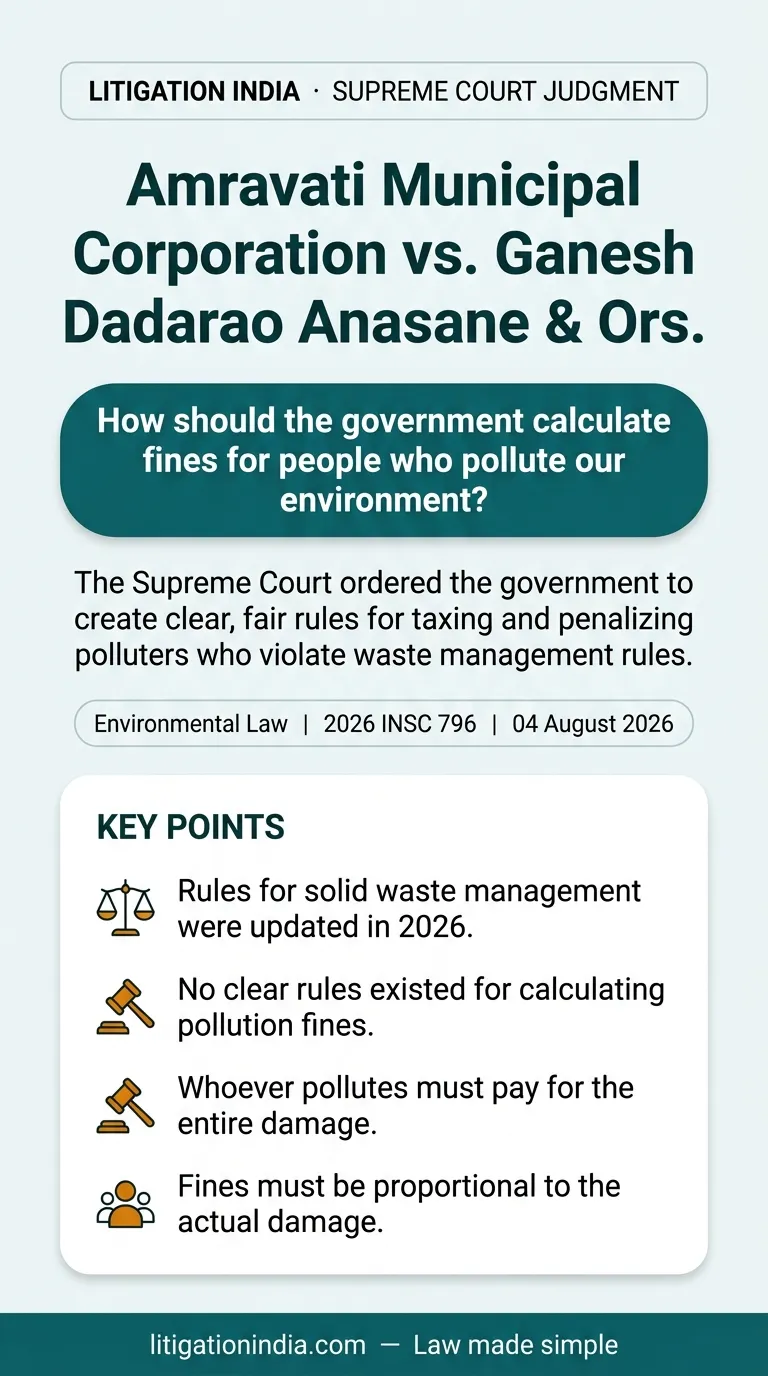
Amravati Municipal Corporation vs. Ganesh Dadarao Anasane & Ors.
The big legal question
How should the government calculate fines for people who pollute our environment?
“The Supreme Court ordered the government to create clear, fair rules for taxing and penalizing polluters who violate waste management rules.”
Story Slides
In short
The Supreme Court of India took a major step towards making waste management laws practical and effective. Under the Solid Waste Management Rules of 2026, the Ministry of Environment, Forest and Climate Change has set up a 'Central Implementation Committee'. This committee is responsible for making sure the waste rules are followed across the country. The Supreme Court pointed out that currently, there are no clear, uniform rules on how to charge money (called environmental compensation) from those who dump garbage, pollute, or violate waste management rules. Often, different officials or courts charge different amounts based on their own choices. To make things fair and certain, the Supreme Court laid down eight golden principles. These principles state that the fine must not just be a punishment, but must cover the actual cost of cleaning up and restoring the environment. The fine must depend on the wealth of the polluter, the actual damage caused, and must continue until the damage is fully repaired. The Court has directed the government to take these principles, along with existing rules for plastic and hazardous waste, and create a clear formula. This way, everyone knows exactly what penalty they will face for harming nature.
Background
The court was hearing appeals related to solid waste management in the Amravati municipal area. The central government informed the court that a new committee has been formed to implement the 2026 Waste Management Rules. The court noticed that there was no structured system to decide how much fine a polluter should pay.
The Decision
The Supreme Court laid down eight key principles to calculate environmental compensation fairly. It directed the Environment Ministry to draft clear, formula-based guidelines within these principles. The government must now file a progress report on making these regulations.
Why it matters for you
This judgment prevents government officers from imposing arbitrary and unfair fines on citizens and businesses. It ensures that fines are used directly to clean up the damaged environment. It holds big polluters highly accountable by linking fines to their financial capacity.
AI-assisted summary, reviewed and verified by our editorial team.
Need help with your case?
Facing a similar legal challenge in the Supreme Court or High Court? Connect with our pro bono volunteer advocates today.
Related Supreme Court services