Vyakti Vikas Kendra India vs Manoj Misra (Dead) & Ors.
The big legal question
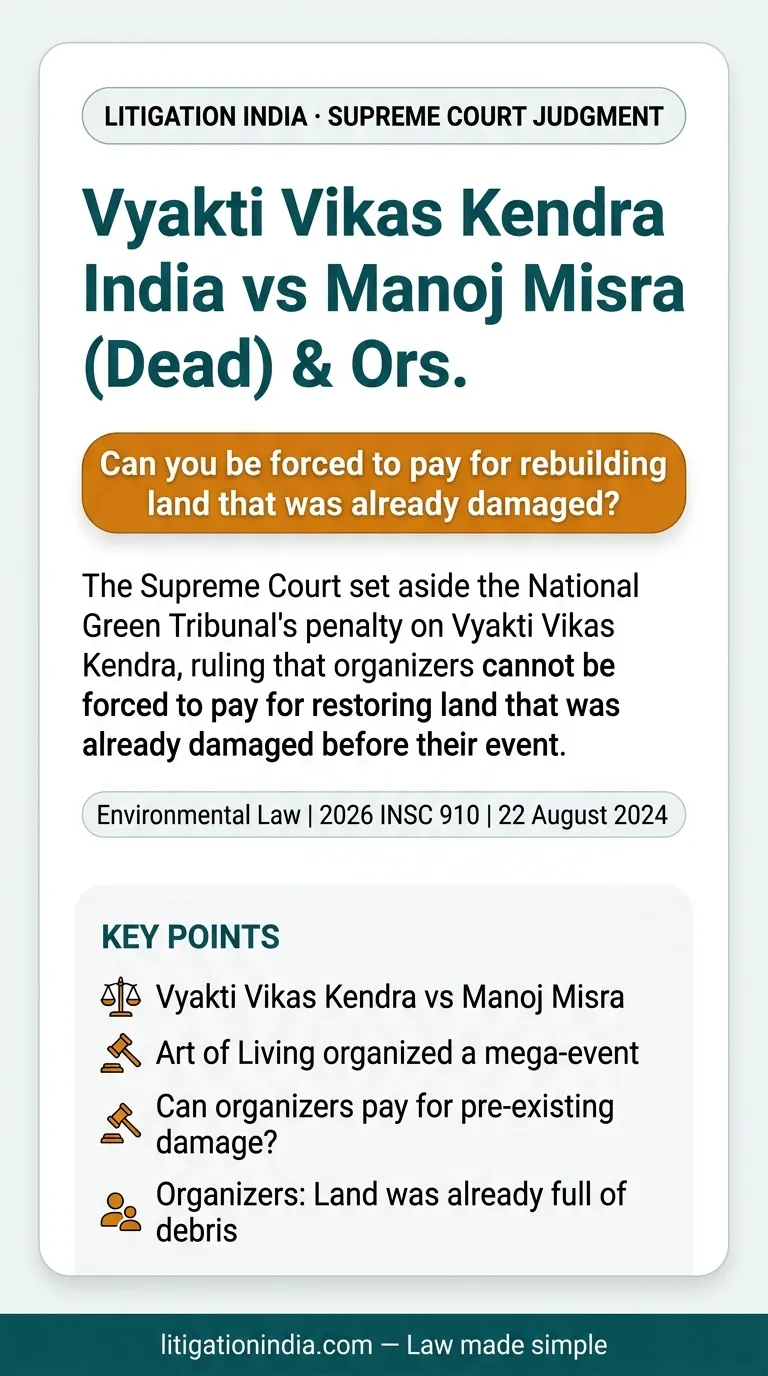
Can you be forced to pay for rebuilding land that was already damaged?
“The Supreme Court set aside the National Green Tribunal's penalty on Vyakti Vikas Kendra, ruling that organizers cannot be forced to pay for restoring land that was already damaged before their event.”
Story Slides
In short
This case is about the 'World Culture Festival' organized by Vyakti Vikas Kendra (Art of Living) on the Yamuna river floodplains in Delhi in March 2016. Before the festival, an activist filed a case in the National Green Tribunal (NGT) claiming the massive event would destroy the river's delicate ecosystem. The NGT allowed the event to go on but ordered the organizers to pay an advance of Rs 5 crore as compensation, later ruling they must pay for the complete rehabilitation of the area, including building a biodiversity park. The Supreme Court reversed this decision. The Court explained that 'restoration' means bringing something back to how it was before. 'Rehabilitation' means developing it into something much better, like a brand-new park. A private group can only be asked to restore damage they directly caused. Evidence showed that the Yamuna floodplains were already severely damaged, full of debris, and in a poor state long before the event. The expert committee's reports were contradictory, and one report even admitted it was impossible to know the site's original condition. The Court ruled that general environmental improvement is the government's job, not a private party's burden. Since no direct link proved the festival caused permanent damage, the Court set aside NGT's penalty and ordered DDA to refund the Rs 5 crore.
Background
Vyakti Vikas Kendra organized a massive cultural festival on 25 hectares of the Yamuna floodplains in Delhi. Activists moved the NGT, arguing that the heavy preparations and temporary structures would permanently destroy the active riverbed and wetlands.
The Decision
The Supreme Court set aside the NGT judgment, holding that the tribunal relied on faulty, unscientific reports that ignored the pre-existing damaged state of the land. The Court ordered the Delhi Development Authority (DDA) to refund the Rs. 5 crore deposit to the appellant within four weeks.
Why it matters for you
This judgment protects citizens and organizations from being unfairly penalized for environmental damage they did not cause. It clarifies that while 'polluters must pay,' they are only liable for specific damage they directly cause, not for funding general state projects like public parks.
AI-assisted summary, reviewed and verified by our editorial team.
Need help with your case?
Facing a similar legal challenge in the Supreme Court or High Court? Connect with our pro bono volunteer advocates today.
Related Supreme Court services