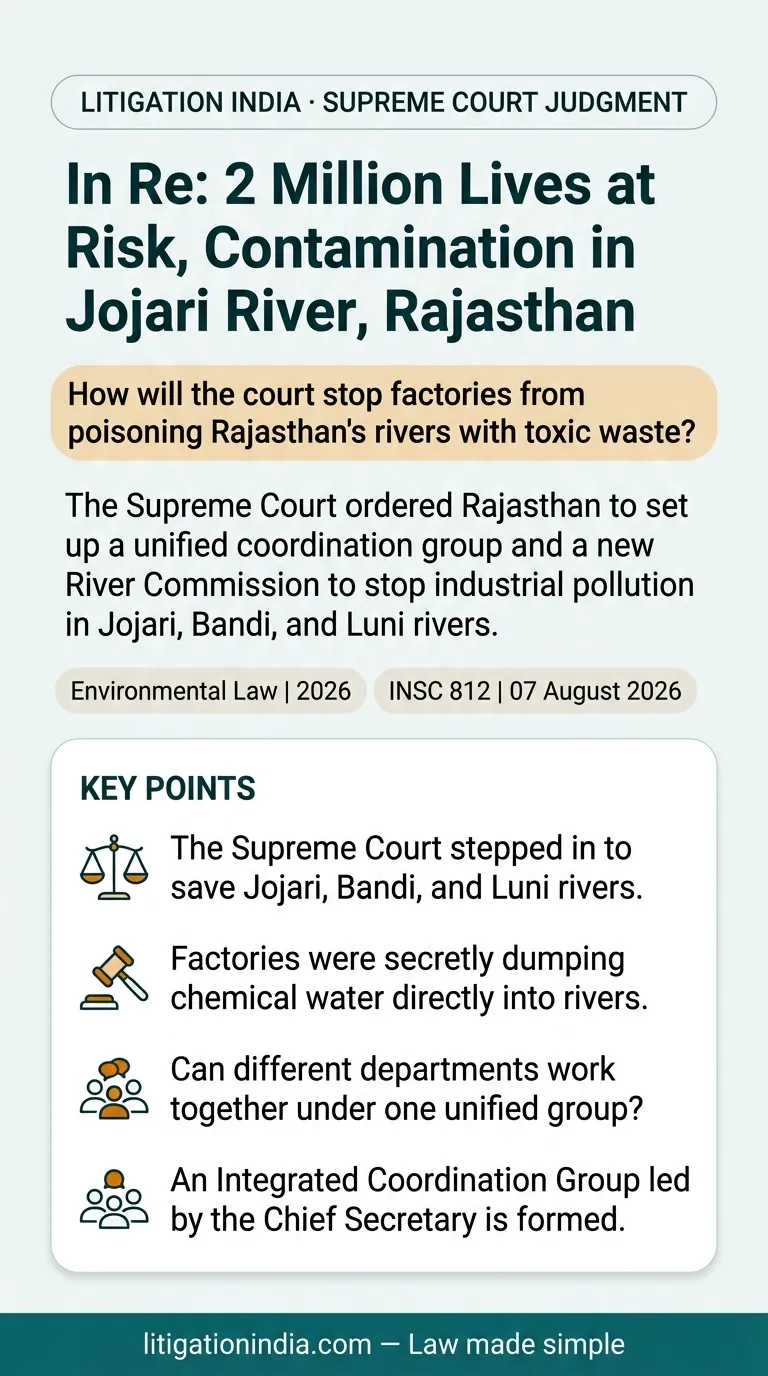
In Re: 2 Million Lives at Risk, Contamination in Jojari River, Rajasthan
The big legal question
How will the court stop factories from poisoning Rajasthan's rivers with toxic waste?
“The Supreme Court ordered Rajasthan to set up a unified coordination group and a new River Commission to stop industrial pollution in Jojari, Bandi, and Luni rivers.”
Story Slides
In short
The Supreme Court of India took serious note of the severe pollution and environmental damage in Rajasthan's Jojari, Bandi, and Luni rivers. This pollution is caused by factories illegally dumping chemical waste and untreated water directly into the rivers, often with the help of corrupt officials. Since many different government departments were working in isolation without any coordination, the Court ordered the Rajasthan government to form an 'Integrated Coordination Group' led by the Chief Secretary. This group must bring all departments together to create a master plan for cleaning the rivers. Additionally, the Court ordered the creation of a new, independent 'River Commission' to oversee the long-term health of all rivers in the state. To help ordinary people fight this pollution, the Court directed the state to launch a digital platform with QR codes. Anyone can scan these QR codes to secretly report environmental crimes, upload photos of illegal waste dumping, and track action taken on their complaints. The Court also warned the police and the Special Investigation Team (SIT) to catch the actual masterminds and corrupt officers behind this environmental crisis, rather than just arresting low-level workers.
Background
Several newspapers and local reports highlighted that over two million lives were at risk in Rajasthan due to heavy chemical contamination in the Jojari River and nearby dams. Factories were illegally bypassing safety systems to dump toxic industrial waste, turning local water bodies pink and black, while government agencies failed to stop them.
The Decision
The Court ordered the immediate setup of an Integrated Coordination Group to submit a comprehensive river-cleaning plan within three weeks. It also banned any new factory or building near rivers until safe boundary lines are scientifically marked, and directed the creation of a secret digital portal for public complaints.
Why it matters for you
This judgment empowers local citizens to actively report pollution and illegal mining safely without fearing retaliation. It forces lazy government departments to work together under one head, ensuring that the water people drink and use for farming does not get poisoned by greedy industrial owners.
AI-assisted summary, reviewed and verified by our editorial team.
Need help with your case?
Facing a similar legal challenge in the Supreme Court or High Court? Connect with our pro bono volunteer advocates today.
Related Supreme Court services