M/s Punahchakran Private Limited vs. Indotech Waste Solution & Ors
The big legal question
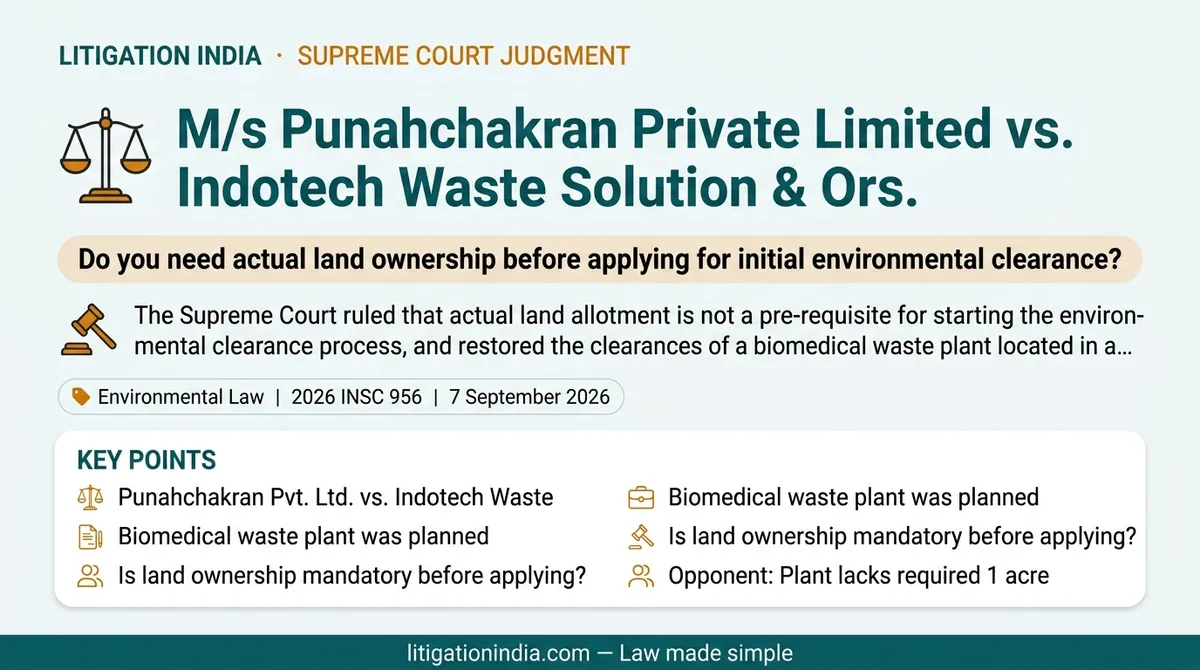
Do you need actual land ownership before applying for initial environmental clearance?
“The Supreme Court ruled that actual land allotment is not a pre-requisite for starting the environmental clearance process, and restored the clearances of a biomedical waste plant located in a rural area.”
Story Slides
In short
This landmark judgment by the Supreme Court of India clarifies the exact stage at which land acquisition documents must be produced during the environmental clearance (EC) process. The dispute arose when M/s Punahchakran Private Limited sought to establish a Common Bio-medical Waste Treatment Facility (CBWTF) in Village Noorpur, Uttar Pradesh. The National Green Tribunal (NGT) had repeatedly cancelled the company's environmental clearance and Consent to Establish (CTE). The NGT wrongly assumed that the project was located within an urban Nagar Panchayat (where land area relaxation from the standard 1 acre is highly restricted) and that the project proponent must fully own or secure land allotment before even starting the EC application process. Reversing the NGT's decision, the Supreme Court made several crucial determinations: First, the court clarified that under Clause 6 of the Environmental Impact Assessment (EIA) Notification, 2006, a project proponent only needs to 'identify' a prospective site to submit a Form 1 application for Terms of Reference (ToR). Formal land allotment or acquisition documents are only required at the later 'appraisal stage' (Stage IV) of the EC process, not at the very beginning. Similarly, successful land allotment is not a strict pre-condition for filing or obtaining a Consent to Establish (CTE) under the Water and Air Acts. Second, the court established that the Central Pollution Control Board's (CPCB) Revised Guidelines of 2016 are mandatory and binding, even if they were not published in the Official Gazette, as publication on the CPCB website is reasonably sufficient. Third, the court relied on a District Magistrate's report confirming that the waste plant was located in Village Noorpur—a rural area—allowing the 1-acre land requirement to be legally relaxed to 0.89 acres with strict pollution control measures. Finally, the court held that setting aside an EC does not automatically invalidate the underlying ToR unless the initial application itself was fraudulent. The Supreme Court set aside the NGT's judgment and restored the clearances.
Background
A private company wanted to set up a biomedical waste treatment plant on a 0.89-acre plot in Village Noorpur, UP. Initially, their environmental clearance was challenged because the standard rule requires at least 1 acre of land. After getting official land relaxation from the central pollution board, they obtained a second clearance, which was again cancelled by the National Green Tribunal (NGT) on the grounds that the land was in an urban area and they didn't own it before applying.
The Decision
The Supreme Court set aside the NGT's order and fully restored the environmental clearance and Consent to Establish for the waste treatment plant. The Court confirmed that the plant is located in a rural area where land area relaxation is legally allowed, and that owning land is not a compulsory starting condition for environmental applications.
Why it matters for you
This judgment prevents unnecessary red tape and delays for business entrepreneurs by ruling that they do not need to lock up expensive land before even knowing if their project will get initial environmental approvals. It balances environmental safety guidelines with practical business realities.
AI-assisted summary, reviewed and verified by our editorial team.
In the Court's words
“Clause 6 of the EIA, 2006 states that an application in Form 1 can be made after the identification of prospective site(s). Therefore, land allotment cannot be said to be a pre-condition...”
“The RG, 2016 is mandatory in nature. It must be scrupulously followed by the relevant authorities and the project proponents alike...”
“It cannot always as a mechanical rule be said that when the EC is set-aside, the ToR is also automatically rendered null and void...”
Need help with your case?
Facing a similar legal challenge in the Supreme Court or High Court? Connect with our pro bono volunteer advocates today.
Related Supreme Court services