Landmark Supreme Court of India rulings, explained in clear, plain language.
Filter by Act / Section
Showing 5 of 5 judgments
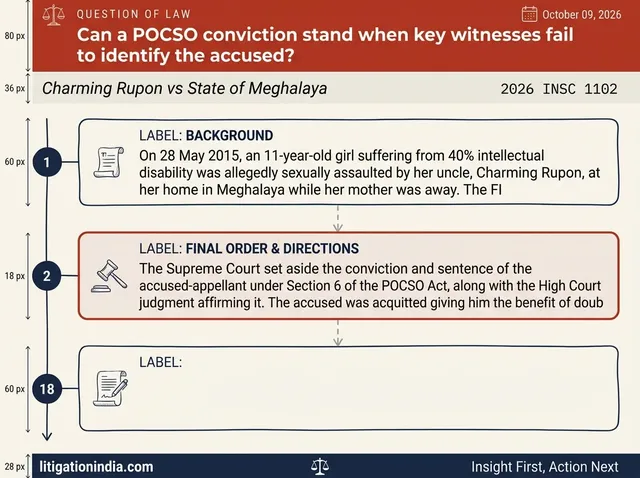
Can a POCSO conviction stand when key witnesses fail to identify the accused?
Charming Rupon vs State of Meghalaya
The Supreme Court acquitted the accused under POCSO Act, finding the prosecution evidence riddled with identification failures, witness tutoring, and unexplained omissions.
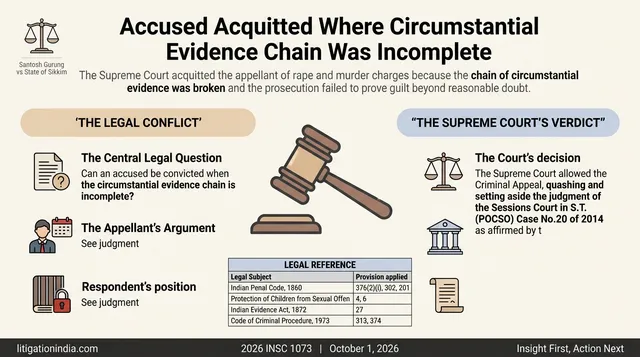
Can an accused be convicted when the circumstantial evidence chain is incomplete?
Santosh Gurung vs State of Sikkim
The Supreme Court acquitted the appellant of rape and murder charges because the chain of circumstantial evidence was broken and the prosecution failed to prove guilt beyond reasonable doubt.
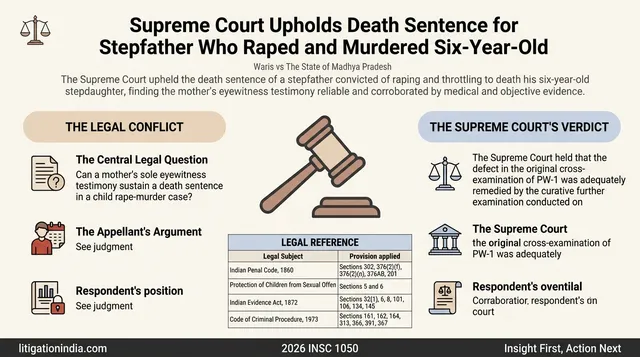
Can a mother's sole eyewitness testimony sustain a death sentence in a child rape-murder case?
Waris vs The State of Madhya Pradesh
The Supreme Court upheld the death sentence of a stepfather convicted of raping and throttling to death his six-year-old stepdaughter, finding the mother's eyewitness testimony reliable and corroborated by medical and objective evidence.
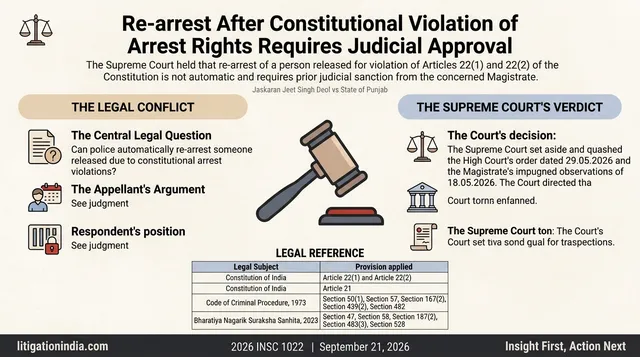
Can police automatically re-arrest someone released due to constitutional arrest violations?
Jaskaran Jeet Singh Deol vs State of Punjab
The Supreme Court held that re-arrest of a person released for violation of Articles 22(1) and 22(2) of the Constitution is not automatic and requires prior judicial sanction from the concerned Magistrate.
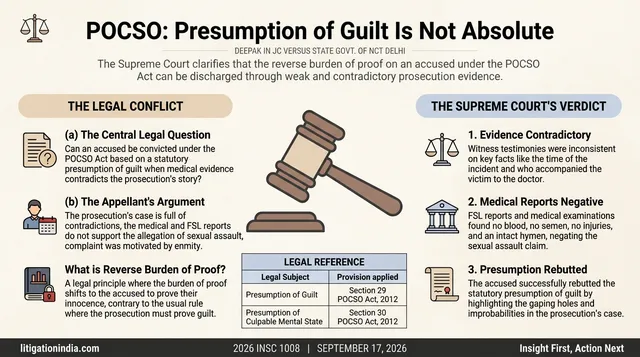
Can POCSO's presumption of guilt stand without corroborative medical evidence?
DEEPAK IN JC VERSUS STATE GOVT. OF NCT DELHI
The Supreme Court acquitted the appellant in a POCSO case, holding that the prosecution failed to prove guilt beyond a reasonable doubt due to contradictory evidence and non-corroborative medical reports.
You have reached the end — all 5 judgments loaded.