Landmark Supreme Court of India rulings, explained in clear, plain language.
Filter by Act / Section
Showing 5 of 5 judgments
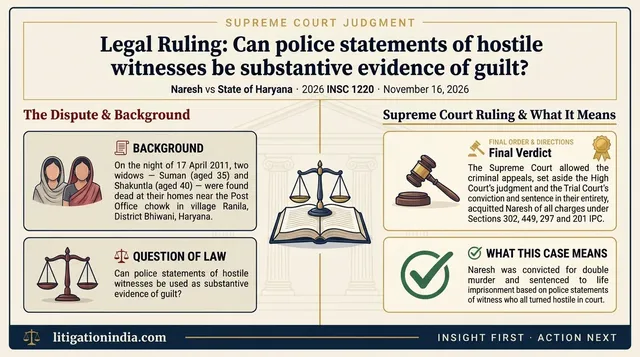
Can police statements of hostile witnesses be used as substantive evidence of guilt?
Naresh vs State of Haryana
The Supreme Court acquitted Naresh of double murder because all witnesses turned hostile, police statements were inadmissible under Section 162 CrPC, and no legally admissible evidence established his guilt beyond reasonable doubt.
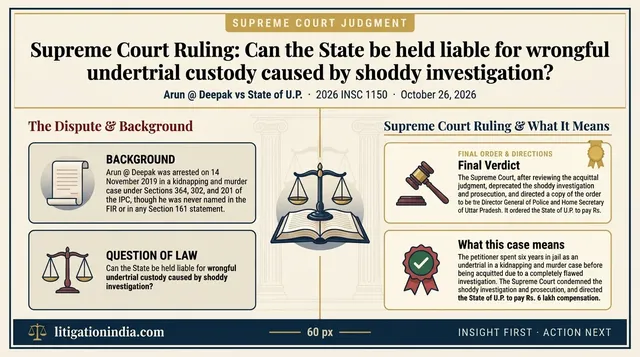
Can the State be held liable for wrongful undertrial custody caused by shoddy investigation?
Arun @ Deepak vs State of U.P.
The Supreme Court directed the State of U.P. to pay Rs. 6 lakh compensation to the petitioner who spent six years in wrongful undertrial custody before being acquitted due to a completely flawed investigation.
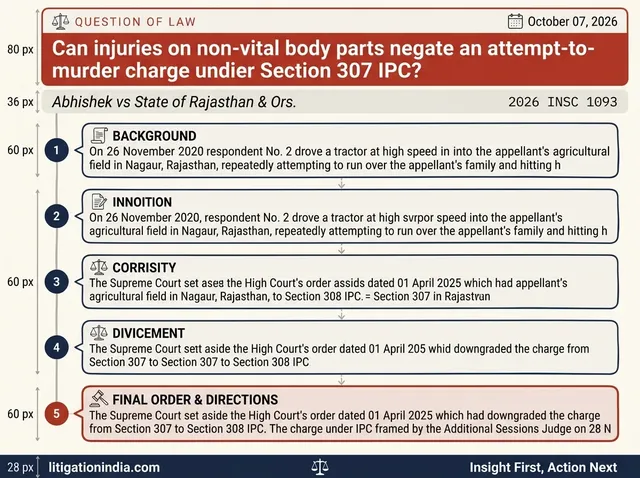
Can injuries on non-vital body parts negate an attempt-to-murder charge under Section 307 IPC?
Abhishek vs State of Rajasthan & Ors.
The Supreme Court restored the Section 307 IPC charge, holding that injuries on non-vital body parts do not negate an attempt-to-murder charge if the requisite intention is evident.
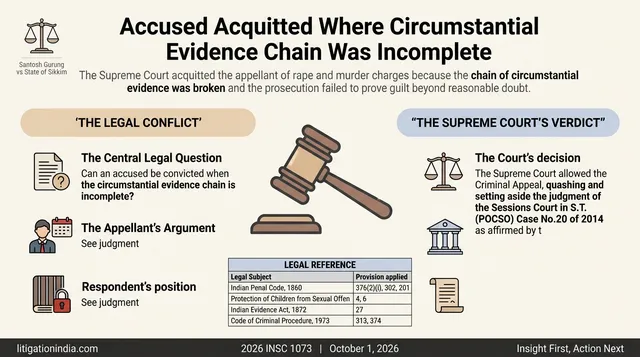
Can an accused be convicted when the circumstantial evidence chain is incomplete?
Santosh Gurung vs State of Sikkim
The Supreme Court acquitted the appellant of rape and murder charges because the chain of circumstantial evidence was broken and the prosecution failed to prove guilt beyond reasonable doubt.
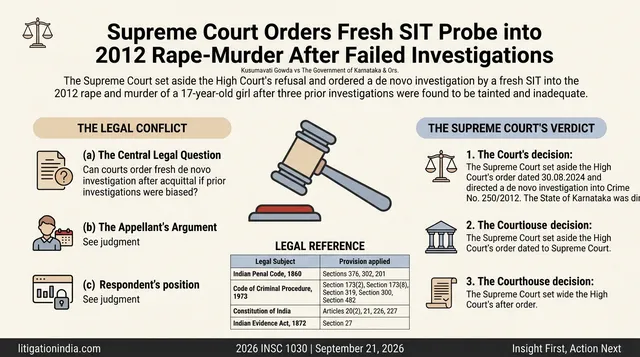
Can courts order fresh de novo investigation after acquittal if prior investigations were biased?
Kusumavati Gowda vs The Government of Karnataka & Ors.
The Supreme Court set aside the High Court's refusal and ordered a de novo investigation by a fresh SIT into the 2012 rape and murder of a 17-year-old girl after three prior investigations were found to be tainted and inadequate.
You have reached the end — all 5 judgments loaded.