
Do promotions within the same grade pay count under the MACP scheme?
Union of India and Others vs. Harbans Lal Verma
Case: Union of India and Others vs. Harbans Lal VermaCitation: 2026 INSC 739Decided on: 23 July 2026
“The Supreme Court decided that promotions within the same Grade Pay count as real promotions, meaning Railway Guards with three promotions are not entitled to additional MACP upgrades.”
Case Quick Facts
- Case Title
- Union of India and Others vs. Harbans Lal Verma
- Neutral Citation
- 2026 INSC 739
- Bench
- Justice Sanjay Karol, Justice Augustine George Masih
- Date of Judgment
- 23 July 2026
- Area of Law
- Service Law / Employment
Outcome: The Supreme Court decided that promotions within the same Grade Pay count as real promotions, meaning Railway Guards with three promotions are not entitled to additional MACP upgrades.
Story Slides
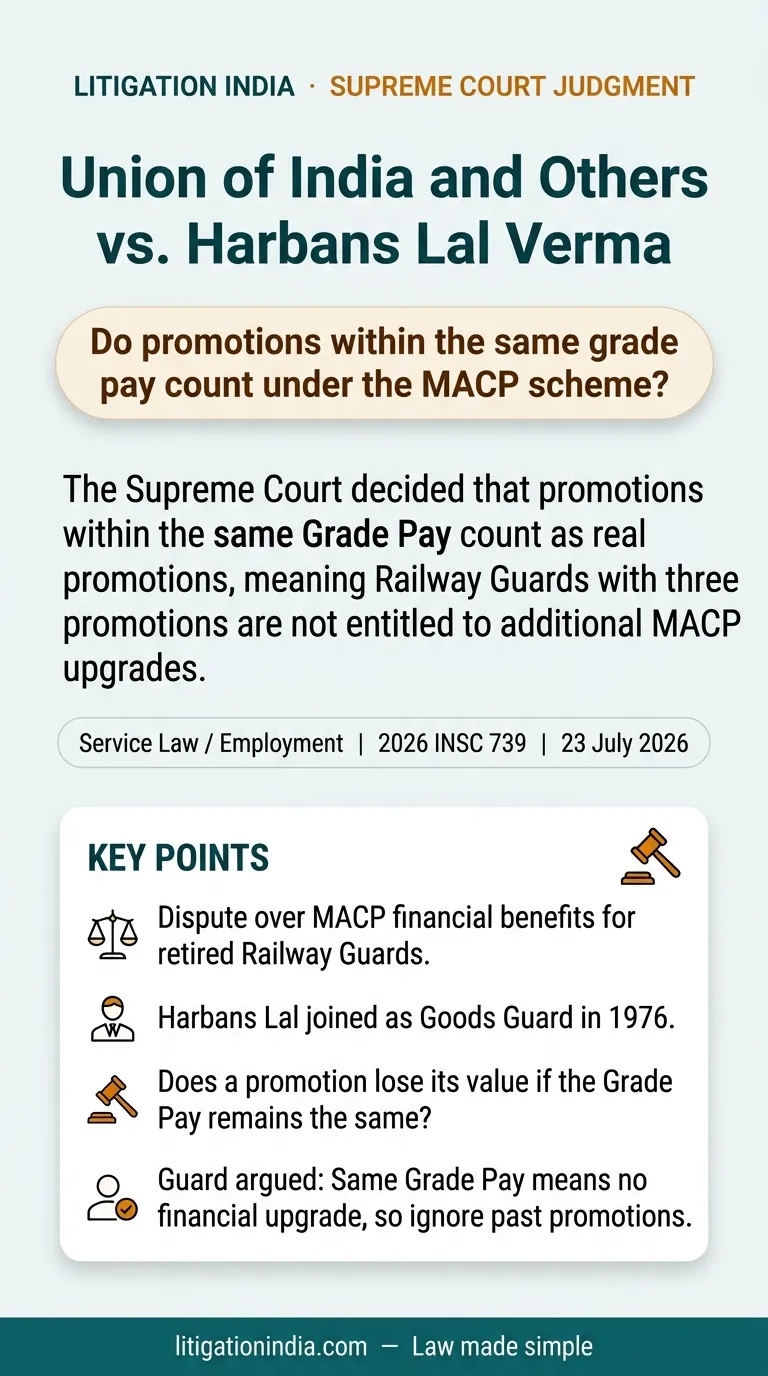
In short
The Supreme Court of India decided an important issue regarding the Modified Assured Career Progression (MACP) scheme for government employees, specifically focusing on Railway Guards. The MACP scheme was introduced to help employees who get stuck in the same post without any promotions for years by giving them automatic financial upgrades after 10, 20, and 30 years of service. However, if an employee gets three actual promotions during their career, they cannot claim these automatic upgrades. In this case, a Railway Guard had received three promotions over his career, eventually reaching the highest guard post. Although his promotions placed him in different higher posts, a new pay system later merged the pay scales of these different posts into a single 'Grade Pay' of Rs. 4,200. The worker argued that since all these posts now had the same Grade Pay, his promotions should be ignored, and he should get extra financial upgrades. The Supreme Court disagreed with the worker. It ruled that his promotions were real because they came with more responsibilities, formal selection, and actual pay increases through special allowances. Therefore, these promotions must be counted. Since he already received three promotions, his quota for automatic financial upgrades was exhausted. However, to protect the retired worker, the court ordered that the government cannot take back any money already paid to him.
Need clarity on a similar legal issue?
Request free pro bono guidance from a Supreme Court Advocate.
Background
Harbans Lal Verma joined the Indian Railways in 1976 as a Goods Guard. Over his 32-year career, he received three promotions, eventually retiring as a Mail/Express Guard in 2009. After a new pay scale merged multiple guard posts into a single Grade Pay of Rs. 4,200, he claimed he was entitled to further financial upgrades under the MACP scheme.
The Decision
The Supreme Court ruled in favor of the Union of India, holding that promotions within the Guard cadre must be counted even if they share the same Grade Pay. The Court confirmed that the employee had exhausted his three MACP upgrades but directed that no recovery of past payments should be made from him.
Why it matters for you
This judgment clarifies that actual job promotions with higher responsibilities and pay increments cannot be ignored just because of a merger in the Grade Pay system. It sets a clear rule for all similar cases across the Indian Railways regarding how MACP benefits must be calculated.
Frequently Asked Questions
AI-assisted summary, reviewed and verified by our editorial team.
Need help with your case?
Facing a similar legal challenge in the Supreme Court or High Court? Connect with our pro bono volunteer advocates today.
Related Supreme Court services
Related Questions of Law
- Can the government force a high-performing officer to retire early shortly after promoting them?
- Can a qualified professor keep his job if his PhD is fake?
- Can local school committees hire government-funded staff without open competition and fair rules?
- Can employers delay processing medical retirement applications to deny compassionate jobs to dependents?
- Can the government cancel a worker's promotion using rules made years later?