
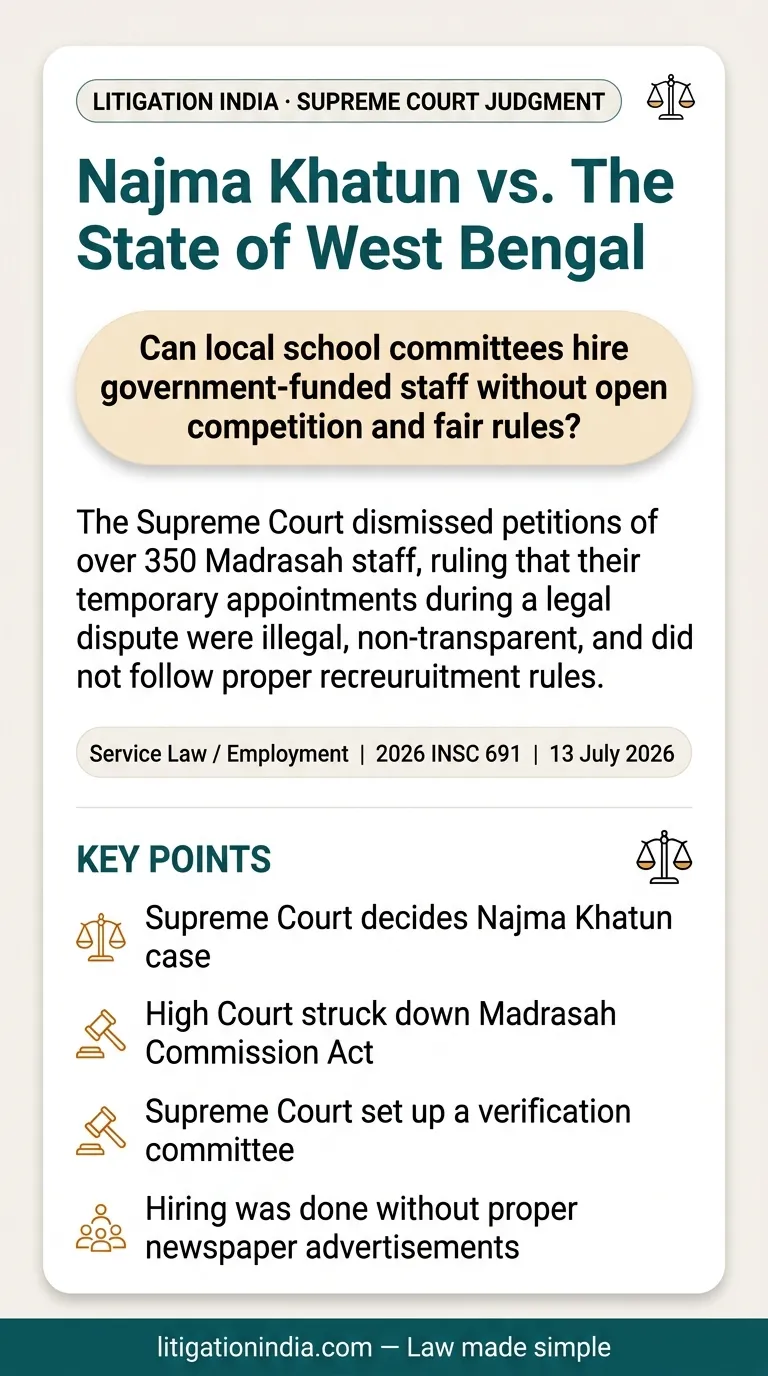
Can local school committees hire government-funded staff without open competition and fair rules?
Najma Khatun vs. The State of West Bengal
Case: Najma Khatun vs. The State of West BengalCitation: 2026 INSC 691Decided on: 13 July 2026
“The Supreme Court dismissed petitions of over 350 Madrasah staff, ruling that their temporary appointments during a legal dispute were illegal, non-transparent, and did not follow proper recruitment rules.”
Case Quick Facts
- Case Title
- Najma Khatun vs. The State of West Bengal
- Neutral Citation
- 2026 INSC 691
- Bench
- Justice Dipankar Datta, Justice Augustine George Masih
- Date of Judgment
- 13 July 2026
- Area of Law
- Service Law / Employment
Outcome: The Supreme Court dismissed petitions of over 350 Madrasah staff, ruling that their temporary appointments during a legal dispute were illegal, non-transparent, and did not follow proper recruitment rules.
Story Slides
In short
The Supreme Court of India decided a batch of 49 petitions filed by over 350 teachers and non-teaching staff of various government-aided Madrasahs in West Bengal. These staff members claimed they were appointed by local managing committees between 2014 and 2020. During this period, the West Bengal Madrasah Service Commission Act, 2008 had been declared unconstitutional by the Calcutta High Court, but that decision was later stayed and ultimately reversed by the Supreme Court in 2020. To verify the genuineness of these interim appointments, the Supreme Court had earlier set up an expert committee. The committee rejected all claims, finding that none of the appointments met the legal standards. Challenging this, the staff approached the Supreme Court. The Supreme Court thoroughly analyzed sample cases and found widespread illegalities, such as hiring through walk-in interviews, lack of newspaper advertisements, backdated appointments, and appointments to non-existent posts. The Court held that hiring for government-funded posts must be transparent and competitive. It ruled that any appointment made after March 14, 2016 (when the SC stayed the High Court's ruling) without the Supreme Court's permission is completely illegal. Consequently, the Supreme Court dismissed all petitions, cancelled interim protections, and ordered that vacancies be filled freshly through the regular Madrasah Service Commission.
Need clarity on a similar legal issue?
Request free pro bono guidance from a Supreme Court Advocate.
Background
A dispute arose in West Bengal over whether Madrasah staff should be recruited by a central State Commission or local committees. While the High Court struck down the State Commission's powers, the Supreme Court later stayed this decision, creating a legal gap during which local committees quickly hired hundreds of staff members, bypassing regular rules.
The Decision
The Supreme Court dismissed all the petitions, ruling that the interim appointments were illegal, non-transparent, and often fraudulent. It cancelled all temporary protections that allowed these workers to draw salaries and ordered that all vacant posts be filled freshly through the official Madrasah Service Commission.
Why it matters for you
This judgment ensures that any school or institution receiving government funds cannot distribute public jobs privately or through favoritism. It protects the future of students by ensuring that only qualified teachers selected through an open, transparent, and competitive process are hired.
Frequently Asked Questions
AI-assisted summary, reviewed and verified by our editorial team.
Need help with your case?
Facing a similar legal challenge in the Supreme Court or High Court? Connect with our pro bono volunteer advocates today.
Related Supreme Court services
Related Questions of Law
- Can the government force a high-performing officer to retire early shortly after promoting them?
- Can a qualified professor keep his job if his PhD is fake?
- Can employers delay processing medical retirement applications to deny compassionate jobs to dependents?
- Can the government cancel a worker's promotion using rules made years later?
- Must a law graduate practice for three years before becoming a judge?