
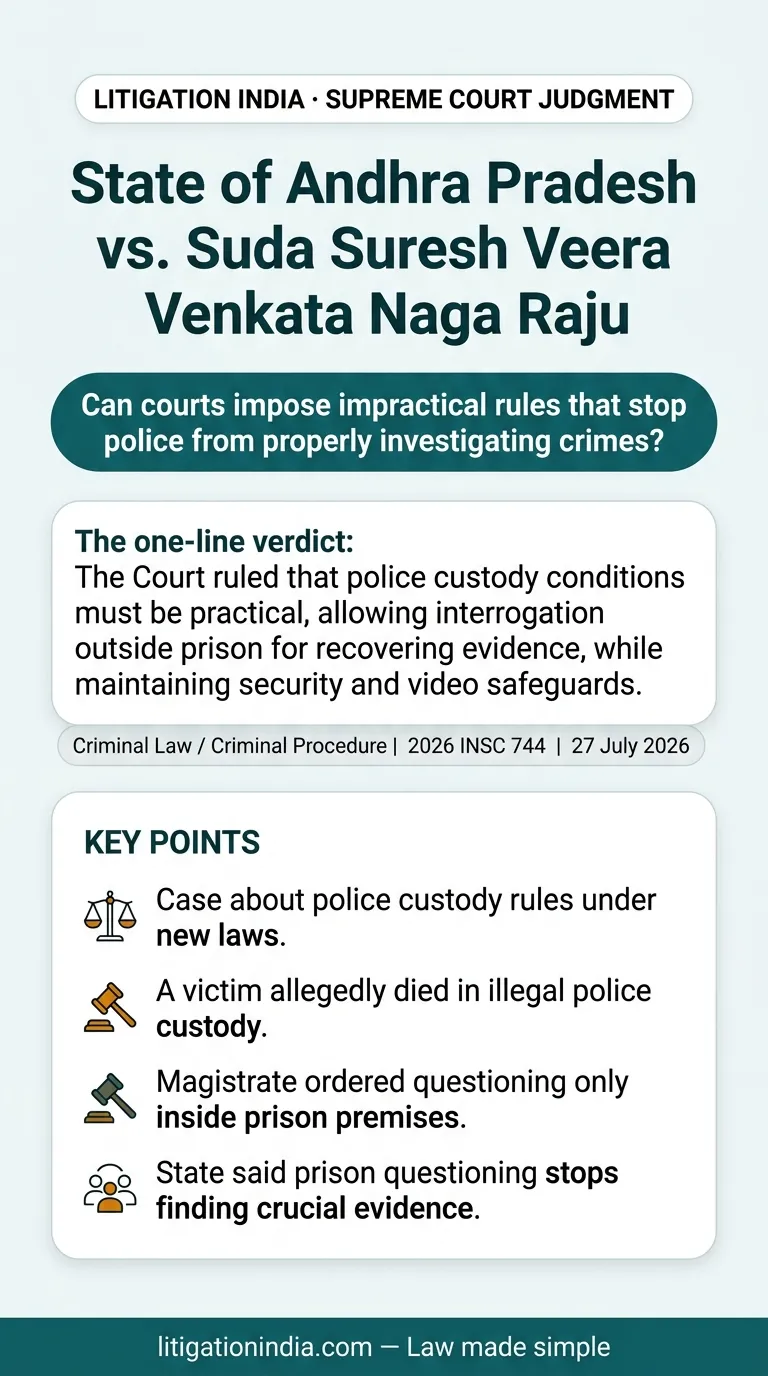
Can courts impose impractical rules that stop police from properly investigating crimes?
State of Andhra Pradesh vs. Suda Suresh Veera Venkata Naga Raju
Case: State of Andhra Pradesh vs. Suda Suresh Veera Venkata Naga RajuCitation: 2026 INSC 744Decided on: 27 July 2026
“The Court ruled that police custody conditions must be practical, allowing interrogation outside prison for recovering evidence, while maintaining security and video safeguards.”
Case Quick Facts
- Case Title
- State of Andhra Pradesh vs. Suda Suresh Veera Venkata Naga Raju
- Neutral Citation
- 2026 INSC 744
- Bench
- Justice Vikram Nath, Justice Sandeep Mehta
- Date of Judgment
- 27 July 2026
- Area of Law
- Criminal Law / Criminal Procedure
Outcome: The Court ruled that police custody conditions must be practical, allowing interrogation outside prison for recovering evidence, while maintaining security and video safeguards.
Story Slides
In short
The Supreme Court of India decided an important case about how police custody should work under the new criminal law, the Bharatiya Nagarik Suraksha Sanhita (BNSS), 2023. The case involved a Police Inspector accused of causing the death of a young man in custody and hiding his body. A local Magistrate and the High Court had allowed the police to question this accused officer but put very strict conditions. They ordered that he could only be questioned inside a prison, that every minute of his travel must be videographed, and that his lawyer must be present at all times. The State government appealed, saying these rules made it impossible to investigate, find the victim's body, or reconstruct the crime scene. The Supreme Court agreed with the State. It ruled that while protecting the rights of an accused person is highly important, the rules must also be realistic. Confining questioning to prison was impractical because police need to take the accused to the actual locations to find hidden evidence. The Court also held that continuous video recording of three-hour road trips is logistically impossible due to battery or signal issues. Additionally, under Section 38 of the BNSS, an accused person can meet their lawyer, but the lawyer does not have the right to sit through the entire interrogation or interfere with the questioning.
Need clarity on a similar legal issue?
Request free pro bono guidance from a Supreme Court Advocate.
Background
A Police Inspector was accused of causing a young man's death in police custody and hiding the body. Since key evidence and the body were missing, the investigation team asked for police custody of the accused officer.
The Decision
The Supreme Court modified the restrictive conditions. It allowed the police to interrogate the accused at a secure interrogation centre and take him to relevant locations to find evidence, while keeping safety and interrogation video-recording rules.
Why it matters for you
This judgment balances the human rights of an accused person with the practical needs of the police to investigate serious crimes. It clarifies how police custody and the right to see a lawyer work under the new criminal laws (BNSS).
Frequently Asked Questions
AI-assisted summary, reviewed and verified by our editorial team.
Need help with your case?
Facing a similar legal challenge in the Supreme Court or High Court? Connect with our pro bono volunteer advocates today.
Related Supreme Court services